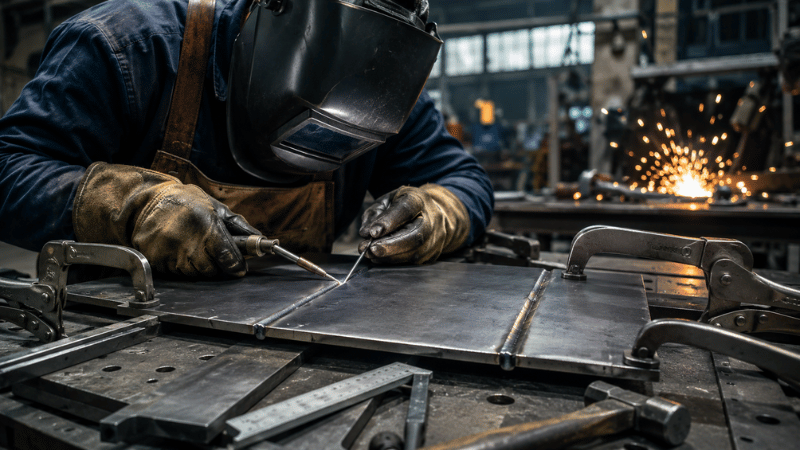
Welding joints are where metal pieces meet before the arc does its magic. Pick the right joint, and your weld has a solid chance. Pick the wrong one, and even a beautiful bead may become shiny metal decoration.
This guide explains the five basic types of welding joints, how they differ, where they are used, and what mistakes beginners should avoid.
What Are Welding Joints?
A welding joint is the arrangement of two or more workpieces before welding. In plain shop language, it is the meeting point where parts touch, overlap, butt up, or stand at an angle.
The five basic welding joint types are butt joints, lap joints, T-joints, corner joints, and edge joints. These are the standard categories used to describe most welded assemblies.
One thing worth clearing up: a joint type is not the same as a weld type. The joint describes how the parts are positioned. The weld type describes how filler metal is deposited, such as a fillet weld or groove weld. TWI’s explanation of weld joint design is a useful reference for understanding this difference.
Think of it this way: the joint is the handshake. The weld is the grip strength.
Quick Comparison of 5 Basic Welding Joint Types
Here is a simple side-by-side guide to help you understand the basic shape, common weld type, typical applications, and key risks of each welding joint.
| Welding Joint Type | Basic Shape | Common Weld Type | Best For | Watch Out For |
|---|---|---|---|---|
| Butt Joint | Edge-to-edge | Groove weld | Plates, pipes, tanks, panels | Poor root penetration |
| Lap Joint | Overlapping pieces | Fillet weld | Sheet metal, patches, light frames | Hidden gaps and corrosion |
| T-Joint | One part meets another at 90° | Fillet weld | Frames, brackets, supports | Lack of fusion |
| Corner Joint | Parts meet at a corner | Fillet / groove weld | Boxes, tanks, enclosures | Distortion |
| Edge Joint | Edges aligned together | Edge / groove weld | Thin sheet, flanges, seams | Weakness under heavy load |
1. Butt Joint Welding
A butt joint is formed when two workpieces sit in the same plane and meet edge-to-edge. Picture two metal plates pushed together on a table. That meeting line is your joint.
Butt joints are common joints of welding for plate, pipe, tanks, structural parts, and sheet metal panels. Thin material may only need a square edge. Thicker material often needs beveling, root openings, backing, or multiple passes to achieve proper penetration.
Butt joints are excellent when a smooth, flush surface is needed. They are widely used in pipes, tanks, machine frames, and visible sheet-metal work. The main challenge is root penetration. A weld can look great on top while hiding poor fusion underneath—basically a tuxedo over pajamas.
For repeatable pipe and tube butt welds, especially in clean, high-purity, or critical applications, automated orbital welding systems can help improve consistency, penetration control, and weld traceability.
Best uses: pipes, plates, pressure parts, tanks, panels, and structural seams.
Common mistake: skipping edge preparation on thick material.
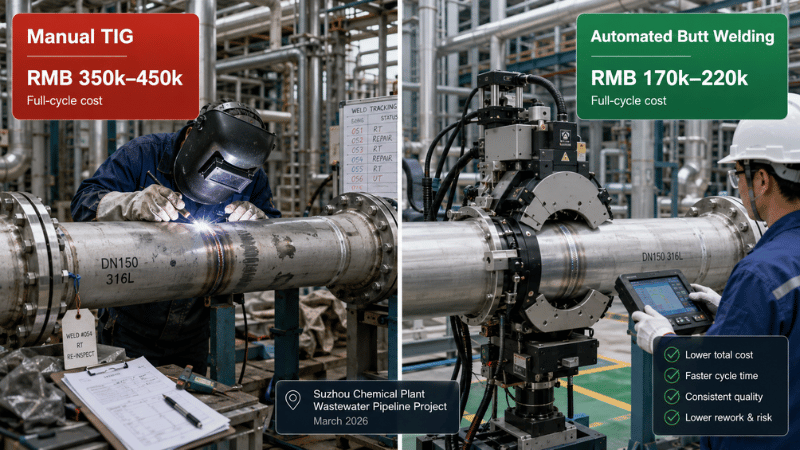
200 Pipe Butt Welds: Manual TIG vs Automated Welding
In March 2026, a Suzhou chemical plant used 316L stainless steel DN150 pipes for a wastewater pipeline project, with around 200 butt joint welds across the line.
Manual TIG Plan
No equipment investment, but higher labor, rework, inspection, delay, and leakage risk.
Automated Butt Welding
Equipment cost added upfront, but labor, rework, and future maintenance risk dropped sharply.
Result: For repetitive 316L stainless steel butt joint welding, automation reduced the project’s estimated full-cycle cost by nearly 50% and made weld quality, schedule, and leakage risk much easier to control.
2. Lap Joint Welding
A lap joint is formed when one piece overlaps another. Instead of meeting edge-to-edge, the parts stack on top of each other.
This is one of the most beginner-friendly different kinds of welding joints, especially for sheet metal, brackets, light frames, covers, and repair patches. Lap joints are usually welded with fillet welds along one or both edges of the overlap.
Lap joints are forgiving because the overlap can hide small cutting errors. That does not mean you should fabricate like a raccoon with a grinder, but it helps.
The downside is trapped gaps. Moisture, dirt, or chemicals can collect between the plates, especially outdoors or in corrosive environments. Good cleaning, fit-up, and sealing matter.
Best uses: sheet metal, patch panels, covers, brackets, light-duty frames, and repairs.
Common mistake: leaving dirty or uneven overlap areas.
3. T-Joint Welding
A T-joint forms when one workpiece meets another at roughly 90 degrees, creating a “T” shape. It is one of the real workhorses of fabrication.
T-joints are widely used in frames, supports, ribs, brackets, stiffeners, and machinery bases. They are usually welded with fillet welds on one or both sides.
The tricky part is fusion at the root. If the arc favors one side too much, the bead may sit on top instead of properly joining both pieces. That is called lack of fusion, and it is the friend who borrows tools and never returns them.
For stronger assemblies, welding both sides often improves strength and balances stress. Load direction also matters, especially in structural or vibrating parts.
Best uses: brackets, frames, ribs, base plates, supports, and stiffeners.
Common mistake: using the wrong work angle and missing root fusion.
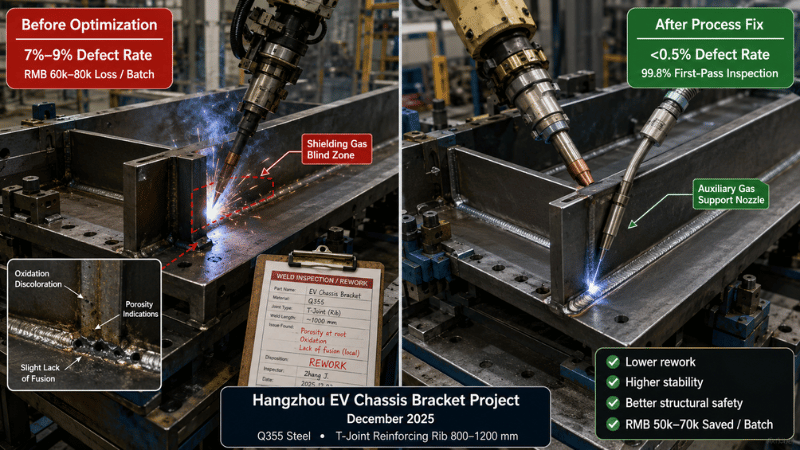
EV Chassis Bracket Welding: When a T-Joint Became the Weak Point
In December 2025, an EV chassis load-bearing bracket project in Hangzhou used Q355 high-strength structural steel. The core load-bearing sections adopted T-joint welding, with each reinforcing rib measuring around 800–1200mm.
Before Optimization
The narrow inner corner of the T-joint created shielding gas blind spots, causing root oxidation, micro-porosity, and partial lack of fusion.
After Process Fix
By adjusting torch angle, layered welding path, and adding stabilized gas support for the inner corner, the shielding blind zone was greatly reduced.
Result: For safety-critical EV chassis T-joint welding, the problem was not the robot itself — it was the shielding blind zone inside the T-joint corner. After process optimization, the first-pass inspection rate reached nearly 99.8%, making weld quality and structural safety much more stable.
4. Corner Joint Welding
A corner joint forms when two workpieces meet at an angle, usually 90 degrees, along their edges. It is common in boxes, tanks, cabinets, trays, enclosures, and rectangular frames.
Corner joints can be open or closed. Depending on material thickness and access, they may use fillet welds, groove welds, or edge-style welds.
The main challenge is distortion. As weld metal cools, it pulls the parts and may knock the assembly out of square. Metal moves when heated. It does not ask permission. For a deeper explanation, see this guide to distortion in welding.
Tack welding, clamping, balanced welds, and controlled heat input help keep the corner where it belongs.
Best uses: tanks, boxes, cabinets, trays, guards, and enclosures.
Common mistake: welding too much too fast without checking squareness.
5. Edge Joint Welding
An edge joint is made when the edges of two or more pieces are placed side by side and welded along the shared edge.
Edge joints are common in thin sheet metal, flanges, covers, light-gauge parts, and seams that do not carry heavy structural loads.
They are useful, but not usually the first choice for high-load applications. The main issue is heat control. Thin edges heat up fast, and once they overheat, congratulations—you have invented a ventilation hole.
Tight fit-up, clean edges, lower heat, and good travel speed are essential. If you are adjusting amperage, voltage, travel speed, or wire feed, this welding parameters and settings chart can help you dial in a more practical starting point.
Best uses: sheet metal seams, flanges, light covers, folded edges, and non-heavy-duty assemblies.
Common mistake: using too much heat on thin edges.
Welding Joint Types vs. Weld Types
This is where many beginners get tangled.
A welding joint type describes how the metal pieces are arranged: butt, lap, T, corner, or edge. A weld type describes the shape or preparation of the deposited weld, such as fillet weld, groove weld, plug weld, or edge weld.
For example, a T-joint usually uses a fillet weld. A butt joint often uses a groove weld. A corner joint may use either, depending on thickness, strength needs, and access. For drawing interpretation, the National Board’s guide to welding symbols gives helpful context on how weld types are shown on technical documents.
Shop-floor version: joint type is how the parts stand. Weld type is how you join them with controlled lightning.
How to Choose the Right Welding Joint
The right joint depends on geometry, material thickness, load direction, access, appearance, and production speed.
For thin sheet metal, lap joints and corner joints are often easier than full-penetration butt joints. For pipes, tanks, and pressure-related seams, butt joints with proper groove preparation are common.
For frames, brackets, and machinery supports, T-joints and lap joints are practical choices. For boxes, cabinets, and enclosures, corner joints naturally match the product shape. For light seams and flanges, edge joints can work well, but they should not be forced into heavy-load jobs.
The best joint is not always the easiest one. It is the one that fits the load, material, access, and required finish.
Which Welding Joint Is Strongest?
There is no universal strongest welding joint. Annoying answer? Yes. Accurate? Also yes.
Strength depends on material, penetration, weld size, filler metal, joint design, load direction, and workmanship. A full-penetration butt joint can be extremely strong in tension. A double-sided T-joint can be excellent for frames and supports. A lap joint may perform well in shear.
The better question is not “Which is strongest?” It is “Strongest for what load?”
Good joint design lets the weld do its job. Bad design asks the weld to become a superhero, and metal is not great at capes.
Joint Preparation Tips
Clean the metal first. Rust, oil, paint, mill scale, and moisture can cause porosity, weak fusion, and ugly welds.
Check fit-up before welding. Gaps and misalignment force the welder to compensate, and compensation usually involves extra time, grinding, and regret.
Use tack welds to hold parts in position and reduce movement. Match edge preparation to material thickness. Thin sheet needs heat control. Thick plate may need beveling, root openings, and multiple passes.
Also, think about access. A perfect joint design is useless if the torch cannot reach it.
Safety deserves a seat at the same table. Welding fumes, shielding gases, and poor airflow can create serious workplace risks, so ventilation should never be treated as decoration. CCOHS explains that welding ventilation helps remove air contaminants from the welder’s breathing zone and work area.
FAQs
1. What are the five basic types of welding joints?
The five basic welding joint types are butt joints, lap joints, T-joints, corner joints, and edge joints. They describe how workpieces are positioned before welding.
2. What is the easiest welding joint for beginners?
Lap joints and T-joints are often easier because they commonly use fillet welds and are more forgiving than full-penetration butt joints.
3. Which welding joint is best for sheet metal?
Lap joints, corner joints, and edge joints are commonly used for sheet metal. Lap joints are especially useful for patches and repairs.
4. What is the difference between a fillet weld and a groove weld?
A fillet weld is usually triangular and joins angled or overlapping surfaces. A groove weld is made in a prepared groove, often used for butt joints and thicker materials.
Conclusion
The five basic types of welding joints—butt, lap, T, corner, and edge—are the foundation of practical welding design. Each has its own strengths, limitations, and best-fit applications.
The smartest welders do not just ask, “Can I weld this?” They ask, “Is this the right joint for the load, material, access, and finish?” That question can save time, money, rework, and a few colorful shop-floor words.
Need Better Welding Results?
Choosing the right joint is only half the battle. iKratz helps manufacturers improve weld consistency with precision orbital welding and automated welding solutions built for demanding pipe, tube, vessel, and industrial fabrication applications.
Tell us your material, wall thickness, weld type, production volume, and quality requirements. Contact us today to discuss your welding project and find the right solution for your workshop or production line.