Choosing the right welding gas should not feel like decoding shop-floor hieroglyphics. For most MIG jobs, the answer becomes simple once you know the metal.
This guide explains which MIG welding gas to use for mild steel, aluminum, stainless steel, and common DIY projects—without turning your brain into slag.
Quick Answer: What Gas Do You Need for MIG Welding?
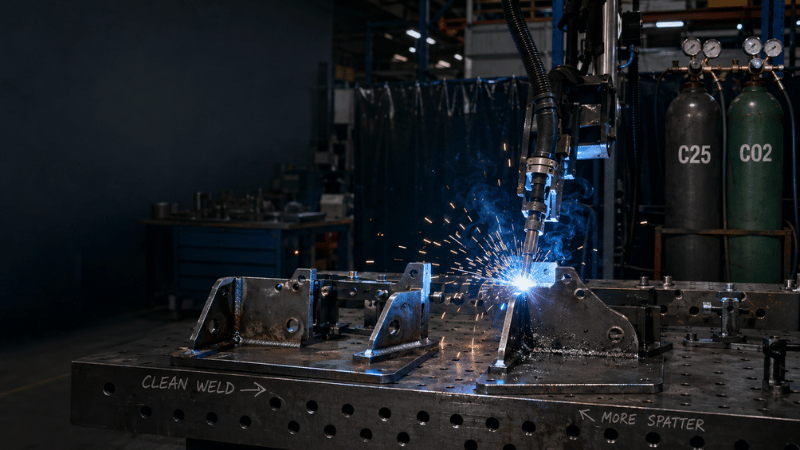
For most mild steel MIG welding, use 75% argon / 25% CO₂, often called C25. It gives a stable arc, cleaner bead appearance, and less spatter than straight CO₂.
For aluminum MIG welding, use 100% argon. For stainless steel, choose a stainless-specific blend based on wire manufacturer recommendations.
For self-shielded flux-core welding, external shielding gas may not be needed because the wire creates its own protective shield. For a deeper process comparison, see our guide on what is flux core welding.
Welding Gas vs Welder Gasoline
Let’s clear the smoke: welding gas for MIG welding is not gasoline. It means shielding gas, which protects molten metal from oxygen, nitrogen, and moisture.
Gas-powered welders may use gasoline or diesel as fuel, but MIG shielding gas does not power the machine. It protects the weld puddle. Big difference—one runs an engine, the other stops your weld from looking like Swiss cheese.
Who This Guide Is For
This guide is for DIY welders, hobby users, auto repair shops, small fabricators, and anyone buying their first gas cylinder while pretending “C25” was totally obvious.
It is not a substitute for certified welding procedures, code compliance, or engineering review. For structural, pressure vessel, lifting, or safety-critical work, follow official procedures and qualified welding guidance.
What Shielding Gas Does in MIG Welding
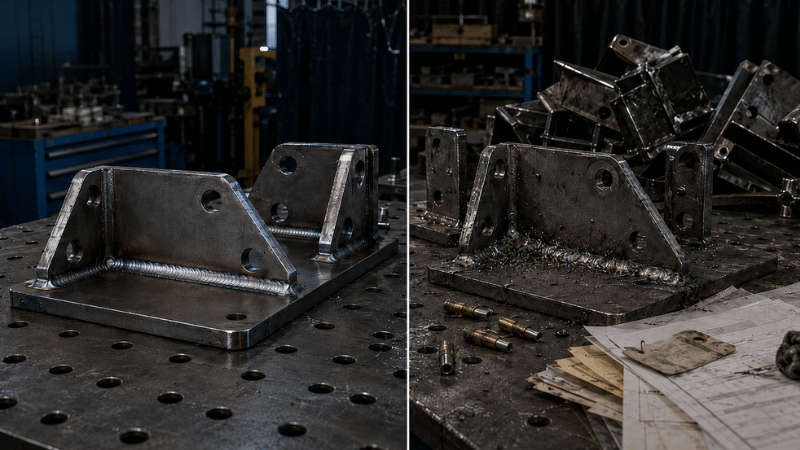
Shielding gas blocks atmospheric contamination while the weld puddle is molten. Without it, oxygen and nitrogen can enter the weld and cause porosity, weak fusion, ugly beads, and unnecessary grinding therapy.
Gas choice affects arc stability, penetration, bead shape, spatter, and cleanup time. The same welder can feel smooth or wildly grumpy depending on gas, wire, settings, and surface prep.
Quick MIG Welding Gas Glossary
Essential terms beginners should understand before choosing a shielding gas.
Inert shielding gas used for clean weld protection and a smoother welding arc.
Clean ArcActive gas that improves penetration but usually creates more spatter.
Deep PenetrationA common 75% argon / 25% CO2 blend used for mild steel MIG welding.
Best All-RounderCubic feet per hour, the standard unit used to measure shielding gas flow.
Gas FlowControls the gas pressure coming from the cylinder before it reaches the torch.
Cylinder ControlShows and adjusts the shielding gas flow rate during welding.
Flow CheckSmall holes in the weld caused by trapped gas, contamination, or poor shielding.
Weld DefectBest MIG Welding Gas by Material
Best MIG Gas for Mild Steel
For most mild steel work, choose 75/25 argon CO₂. It is beginner-friendly, widely available, and ideal for DIY repairs, auto panels, brackets, small frames, and general fabrication.
The budget option is 100% CO₂ welding gas. It costs less and provides good penetration, but it usually creates more spatter and cleanup.
Avoid 100% argon for standard mild steel MIG with solid wire. It may sound premium, but it often causes poor arc behavior and unattractive bead shape. Fancy does not always mean correct.
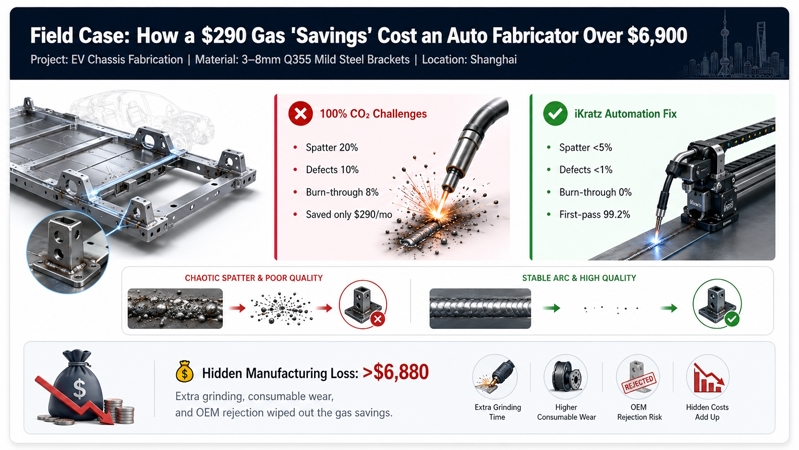
Field Case: How a $290 Gas “Savings” Cost an Auto Fabricator Over $6,900
Project: EV Chassis Fabrication | Material: 3–8mm Q355 Mild Steel Brackets | Location: Shanghai, China
100% CO2 Welding Challenges
- Spatter Surge: Spatter rate jumped from 5% to 20%, creating heavy post-weld cleanup.
- Quality Defects: Porosity and undercut increased from 2% to 10%.
- Burn-Through Risk: Thin 3mm sections reached an 8% burn-through rate due to an unstable CO2 arc.
iKratz Automation + Waveform Control
- Spatter Control: Advanced waveform control brought spatter back below 5%.
- Precision Automation: Automated track welding reduced porosity and undercut to less than 1%.
- Low Heat Input: Built-in pulse profiles reduced burn-through on 3mm steel to 0%.
💰 Estimated Financial Impact: $6,880+ Loss Avoided
The shop initially saved only $290/month on shielding gas by switching from C25 gas to 100% CO2. However, the hidden production losses quickly outweighed the gas savings.
Post-weld grinding increased from 3 seconds to 20 seconds per meter, causing an estimated $1,930/month loss in extra labor and consumable wear. A rejected OEM batch added another $5,240 one-time quality penalty.
After integrating the iKratz digital automated welding solution, grinding labor was nearly eliminated, contact tip life increased by 4x, and first-pass acceptance reached 99.2%.
Bottom Line: The shop kept its budget-friendly 100% CO2 gas, but stopped paying the hidden “spatter tax” caused by unstable welding.
Best MIG Gas for Aluminum
For aluminum MIG welding, use 100% argon shielding gas. Aluminum needs clean inert shielding, and argon is the standard starting point for most beginner and light-shop aluminum MIG work.
Helium blends may help with thicker aluminum because they increase heat input, but they are more expensive and usually unnecessary for everyday MIG welding.
Best MIG Gas for Stainless Steel
Stainless steel needs more careful gas selection. Standard C25 may not be ideal because too much CO₂ can affect bead quality and corrosion resistance.
Use tri-mix or stainless-specific argon blends, and always check the welding wire datasheet before choosing your gas. Stainless is not the place to play “gas bottle roulette.”
Best Gas for Silicon Bronze MIG Brazing
For silicon bronze MIG brazing, 100% argon is commonly used. It works well for thin sheet, bodywork, and lower-heat joining where reducing distortion matters.
This process is not the same as standard mild steel MIG welding, so do not assume your mild steel gas will behave nicely here.
Quick Comparison Table
| Material | Recommended Gas | Budget Option | Best Use | Avoid |
|---|---|---|---|---|
| Mild steel | 75/25 argon CO2 | 100% CO2 | DIY, auto repair, fabrication | 100% argon |
| Aluminum | 100% argon | — | Aluminum MIG welding | CO2 blends |
| Stainless steel | Stainless blend or tri-mix | Depends on wire | Stainless fabrication | Random C25 use |
| Silicon bronze | 100% argon | — | Thin sheet, brazing | CO2-heavy gas |
| Self-shielded flux-core | No external gas | — | Outdoor repair | Gas-only MIG settings |
Common MIG Shielding Gases Compared
75/25 Argon CO₂
75/25 argon CO₂ is the best all-around choice for mild steel MIG welding. It gives a smoother arc, less spatter, and cleaner weld appearance than straight CO₂.
For beginners, that means fewer ugly surprises and less time grinding away evidence. Your angle grinder deserves a break too.
100% CO₂
CO₂ welding gas is cheaper and provides strong penetration. The tradeoff is more spatter, a harsher arc, and more post-weld cleanup.
It works well for budget shop welding, thicker material, and non-cosmetic repairs. It is less ideal when bead appearance matters.
100% Argon
Argon shielding gas is excellent for aluminum and silicon bronze, but it is not ideal for standard mild steel MIG with solid wire.
Pure argon on mild steel can create unstable arc behavior and poor bead shape. This is one of those rare times when “more premium” can produce worse results.
Tri-Mix and Specialty Blends
Stainless steel often uses tri-mix gases or argon-rich blends with small reactive additions. These gases help improve arc behavior and support better stainless weld quality.
The safest rule is simple: match the gas to the wire manufacturer’s recommendation. Welding rewards preparation, not guessing.
How to Choose the Right MIG Gas
Start with the base metal. Mild steel, aluminum, stainless steel, and silicon bronze all need different gas choices.
Then match the gas to the wire. Solid MIG wire usually needs external shielding gas, while self-shielded flux-core wire does not. If you are not sure which wire diameter fits your material, check our MIG wire size chart before finalizing the setup.
Next, decide between cost and weld appearance. CO₂ welding gas saves money, but C25 usually saves cleanup time. If your project needs clean visible welds, the cheaper gas may not be cheaper after grinding, rework, and frustration.
Finally, consider location. Gas MIG does not like wind. For outdoor welding, flux-core may be better because the shielding will not blow away like a napkin in a parking lot.
Do You Always Need Gas for MIG Welding?
No. Gas MIG uses external shielding gas, while self-shielded flux-core wire creates its own protection through the flux inside the wire.
Flux-core is better for outdoor welding, windy conditions, farm repair, and dirty environments. It may not look as clean, but it gets the job done when conditions are rude.
Gas MIG is better for cleaner welds, thinner materials, indoor fabrication, auto body work, and projects where appearance matters.
Shielding Gas Flow Rate and Setup Basics
Most beginner MIG setups start around 15–30 CFH, depending on the machine, nozzle size, joint type, gas blend, and working environment.
More gas is not always better. Excessive flow can create turbulence and pull air into the shielding zone. That means you can waste gas and make the weld worse. Welding has a sense of humor, apparently.
To set up a gas cylinder, secure it upright, install the regulator, check fittings, open the valve carefully, and set flow while pulling the trigger.
Before welding, confirm the gas type, check flow, listen for leaks, inspect the nozzle, clean the base metal, and test on scrap. Scrap metal exists so your real project does not suffer first.
Common MIG Gas Problems and Fixes
Porosity usually means poor shielding or contamination. Common causes include low gas flow, excessive gas flow, leaks, wind, dirty metal, clogged nozzles, or too much stickout.
TWI explains that even small air entrainment in shielding gas can contribute to porosity, and common causes include leaks, drafts, excessive gas flow, and turbulence. For a deeper defect checklist, see our guide on weld porosity causes and fixes, or review TWI’s technical note on porosity in welding.
Excessive spatter may come from straight CO₂, wrong voltage, poor wire speed, dirty material, or a worn contact tip. Switching to C25 welding gas often helps mild steel welds behave better.
An unstable arc can point to the wrong gas blend, poor ground, bad settings, or wire mismatch. Verify gas, wire, polarity, and machine setup before twisting every knob like you are cracking a safe.
If gas runs out quickly, check for leaks, high flow settings, frequent tack welding, and the classic mistake: forgetting to close the cylinder after use.
Welding Gas Cylinder Buying Guide
Beginners can rent, exchange, or buy cylinders. Buying gives flexibility, but some local suppliers only exchange certain sizes or brands.
Small cylinders are portable but empty quickly. Larger cylinders last longer but are less fun to move unless wrestling steel penguins is your hobby.
At the welding supply store, ask clear questions:
“What gas do you recommend for MIG welding mild steel with solid wire?”
“Do you exchange this cylinder size?”
“Is this gas compatible with my regulator?”
“What flow range should I start with?”
The cheapest gas is not always the cheapest result. CO₂ may cost less, but C25 often reduces grinding, rework, and beginner frustration.
Safety Notes and Best Practices
Compressed gas cylinders must be secured upright, protected during transport, and kept away from heat. OSHA’s compressed gas resources provide safety guidance for handling and storing compressed gas equipment.
Shielding gas does not remove welding fumes. You still need ventilation, gloves, eye protection, protective clothing, and appropriate PPE. The American Welding Society also offers educational material on welding safety, including hazards such as fumes, fire, radiation, and electrical shock.
For structural work, pressure vessels, vehicle safety repairs, lifting equipment, or code-regulated jobs, follow certified welding procedures and qualified engineering review. A blog post is useful; a qualified procedure is what keeps serious work serious.
FAQs
What is the best gas for MIG welding mild steel?
For most beginner and DIY mild steel MIG welding, 75% argon / 25% CO₂ is the best all-around choice because it provides a stable arc, cleaner welds, and less spatter than straight CO₂.
Can I use 100% argon for MIG welding steel?
100% argon is generally not recommended for standard MIG welding on mild steel with solid wire. Mild steel usually performs better with an argon/CO₂ blend or CO₂.
Do I need shielding gas if I use flux-core wire?
Self-shielded flux-core wire does not require an external gas cylinder because the wire produces its own shielding protection, making it useful outdoors or in windy conditions.
Why am I getting porosity even with the right welding gas?
Porosity can happen because of low flow, excessive flow, leaks, wind, dirty metal, clogged nozzles, or poor stickout. Check shielding coverage, clean the base metal, and test on scrap before changing gas.
Conclusion
The best welding gas depends on the metal first. For mild steel, choose 75/25 argon CO₂. For aluminum, use 100% argon. For stainless steel, follow wire manufacturer guidance and use a stainless-specific blend.
Gas choice matters, but setup matters just as much. Wrong flow, leaks, wind, dirty nozzles, and contaminated metal can ruin even the perfect cylinder. Start with the right gas, then fine-tune the process before blaming the welder.
Get the Right MIG Welding Setup Without Guesswork
Choosing gas, wire, regulators, and machine settings can feel like juggling hot metal. At iKratz, we help customers match welding consumables, setup requirements, and process recommendations for cleaner welds, fewer defects, and less trial-and-error in the shop.
Need help choosing the right setup for your material and project? Contact us today to request a welding setup recommendation.