Choosing a TIG torch by model number alone is like buying work boots by color. The specification may look impressive, but it says little about how the torch will perform on your weld.
Effective TIG torch selection starts with current, arc-on time, joint access, cooling, compatibility, and production volume.
TIG Torch Selection at a Glance
The right torch is not automatically the model with the highest amperage rating. It is the simplest configuration that can safely produce repeatable welds throughout the actual production cycle.
| Configuration | Best application | Main limitation |
|---|---|---|
| Manual air-cooled | Repairs, prototypes, short runs | Heat buildup |
| Manual water-cooled | Longer manual welds | Requires a cooler |
| Automatic water-cooled | Repetitive production | More integration |
| Circumferential system | Pipes, tanks, cylinders | Requires fixtures and motion |
Use an air-cooled torch for intermittent work. Consider water cooling when longer arc time, higher thermal load, or a smaller torch body is required.
Choose automatic TIG when joint geometry and production cycles repeat. For circular parts, a complete circumferential welding machine is usually more practical than adapting a manual setup.
Ratings still need careful comparison. Manufacturers may use different duty cycles, cooling conditions, and AC/DC test assumptions.
What Is a TIG Welding Torch?
TIG, formally called gas tungsten arc welding or GTAW, uses a non-consumable tungsten electrode while shielding gas protects the weld pool. The American Welding Society’s GTAW overview provides a useful explanation of the process.
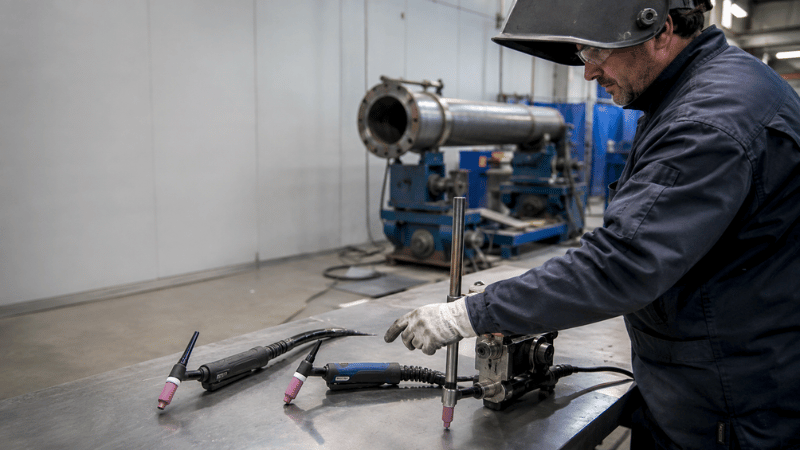
A TIG welding torch typically includes the torch body, tungsten, collet, gas lens or collet body, ceramic cup, back cap, power cable, gas hose, and optional coolant lines.
The torch is only one part of the system. TWI’s guide to TIG welding equipment identifies the power source, torch, backing equipment, and protective equipment as essential elements.
Torch Rating Versus System Capacity
Torch amperage alone does not define system performance. The real capacity also depends on:
- Power-source duty cycle
- Cooler capacity
- Cable length
- Tungsten diameter
- Gas delivery
- Connector type
- Machine controls
For automatic welding, the controller may also coordinate arc start, current scheduling, travel, rotation, and wire feeding.
A premium torch connected to an undersized cooler is still an expensive hand warmer.
Step 1—Define the Welding Requirements
Start with the welding procedure or documented application requirements. Record the material, thickness, joint type, polarity, maximum current, arc-on time, production quantity, and inspection standard.
Stainless steel, aluminum, titanium, carbon steel, and nickel alloys create different process demands. So do fillet joints, tube welds, circular seams, and tube-to-tubesheet connections.
Current and Arc-On Time
Use the maximum procedure current, including pulse peaks. Then determine how long the arc remains active during one weld and across consecutive production cycles.
Arc-on time often reveals thermal problems that amperage ratings hide. A torch may complete one test weld but become too hot after twenty repeated parts.
Access and Torch Geometry
Check torch angle, body length, cup diameter, tungsten extension, cable flexibility, and fixture clearance.
A powerful torch that cannot reach the joint is not oversized. It is decorative.
Step 2—Choose Manual or Automatic TIG
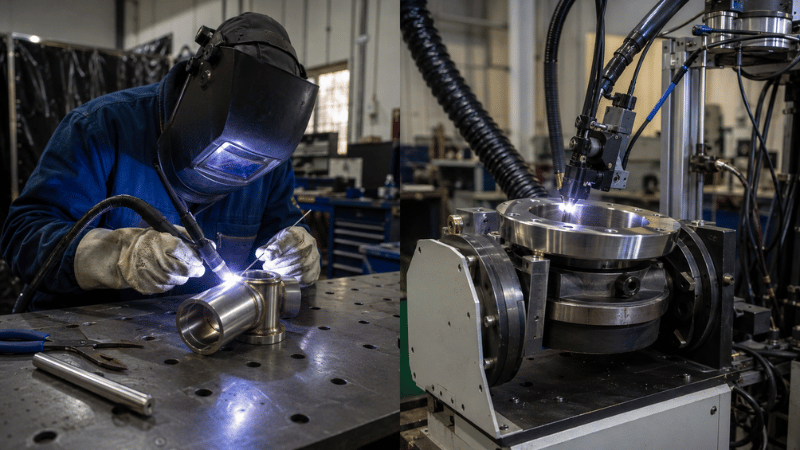
Manual TIG suits repairs, prototypes, irregular components, and frequently changing work. A skilled welder can adjust torch angle, travel speed, and filler placement immediately.
Its limitation is operator dependency. Fatigue, visibility, and joint access can affect arc length and bead consistency.
When Automatic TIG Makes Sense
Automatic TIG is better suited to repetitive joints, stable geometry, controlled heat input, and higher production volumes.
| Factor | Manual TIG | Automatic TIG |
| Part variation | Handles changes well | Prefers stable geometry |
| Setup | Faster | More preparation |
| Repeatability | Operator-dependent | Mechanically controlled |
| Output | Lower | Better for repeated work |
| Investment | Lower | Higher |
An automatic torch is not a complete machine. The system may also need a controller, fixture, positioner, wire feeder, guarding, and process monitoring.
The iKratz guide to robotic TIG welding explains how robotic, orbital, and dedicated automatic TIG systems differ.
Step 3—Choose Air or Water Cooling
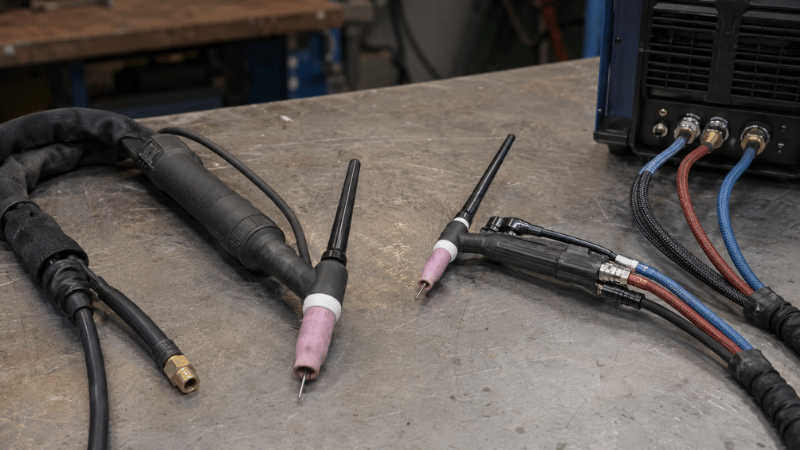
Air-cooled torches are simple, portable, and relatively easy to maintain. They are suitable for intermittent welding and lower thermal loads.
At higher ratings, however, they often require larger torch bodies and heavier cables. Precise control can start to feel like wrestling a garden hose.
When Water Cooling Is Justified
A water-cooled TIG torch circulates coolant through the torch and cable assembly. Better heat removal allows a smaller body and more flexible cable.
Water cooling is commonly used for:
- Continuous seams
- Repetitive production
- Higher thermal loads
- Restricted joint access
- Machine-mounted welding
| Factor | Air-cooled | Water-cooled |
| Portability | Better | Lower |
| Complexity | Lower | Higher |
| Torch size | Often larger | More compact |
| Long arc time | More limited | Better suited |
| Maintenance | Simpler | Requires coolant care |
The MWP-65 tube-to-tubesheet welding machine demonstrates how water-cooled GTAW can support repetitive tube-to-tubesheet welding.
Do not select water cooling by amperage alone. Cooler capacity, flow rate, ambient temperature, and consecutive cycle count also matter.
Step 4—Match Amperage and Duty Cycle
A useful torch rating should state current, duty cycle, cooling method, and whether the rating applies to AC or DC.
Duty cycle describes how long equipment can operate at a stated load within a defined period before reaching its thermal limit.
The torch, power source, and cooler may have different limits. The weakest component determines the real system capacity.
Practical Sizing Method
Identify the maximum welding current and expected arc-on time. Then compare:
- Torch current rating
- Torch duty cycle
- Power-source duty cycle
- Cooler capacity
- Tungsten and cable limits
Apply a reasonable engineering margin and confirm the final configuration with the manufacturer.
There is no universal amperage threshold that automatically makes water cooling mandatory.
Step 5—Verify System Compatibility
A capable torch is useless if it cannot connect to the existing system.
Confirm the power connector, gas fitting, coolant connections, remote-control interface, cable length, consumable series, and mechanical mounting.
For automatic TIG welding, also verify:
- Arc-start control
- Current programming
- Wire-feeder communication
- Positioner synchronization
- Emergency-stop integration
- Mounting dimensions
Provide the supplier with the power-source model, cooler model, connector details, cable requirements, and mounting dimensions.
Compatibility checks are not glamorous, but neither is receiving a torch that fits nothing in the factory.
Step 6—Select the Body and Consumables
Choose the torch body according to access and mounting requirements. Straight, angled, flexible, compact, and extended designs solve different geometric problems.
Flexible heads are useful for manual access but may not provide the rigidity required for repeatable machine mounting.
Gas Lens, Cup, and Tungsten
A gas lens can improve shielding coverage and permit greater tungsten extension. Cup size should protect the weld without colliding with the workpiece or fixture.
Match tungsten type and diameter to current, material, polarity, and the qualified welding procedure.
Standardizing cups, collets, gas lenses, and tungsten sizes across multiple stations can reduce inventory and setup mistakes.
Step 7—Configure Circumferential Welding
Circumferential welding creates a circular seam on pipes, tanks, cylinders, vessels, and flanges.
The workpiece may rotate under a stationary torch, or the torch may move around a stationary component. The correct arrangement depends on diameter, length, weight, orientation, and fixture design.
Provide the supplier with:
- Workpiece dimensions
- Material and wall thickness
- Joint design
- Part weight
- Rotation-speed range
- Torch angle
- Filler-wire requirements
The MWHF-HM circumferential seam welding machine shows how the torch, rotary motion, digital control, and adjustment system work together.
Optional functions include cold-wire feeding, oscillation, arc voltage control, seam tracking, and data recording. Add them because the process requires them—not because the quotation needs more exciting nouns.
A Simple Selection Framework
Score each configuration from 1 to 5 against the actual application.
| Factor | Low score | High score |
| Current | Low load | High load |
| Arc-on time | Intermittent | Continuous |
| Production | Occasional | High volume |
| Joint geometry | Variable | Repeatable |
| Access | Open | Restricted |
| Repeatability | Moderate | Critical |
Eliminate options that fail safety, cooling, or compatibility requirements. Then choose the lowest-complexity system that meets production needs.
Borderline choices should be tested under realistic production conditions.
Total Cost of Ownership
Purchase price is only part of the decision. Total cost may include the torch, cooler, controller, fixtures, positioner, installation, consumables, labor, downtime, inspection, and rework.
A useful metric is cost per accepted weld:
Cost per accepted weld = setup + welding + inspection + repair + downtime ÷ accepted parts
A manual torch may cost less initially but more per approved part when production volume and rework increase.
Common Selection Mistakes
Buying by Amperage Alone
Fix: Compare current, duty cycle, arc-on time, polarity, and cooling together.
Ignoring Compatibility
Fix: Verify electrical, gas, coolant, control, and mounting interfaces before ordering.
Using Manual TIG for Repetitive Work
Fix: Compare cost per accepted weld rather than torch price alone.
Treating the Torch as a Complete Machine
Fix: Include motion, fixtures, controls, wire feeding, and safety equipment.
Skipping Production Trials
Fix: Run enough consecutive welds to expose heat buildup and process variation.
What to Check During a Torch Trial
Reproduce the production current, arc-on time, orientation, access, and cycle count.
Check torch temperature, coolant flow, arc stability, tungsten condition, shielding coverage, cable movement, fixture clearance, bead quality, and cycle time.
One successful weld proves little about production stability. Consecutive trials reveal heat buildup, cable drag, and consumable wear.
Welding also presents risks from fumes, ultraviolet radiation, electrical shock, burns, and moving equipment. Review the relevant OSHA welding hazards and solutions and apply local safety requirements.

TIG Torch RFQ Checklist
Before requesting a quotation, provide:
- Material and thickness
- Joint drawing
- Workpiece dimensions
- Current range and polarity
- Arc-on time
- Production quantity
- Existing power source and cooler
- Connector details
- Torch angle and cable length
- Manual or machine-mounted use
- Inspection requirements
- Target cycle time
- Photos or samples
A detailed RFQ allows the supplier to evaluate the complete application instead of guessing from “Need TIG torch, please quote best price.”
FAQs
How do I choose the correct TIG torch amperage?
Start with the maximum procedure current. Then check duty cycle, cooling, polarity, arc-on time, tungsten capacity, and the manufacturer’s rating conditions.
When should I use a water-cooled TIG torch?
Use one for longer arc time, repetitive welding, higher thermal loads, restricted access, or automatic production. The cooler must provide sufficient flow and cooling capacity.
What is the difference between manual and automatic TIG torches?
A manual torch is positioned by the welder. An automatic torch works with equipment controlling movement, rotation, current schedules, or wire feeding.
Can any TIG torch connect to any welding machine?
No. Connectors, gas fittings, coolant lines, controls, cable ratings, and consumables vary. Verify compatibility before ordering.
Conclusion
Effective TIG torch selection requires more than matching an amperage number. Current, duty cycle, cooling, access, compatibility, consumables, and production volume must be considered together.
Use manual TIG when flexibility matters. Select water cooling when thermal load and handling justify it. Choose automatic TIG when joint repeatability and production economics support the investment.
The best configuration is the simplest system that safely produces repeatable welds under real production conditions.
Build a TIG System Around Your Weld
iKratz combines orbital welding experience, application analysis, configurable equipment, and automation integration for tube, pipe, tubesheet, and circumferential welding projects. The engineering team can review your joint, material, dimensions, output target, and existing equipment before recommending a solution.
Contact iKratz today with your drawings, welding requirements, production volume, and equipment details. Request a technical review for a suitable TIG torch or automated welding configuration.