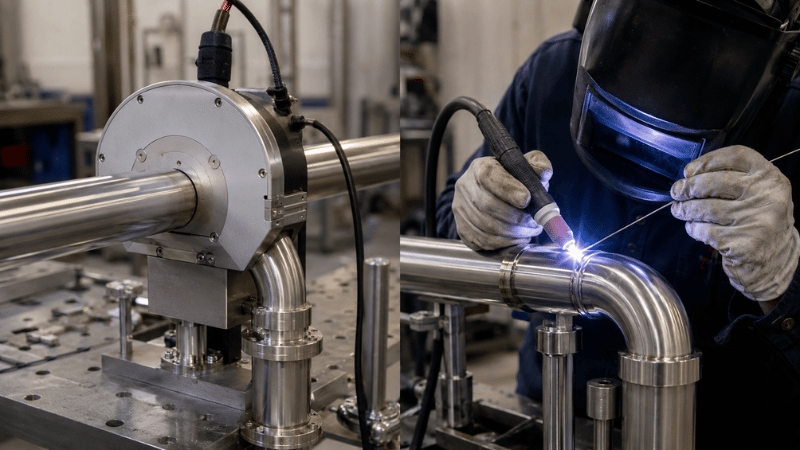
Choosing between orbital welding vs manual welding is not simply a contest between machines and human skill. For sanitary tubing, the real question is which method can produce an acceptable internal weld consistently, efficiently, and with manageable inspection costs.
Orbital TIG usually suits repetitive, accessible tube joints. Manual TIG remains valuable for repairs, tight spaces, irregular geometry, and low-volume work. Neither method can rescue dirty tube ends, poor fit-up, or weak purge control.
Orbital Welding and Manual TIG at a Glance
What Is Orbital TIG Welding?
Orbital TIG welding is a mechanized GTAW process in which the tube remains stationary while the tungsten electrode travels around the joint. The equipment can control current, pulse timing, rotation speed, travel sectors, shielding gas, and sometimes filler-wire delivery.
The Welding Institute describes orbital welding as a process in which the welding arc rotates around a stationary tube or pipe. See TWI’s orbital welding explanation.
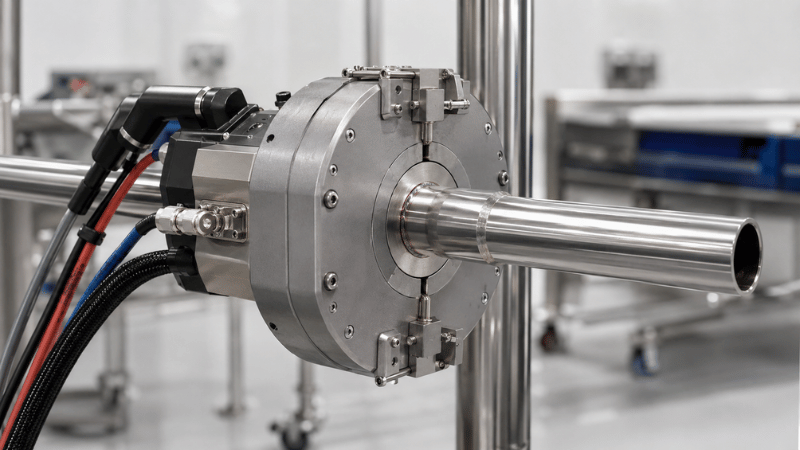
Closed weld heads are commonly used for small-diameter, autogenous sanitary tube welding. Open heads provide more flexibility for larger diameters, thicker walls, filler wire, and multipass joints.
For compact high-purity applications, the MWF-40 closed orbital welding head is designed for tubing from 6.35 to 38.1 mm. Its enclosed shielding chamber and water-cooled design suit pharmaceutical, semiconductor, food-processing, and specialty-fluid systems.
What Is Manual TIG Welding?
Manual TIG uses the same non-consumable tungsten electrode, but the welder controls torch angle, arc length, travel speed, heat input, and filler addition by hand.
This control gives a skilled welder excellent flexibility. It also introduces more variation because consistency depends on experience, position, fatigue, access, and changing joint conditions.
What Both Processes Require
Both methods depend on proper tube facing, clean material, correct tungsten preparation, stable shielding gas, effective internal purging, accurate fit-up, approved procedures, and suitable inspection.
Automation controls the arc. It does not clean the tube, correct alignment, or convince oxygen to stay away.
Orbital Welding vs Manual TIG Welding: Key Differences
| Factor | Orbital TIG | Manual TIG |
|---|---|---|
| Repeatability | High after program verification | Depends heavily on welder skill |
| Operator influence | Lower during welding | High throughout the weld |
| Internal bead consistency | Strong on repeatable joints | More variable but adaptable |
| Initial setup | Longer | Usually faster |
| Production volume | Best for repeated joints | Best for low-volume or mixed work |
| Joint access | Requires head clearance | Better in restricted locations |
| Documentation | Automated records may be available | Usually recorded manually |
| Equipment cost | Higher | Lower |
| Repair flexibility | Limited by tooling | Excellent |
| Cost per accepted weld | Often lower at volume | Often lower for a few joints |
Weld Quality and Repeatability
Orbital welding can repeat current, travel speed, pulse timing, and sector-specific heat input around every joint. Once a schedule is verified, this reduces weld-to-weld variation.
However, automation repeats errors just as effectively as it repeats good parameters. Poor fit-up, contaminated tungsten, an unstable purge, or an incorrect program can produce a consistent series of rejected welds.
Manual TIG introduces more operator variation, but an experienced welder can respond immediately to changing gaps, wall thickness, or alignment. That adaptability can outperform a fixed program when joint conditions are unpredictable.
Speed and Production Volume
Manual TIG often wins on the first weld because setup is simple. Orbital welding may require collets, head alignment, program selection, cable routing, purge confirmation, and a trial coupon.
Once production starts, the balance can change quickly. Hundreds of similar joints allow the orbital system to reuse the same verified schedule, improving productivity and reducing manual torch time.
Frequent changes in diameter, wall thickness, material, or joint design reduce this advantage. Orbital welding loves repetition. Constant surprises are not really its thing.
Skill Requirements
Orbital welding does not eliminate skilled labor. It shifts the required expertise toward tube preparation, programming, setup, purge control, troubleshooting, inspection, and maintenance.
Manual TIG requires stronger hand coordination and real-time control. The welder must maintain arc length, angle, speed, and filler addition while also managing access and heat input.
Documentation and Traceability
Orbital systems may store weld schedules, operator names, weld numbers, current values, alarms, and completion records. This supports weld parameter traceability in pharmaceutical, biotechnology, and semiconductor projects.
The ASME BPE framework includes requirements related to hygienic and bioprocess systems, while SEMI standards address GTA welding and weld inspection in semiconductor fluid-distribution systems. Review the ASME BPE scope.
Documentation alone does not prove a good weld, but it makes production conditions easier to verify.
Orbital TIG for Volume. Manual TIG for Tight Access.
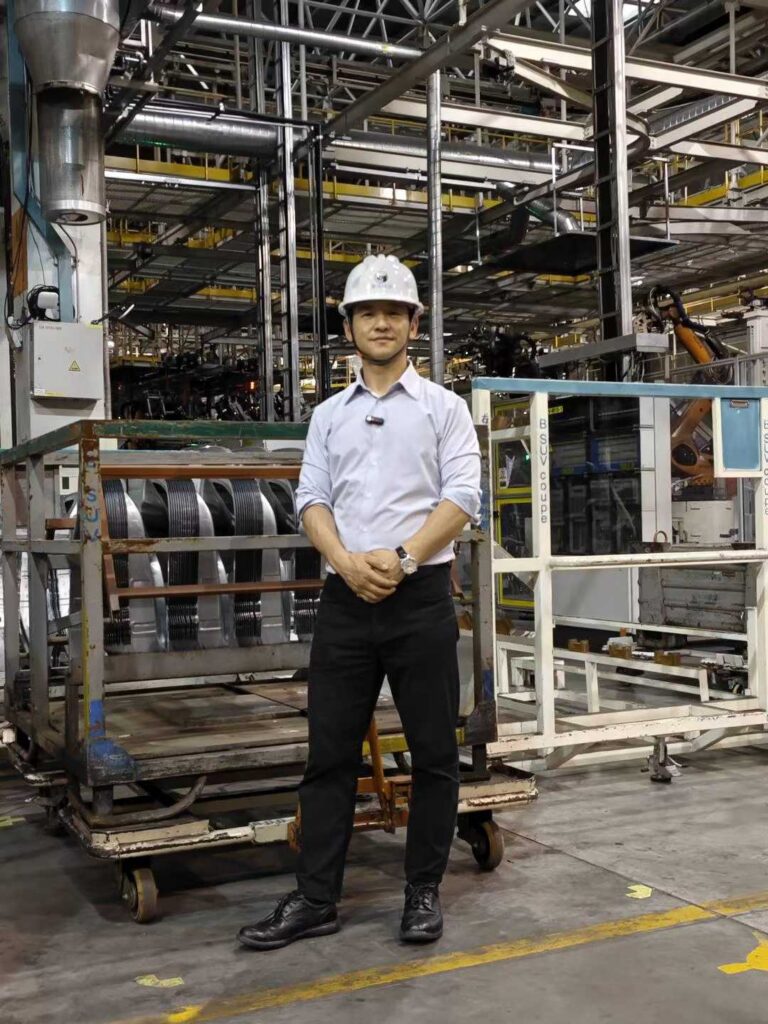
A Shanghai biotechnology contractor split 3,000 ASME BPE joints between automation and skilled manual welding.
Repetitive Straight Runs
MWF-40 closed head with preset recipes and oxygen interlock.
Mirror-like internal welds with zero heat tint on 2,600 joints.
Automatic parameter logging reduced welding and QA time.
Tight Valves & Tie-Ins
400 tie-ins, branch tees, and valve clusters under 30 mm clearance.
Micro-torches reached joints where orbital heads could not clamp.
Avoided manifold redesign and two weeks of delay.
Which Method Produces Better Weld Quality?
External Appearance Is Not Enough
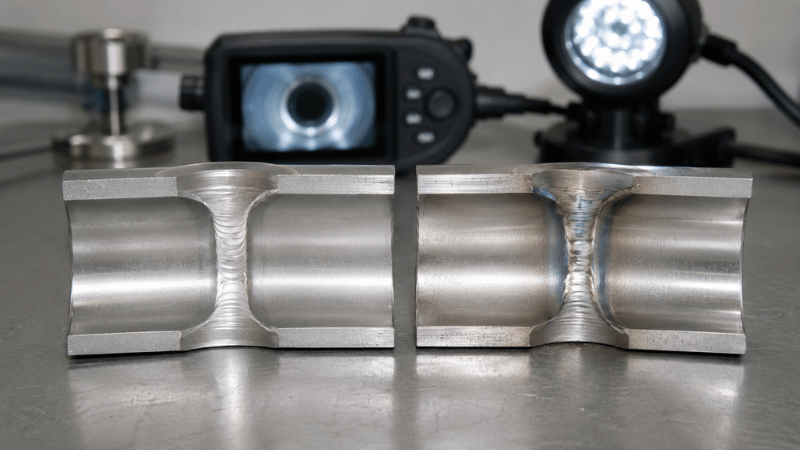
A smooth external bead does not confirm complete penetration, acceptable internal reinforcement, or adequate oxidation control.
Where internal condition matters, inspection may include borescopes, qualification coupons, approved visual standards, oxygen records, leak testing, or other specified methods. SEMI F81, for example, addresses visual inspection and acceptance of GTA welds in semiconductor fluid systems. See the SEMI F81 overview.
Quality Factors Shared by Both Methods
Tube-end squareness, mismatch, contamination, purge oxygen, tungsten condition, shielding coverage, and heat input all affect the final weld.
Purge flow deserves particular attention. Too little flow may leave oxygen in the tube, while excessive flow can create turbulence or pressure. Proper sealing and venting are just as important as the gas-flow number on the regulator.
Where Manual TIG Has the Advantage
Manual TIG may perform better when fit-up changes around the joint, access is limited, or a repair requires real-time heat adjustment. It is also practical for branch connections, field modifications, unusual geometry, and final tie-ins.
Where Orbital TIG Has the Advantage
Orbital TIG performs best on accessible, repeatable joints with consistent dimensions and strict bead-profile requirements.
For large numbers of identical thin-wall stainless steel joints, controlled travel speed and repeatable heat input generally provide better consistency than relying entirely on manual torch movement.
Which Method Is Better for Sanitary Tubing?
Orbital TIG is usually preferred for repetitive thin-wall tubing, controlled fabrication environments, high documentation requirements, and projects where rework is especially expensive.
A properly configured range of orbital welding systems may include closed heads, open heads, programmable power sources, cooling units, tooling, and data-recording functions. The selected setup must match the actual diameter, wall thickness, filler requirement, and available clearance.
Manual TIG remains appropriate for low weld counts, repair work, prototypes, restricted spaces, and joints with changing conditions. A qualified manual weld can meet demanding sanitary requirements, while a poorly prepared orbital weld can fail them with remarkable consistency.
Industry Considerations
Pharmaceutical and biotechnology systems often emphasize cleanability, documentation, internal surface condition, and controlled installation.
Food and beverage systems prioritize hygienic design and corrosion-resistant product-contact surfaces. Semiconductor gas-delivery systems may require even tighter control of materials, joining practices, inspection, and records.
Neither method is automatically code compliant. Compliance depends on the applicable code, approved procedure, operator qualification, purge control, inspection method, and customer specification.
What Many Comparisons Miss
Equipment price is not the most useful decision metric. The better measure is cost per accepted weld.
This includes setup, welding, inspection, documentation, rejected joints, repair labor, cleaning, lost tube length, downtime, and schedule disruption.
Accessibility can also override every other advantage. Orbital welding may be technically ideal, but it is not practical if the weld head cannot close around the joint.
Many facilities benefit from a hybrid approach. Orbital TIG handles planned production welds, while manual TIG covers tie-ins, repairs, and awkward locations.
A Practical Selection Framework
Start by defining:
- Material grade and tube dimensions
- Number of welds
- Joint geometry
- Filler requirements
- Cleanliness and inspection criteria
- Available weld-head clearance
- Documentation requirements
- Cost of rework
Then score orbital and manual TIG from one to five for quality, access, production volume, traceability, operator availability, and cost.
Choose orbital TIG when joints are repetitive, accessible, and specification-driven. Choose manual TIG when the work is irregular, repair-focused, restricted, or very low volume.
Use both when the project includes both production welds and field modifications—which is more common than most neat comparison charts admit.

Cost Comparison and ROI
Orbital Welding Costs
Orbital investment may include the power supply, weld heads, collets, cables, cooling, gas control, tube-facing equipment, oxygen monitoring, training, programming, calibration, and maintenance.
For a broader purchasing breakdown, review this guide to orbital welding machine cost. System scope, tooling, regional support, tube sizes, and data requirements can significantly change the final investment.
Manual TIG Costs
Manual TIG equipment costs less initially, but skilled labor is the major expense. Repetitive manual work may also involve slower production, greater operator variation, more inspection time, and higher exposure to repairs.
Simple ROI Example
Assume an orbital system, tooling, and training cost $40,000.
If the system saves an estimated $14 in labor and documentation plus $6 in expected rework cost per accepted weld, total savings equal $20 per weld.
At 2,500 welds per year:
2,500 × $20 = $50,000 annual savings
Estimated payback:
$40,000 ÷ $50,000 = 0.8 years
These figures are illustrative. Actual payback depends on labor rates, joint mix, equipment utilization, rejection rates, inspection requirements, and maintenance.
For occasional work, rental or subcontracting may make more financial sense than ownership.
Common Pitfalls
Poor tube-end preparation is one of the most common causes of inconsistent penetration. Use proper facing tools, verify squareness, remove burrs, and protect cleaned ends from contamination.
Inadequate purge control can cause internal oxidation even when the external weld looks acceptable. Follow the qualified procedure for gas flow, sealing, venting, oxygen limits, and purge time.
Do not use an unverified weld program for production. Confirm the schedule on representative coupons made with the actual material, diameter, wall thickness, tooling, and purge arrangement.
Worn or contaminated tungsten should also be replaced according to defined inspection intervals. Automation does not make damaged consumables less damaged.
Finally, verify weld-head clearance before fabrication. A CAD drawing showing empty space is not the same as testing the actual head, collets, cables, and adjacent components.
Frequently Asked Questions
Is orbital welding better than manual TIG welding?
Orbital welding is generally better for repetitive, accessible tube joints that require consistency, productivity, and documentation. Manual TIG is often better for repairs, irregular geometry, restricted access, and low-volume work.
Is orbital welding required for high-purity piping?
Not universally. The required method depends on the project specification, approved welding procedure, code requirements, inspection method, and customer acceptance criteria.
Does orbital welding eliminate skilled welders?
No. Skilled personnel are still required for preparation, setup, programming, purge control, troubleshooting, inspection, calibration, and maintenance.
Can orbital and manual TIG be used together?
Yes. Many projects use orbital TIG for repetitive production welds and manual TIG for final tie-ins, repairs, unusual geometry, and locations where the orbital head cannot fit.
Conclusion
In the orbital welding vs manual welding comparison, orbital TIG offers stronger repeatability, productivity, parameter control, and traceability for suitable sanitary tube joints.
Manual TIG remains essential for repairs, restricted access, irregular geometry, and low-volume work. The best decision depends on the total cost and risk of producing an accepted weld—not simply the equipment price or welding speed.
Find the Right System for Your Tube Application
Your project may involve strict internal bead requirements, limited clearance, multiple tube sizes, or detailed weld records. iKratz provides orbital welding equipment, application-matched weld heads, programmable controls, and configuration support for sanitary and high-purity tubing.
Share your material, tube diameter, wall thickness, weld quantity, and application requirements. Contact iKratz today to request an equipment recommendation or application review.