Choosing an orbital welding power source is not an amperage contest. The largest number on the specification sheet is not automatically the smartest investment.
The right choice depends on your pipe, material, welding process, weld head, duty cycle, available power, and production target. Here is how 200 amp and 400 amp systems compare in real applications.
What Does an Orbital Welding Power Source Control?
An orbital welding power source converts incoming electricity into accurately controlled welding current. Unlike a standard TIG power supply, it may also coordinate:
- Peak and background current
- Pulse time and weld sectors
- Weld-head rotation speed
- Gas pre-flow and post-flow
- Wire-feed speed
- Cooling and weld-data recording
This coordination creates the repeatability expected from automated orbital GTAW. TWI’s explanation of orbital welding notes that computerized systems can store and reproduce welding parameters for consistent tube and pipe joints.
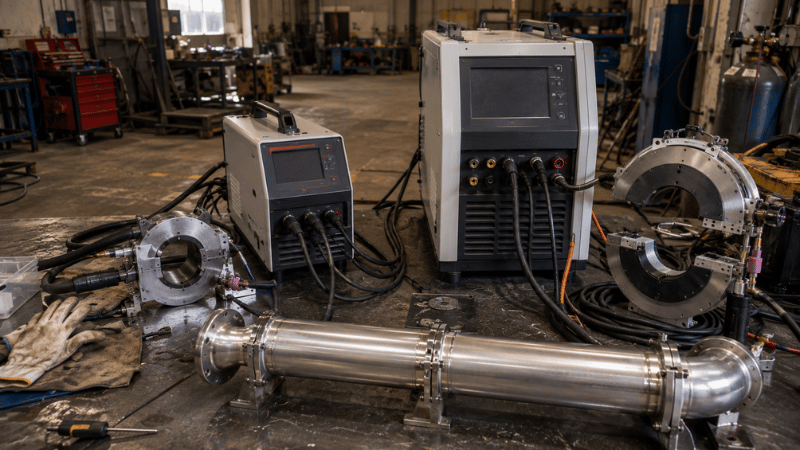
The power source is only one part of the system. A complete setup may include an enclosed or open weld head, control cables, shielding-gas equipment, a water cooler, and a wire feeder.
Compatibility matters. Similar-looking connectors do not guarantee that a controller can operate a particular head. Current rating, cooling, communication protocols, rotation control, and software must all match.
Readers new to the process can review this comprehensive guide to orbital welding before comparing equipment configurations.

200 Amp vs. 400 Amp: Quick Comparison
| Selection Factor | 200 Amp System | 400 Amp System |
|---|---|---|
| Typical work | Thin-wall tube and smaller pipe | Larger or thicker-wall pipe |
| Common process | Autogenous fusion | Fusion or filler-wire welding |
| Typical weld head | Enclosed fusion head | Open orbital head |
| Portability | Generally easier to move | Usually larger and heavier |
| Input power | Often less demanding | Greater supply may be required |
| Production use | Field and moderate production | Sustained industrial production |
| Expansion capacity | Limited for heavier work | Broader application range |
These are general application profiles—not universal thickness limits. Required amperage changes with material, joint design, travel speed, welding position, number of passes, and the qualified weld schedule.
Welding metallurgy rarely respects a neat “one thickness equals one amperage” chart. It likes making engineers earn their coffee.
200A for Precision. 400A for Heavy-Duty Production.
iKratz matched each workshop with the power level its joints actually required.
High-Purity Thin-Wall Tubing
1/4–2 in EP 316L tubing, 1.65 mm wall, cleanroom installation.
MWA-200 with MWF enclosed fusion weld heads.
Stable 30–80A pulsing, low heat input, compact size, and easy mobility.
Heavy-Wall Multi-Pass Piping
6 in Schedule 40 carbon and duplex pipe, 7.1 mm wall.
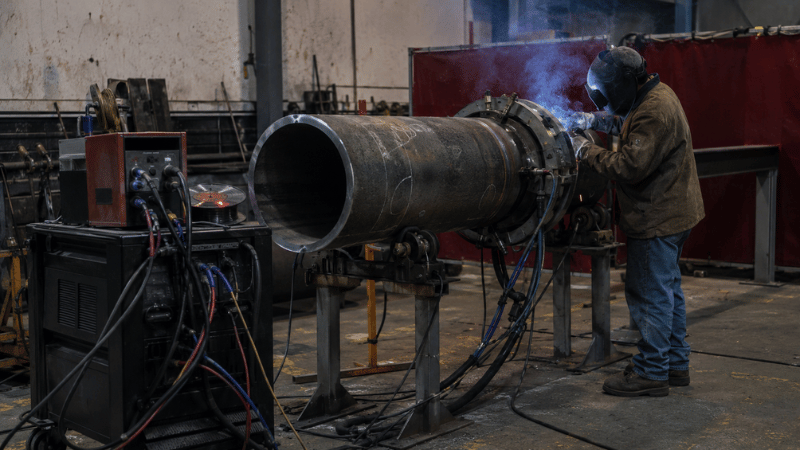
400A power source, MWG-90 open head, wire feed, and water cooling.
Continuous 180–280A multi-pass welding with 100% duty-cycle margin.
When a 200 Amp Welder Is the Better Choice
A 200 amp welder is often suitable for thin-wall tubing, sanitary piping, pharmaceutical installations, semiconductor gas lines, food-processing systems, and other high-purity applications.
These projects commonly use autogenous welding, where the joint is fused without filler metal. An enclosed orbital head surrounds the joint, maintains shielding-gas coverage, and rotates the electrode at a controlled speed.
A 200 amp system usually makes sense when:
- Thin-wall fusion welding dominates production
- Enclosed weld heads are primarily used
- Portability is important
- Site power is limited
- Filler wire and multipass welding are uncommon
Compact equipment can be valuable in cleanrooms, mechanical spaces, and maintenance areas where access is limited. A lighter power source is considerably more attractive after the third staircase and the fifth narrow doorway.
However, do not select a machine by maximum current alone. Compare the procedure’s operating current with the power source’s rated duty cycle. A machine may reach 200 amps without being designed to remain there throughout a demanding production shift.
When a 400 Amp Welder Makes More Sense
A 400 amp welder becomes more useful when the process requires higher current, longer arc-on time, filler wire, multiple passes, or a larger open weld head.
Open heads provide access to prepared joints and can accommodate external filler-wire delivery. They are commonly used for industrial process piping, power-generation components, energy projects, and heavier fabrication.
A 400 amp orbital welding power source may be justified when:
- Open-head welding is performed regularly
- The joint requires added filler metal
- Procedures involve multiple passes
- Daily weld counts and arc-on time are high
- Several weld-head types must be supported
- Future projects may involve heavier pipe
The MWG-90 open orbital welding machine illustrates an open-head configuration designed for pipe welding with water cooling. It also shows why the head, power source, cooler, and process should be evaluated as one system.
Greater capacity does not automatically produce a better weld. It only provides additional operating margin when the procedure needs it.
A 400 amp system may also require more input power, heavier cables, stronger cooling, and a larger equipment budget. Buying unused capacity is not always future-proofing. Sometimes it is simply an expensive way to store spare amperage.
Why Duty Cycle Matters
Welding duty cycle describes how long a power source can operate at a stated current during a specified test period.
This is important because two power sources with similar maximum amperage may behave very differently during sustained production.
A 200 amp system might complete occasional welds successfully but experience thermal interruptions during high-volume work. A 400 amp unit operating well below its maximum may offer more thermal margin.
Before choosing, compare:
- Duty cycle at the actual welding current
- Arc-on time per joint
- Number of welds per shift
- Cooling time between welds
- Ambient operating conditions
- Torch, cable, and cooler ratings
The power source cannot compensate for an undersized head or cooling package. Every component carrying current or removing heat must support the procedure.
How to Select the Right Welding Power Supply
Define the Workpiece
Document the material grade, outside diameter, wall thickness, joint preparation, fit-up tolerance, and welding position.
Stainless steel, titanium, nickel alloys, and carbon steel do not react identically to the same current. Joint geometry also influences heat input, penetration, filler-metal requirements, and the number of passes.
Define the Welding Process
Determine whether the application requires autogenous fusion, cold-wire GTAW, hot-wire GTAW, or multipass welding.
Fusion welding normally uses a simpler equipment configuration. Filler-wire welding adds a coordinated variable and may require a wire feeder, open head, water cooler, and additional controller functions.
Match the Weld Head
Confirm the head’s diameter range, current rating, cooling method, cable requirements, and controller compatibility.
Enclosed heads are commonly selected for repeatable high-purity tube welding. Open heads provide more flexibility for larger pipe, prepared joints, and filler metal.
Obtain written compatibility confirmation from the supplier. “The connector seems to fit” is not a technical specification.
Verify Site Power
Check the available voltage, phase, amperage, plug configuration, generator compatibility, cable length, and environmental conditions.
A technically impressive 400 amp power source becomes a very expensive cabinet when the jobsite cannot power it.
Review Documentation Features
Regulated and critical industries may require program storage, operator permissions, parameter monitoring, calibration records, weld identification, and report export.
Applications governed by piping or pressure-equipment requirements may also need qualified procedures and documented operator controls. The ASME Section IX overview provides information on welding procedure and personnel qualification requirements.
The equipment can support compliance, but it does not qualify a welding procedure by itself.
A Simple Decision Framework
Choose a 200 amp orbital welding power source when the qualified procedure remains comfortably within the system’s rated output, thin-wall fusion work dominates, portability matters, and enclosed heads are the main tools.
Choose a 400 amp system when the application involves open heads, filler wire, multiple passes, longer arc-on time, sustained production, or likely expansion into heavier pipe welding.
An engineering review is advisable when:
- Procedure current approaches the equipment limit
- The material or joint design is unusual
- Existing heads come from another manufacturer
- Hot-wire welding is required
- Full weld-data traceability is mandatory
A useful quotation request should include the material, pipe diameter, wall thickness, joint design, process, required current, preferred weld head, production rate, available input power, and documentation requirements.
That information is far more valuable than simply asking, “How much is your 400 amp machine?”
Common Selection Mistakes
The most common mistake is comparing maximum amperage while ignoring duty cycle. Maximum current shows what the machine can reach; duty cycle indicates how it can perform at that output.
Another mistake is choosing the controller before the weld head. The head influences the required current, cooling, cable arrangement, rotation control, and wire-feed configuration.
Buyers also overlook facility power, cable length, training, calibration, spare parts, and technical service. These items may not look exciting in a quotation, but neither does production downtime.
Finally, avoid buying excessive capacity without a realistic expansion plan. Compare the larger system’s flexibility against its higher purchase cost, energy requirements, cooling package, portability, and maintenance needs.
Frequently Asked Questions
Is a 200 amp welder enough for orbital welding?
It can be sufficient for many thin-wall tube and autogenous fusion applications. Suitability depends on the material, wall thickness, procedure current, duty cycle, weld head, cooling, and production rate.
When should I choose a 400 amp power source?
Choose a 400 amp system when the application requires higher output, longer arc-on time, open weld heads, filler wire, multiple passes, or sustained high-volume production.
Can one power source operate different weld heads?
Some controllers support several heads, but compatibility is not universal. Confirm the electrical connections, communication protocol, current rating, cooling method, rotation control, and software support.
Does higher amperage improve weld quality?
Not by itself. Weld quality also depends on the procedure, fit-up, tungsten condition, shielding gas, travel speed, cooling, and operator setup. Higher amperage only adds capacity when the process requires it.
Conclusion
The correct orbital welding power source is determined by the complete application—not by the biggest amperage number your budget can tolerate.
A 200 amp system is often the practical choice for portable, thin-wall, autogenous fusion welding. A 400 amp system is better suited to open heads, filler wire, multipass procedures, heavier pipe, and sustained production.
Before ordering, verify the weld procedure, actual operating current, duty cycle, input power, cooling, head compatibility, and reporting requirements. That approach produces a defensible equipment decision rather than an expensive technical guess.
Configure the Right Orbital Welding System
iKratz develops orbital welding and automation solutions around real application requirements, from compact high-purity tubing systems to open-head equipment for demanding industrial pipe fabrication. Customers receive equipment configuration support, technical guidance, and solutions designed for repeatable production.
Visit iKratz and share your material, pipe dimensions, welding process, and production target. Contact the team today for an application review and tailored system quotation.