The orbital welding machine price on a quotation may look wonderfully simple. Unfortunately, the number can become considerably less charming once weld heads, tooling, cooling, cables, training, and freight join the party.
This guide explains what a production-ready system really costs, which configuration fits your application, and how to compare quotations without buying an expensive collection of incompatible boxes.
Orbital Welding Machine Price: What Should Buyers Expect?
There is no universal orbital welder price because there is no universal welding application. A system for thin pharmaceutical tubing is very different from an automatic pipe welding machine designed for thick-wall carbon steel with filler wire.
Pipe diameter, wall thickness, base material, joint preparation, production volume, weld-head style, documentation requirements, and local support all influence the final price.
A publicly available US market reference estimates that a new complete orbital welding system may cost approximately USD 35,000–55,000. Treat that as a planning benchmark rather than a global average; regional pricing, system scope, accessories, taxes, and engineering requirements can move the figure significantly.
Orbital Welding System Cost by Configuration
A lower initial quote may exclude components required for production.
| Configuration | Typical Cost Position | What Buyers Must Confirm |
|---|---|---|
|
⚡
Power supply only
|
Lowest | Confirm: head compatibility, cables, controls and cooling. |
|
⭕
Basic power supply and weld-head package
|
Medium | Confirm: diameter tooling, gas control and commissioning. |
|
✅
Complete production-ready system
|
Higher | Confirm: cooling, tooling, training and documentation. |
|
🏭
Customized welding cell
|
Highest | Confirm: automation, fixtures, integration and safety guarding. |
The important phrase is production-ready system. Comparing a power-source quotation with a complete-package quotation is like comparing the price of an engine with the price of a truck. Both numbers are technically correct; only one gets your cargo moving.
What Is an Orbital Welding Machine?
Orbital welding rotates the welding tool around a stationary tube or pipe. It is commonly based on TIG, also known as Gas Tungsten Arc Welding or GTAW.
According to TWI’s orbital welding explanation, computerized parameter control allows welding programs to be stored and reused, supporting repeatable tube-to-tube, pipe-to-pipe, and tube-to-tubesheet welds.
Automation does not eliminate the need for welding knowledge. Operators still need to confirm fit-up, select the correct program, inspect test coupons, manage shielding gas, and recognize when the weld pool is misbehaving. The machine is clever, but it has not yet developed common sense.
What Is Included in a Complete System?
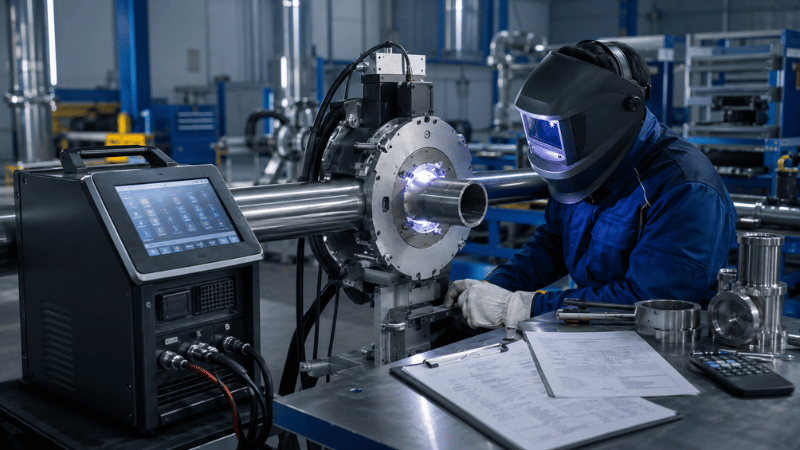
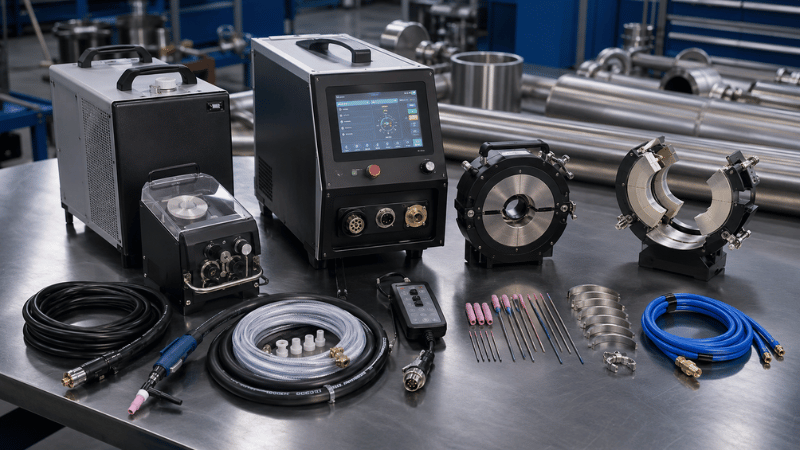
A functional orbital welding system normally includes a programmable power supply, compatible weld head, control cables, shielding-gas equipment, clamping tooling, tungsten electrodes, and startup consumables.
Depending on the job, it may also require a water cooler, wire feeder, purge equipment, extension cables, remote controls, additional collets, weld-data software, calibration, training, and commissioning. TWI likewise identifies the power supply, welding head, optional wire feeder, and cooling equipment as core system elements.
Before approving a purchase, ask the supplier one gloriously unexciting but financially valuable question: “Can this exact quotation produce our specified weld on delivery?”
Closed-Head vs. Open-Head Equipment
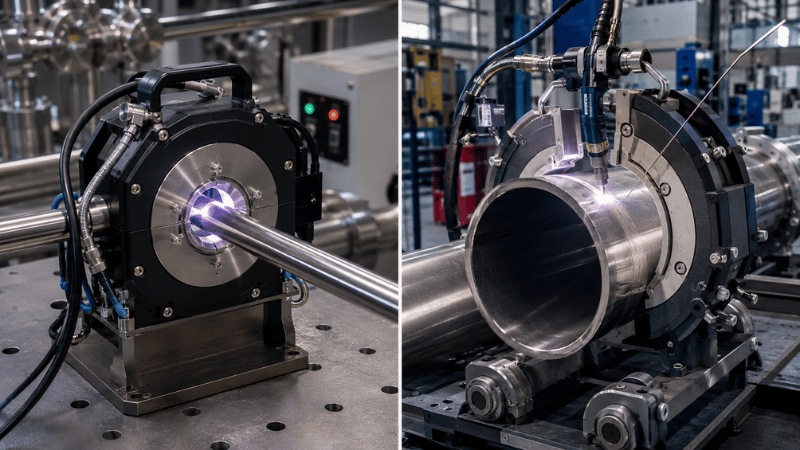
A closed-head orbital welder surrounds the joint in an enclosed chamber. It is generally suited to small-diameter, thin-wall tubing where shielding, cleanliness, and repeatability matter, including pharmaceutical, semiconductor, food-processing, and high-purity gas applications.
An open-head system provides greater access and visibility. It is usually better for larger diameters, thicker walls, irregular joint conditions, and applications requiring filler wire. However, wire feeding, torch positioning, cooling, and multi-pass programming can increase the orbital welding system cost.
Choose a closed head when tubing is clean, accurately prepared, and suitable for autogenous welding. Choose an open head when the joint requires filler metal, wider diameter coverage, or more adjustment around the weld.
When neither option fits comfortably, request an engineering review instead of forcing the application into the nearest product brochure. Welding equipment has many talents; reading wishful thinking is not one of them.
Main Factors Affecting Orbital Welder Cost
Outside diameter determines which welding heads and clamping inserts are suitable. Even a small diameter change can require different tooling, so “approximately 50 millimeters” is not the measurement suppliers dream about.
Wall thickness affects current requirements, duty cycle, cooling, and whether the joint needs one pass or several. Thicker pipe may require filler-wire capability, oscillation, arc-voltage control, and more sophisticated programming.
Material also matters. Stainless steel, carbon steel, titanium, nickel alloys, and aluminum behave differently under heat. Shielding and purge-gas requirements must therefore be considered alongside penetration and heat input.
Finally, regulated or quality-critical industries may require weld data logging, operator permissions, stored programs, calibration records, and traceability. These features increase initial cost but may prevent considerably larger expenses during audits, inspection failures, or production recalls.
How to Choose the Right Orbital Welding Equipment
Begin with the workpiece, not the machine catalogue. Record the minimum and maximum outside diameter, wall thickness, material grade, joint type, available clearance, and required weld position.
Next, define whether the weld is autogenous or uses filler wire, whether it is single-pass or multi-pass, and what internal penetration profile and inspection standard must be achieved.
Production environment is equally important. Workshop equipment may prioritize duty cycle, while field equipment needs portability, durable cables, manageable input power, and protection from dust or weather.
For applications requiring programmable control and industrial connectivity, the MWA-200 welding control power source supports a 5–200 A range, real-time parameter monitoring, a touchscreen interface, stored welding programs, and multiple electrical protection functions. Its suitability still depends on the connected weld head and the complete application configuration.
Buyers comparing broader options can review the iKratz orbital welding and automation range for closed-head, open-head, tube-to-tubesheet, heat-exchanger, and customized welding systems.
The $22,000 Bargain That Cost $44,450
The buyer expected a production-ready orbital welding system. What arrived was only an incomplete power source.
An Incomplete System
- No matched orbital weld head
- No circulating water cooler
- No control or extension cables
- Unable to strike an arc
Everything Needed to Produce
- MWA-200 power source
- Matched enclosed weld head
- Integrated dual-circuit cooling
- Heavy-duty control cables
From Crate to Production in 48 Hours
The second production line used the complete iKratz MWA-200 package, with no emergency accessory purchases or integration delays.
View MWA-200 Package →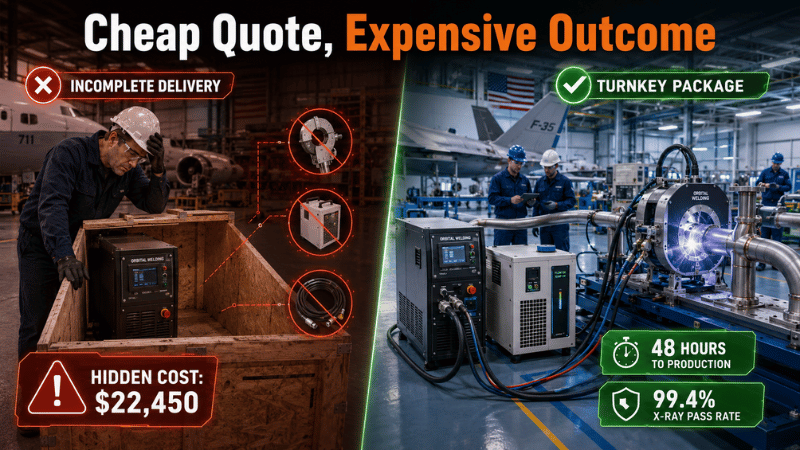
New, Used, or Rental Equipment?
Buying new usually provides current controls, compatible accessories, training, warranty coverage, and application support. It is generally the strongest option for continuous production or quality-critical work.
Used equipment can reduce the purchase price, but calibration status, software age, missing tooling, service history, weld-head compatibility, and spare-part availability must be checked. A bargain power source with obsolete connectors is mostly an unusually heavy office ornament.
Rental equipment can make sense for shutdowns, short contracts, application trials, or uncertain production volumes. Compare the total rental period, availability, freight, consumables, and technical support against the annual utilization expected from purchased equipment.
Calculate Total Cost, Not Just Purchase Price
Total cost of ownership includes equipment, weld heads, tooling, cooling, gas-control components, training, maintenance, calibration, consumables, software, freight, taxes, and downtime.
It should also include the cost of an unsuitable configuration. A cheaper machine that cannot maintain duty cycle or produce the required documentation may become the most expensive option surprisingly quickly.
A simple payback calculation is:
Payback period = total system investment ÷ monthly net savings
Monthly savings may include reduced welding labor, lower rework, shorter inspection time, faster production, and fewer delays. Use actual shop data rather than universal productivity claims. Your pipes have not read the sales brochure.
How to Compare Supplier Quotations
Normalize every quotation before comparing prices. Each proposal should identify the power source, weld head, diameter range, cooling system, wire feeder, cables, gas controls, tooling, software, consumables, training, commissioning, warranty, freight, and delivery terms.
Then confirm technical capability: material, wall thickness, duty cycle, filler-wire support, program control, data logging, and applicable welding requirements.
Disqualify any system that cannot cover the required diameter, duty cycle, material, documentation, or local support. A low score in a critical category should not be averaged away by a lovely touchscreen.
Safety and Compliance Still Matter
Orbital automation reduces some operator exposure, but it does not remove welding hazards. OSHA identifies metal fumes, ultraviolet radiation, burns, eye injuries, and electrical shock among the risks requiring suitable work practices and personal protective equipment. Review OSHA welding safety guidance when planning installation and operation.
Applicable procedures and qualifications should also be reviewed by competent welding personnel using recognized resources such as the American Welding Society.
Frequently Asked Questions
How much does an orbital welding machine cost?
A published US reference places some complete new systems around USD 35,000–55,000. Actual prices depend on the weld head, diameter range, tooling, cooling, filler-wire capability, software, training, freight, and regional support.
What equipment is required for orbital welding?
Most systems require a programmable power supply, compatible weld head, cables, clamping tooling, shielding-gas equipment, tungsten electrodes, and consumables. Water cooling, wire feeding, purge equipment, and data logging may also be required.
Should I buy, rent, or purchase used equipment?
Buy when utilization is frequent and long-term. Rent for temporary projects, shutdown work, or trials. Consider used equipment only after verifying calibration, compatibility, software support, service history, and replacement-part availability.
Is the power supply a complete orbital welding machine?
Usually not. A power supply controls the process, but the system still needs a compatible weld head and application-specific accessories. Always request an itemized quotation showing exactly what is required to begin production.
Conclusion: Build a Realistic Orbital Welding Budget
The orbital welding machine price depends on the complete application, not merely the power supply. Define diameter, wall thickness, material, joint design, filler-wire requirements, production volume, and traceability before requesting quotations.
The best-value system is not automatically the cheapest. It is the configuration that produces compliant, repeatable welds at the lowest justified total ownership cost—without requiring an emergency accessory-shopping expedition after delivery.
Get a Configuration Built Around Your Application
iKratz combines orbital welding equipment, intelligent controls, application engineering, and system integration to help manufacturers avoid incomplete or oversized configurations. From high-purity tubing to automated industrial production, each recommendation can be matched to your material, pipe dimensions, quality requirements, and output targets.
Review the MWA-200 power source or contact iKratz today with your project specifications to request a system recommendation and itemized quotation.