Quick Summary
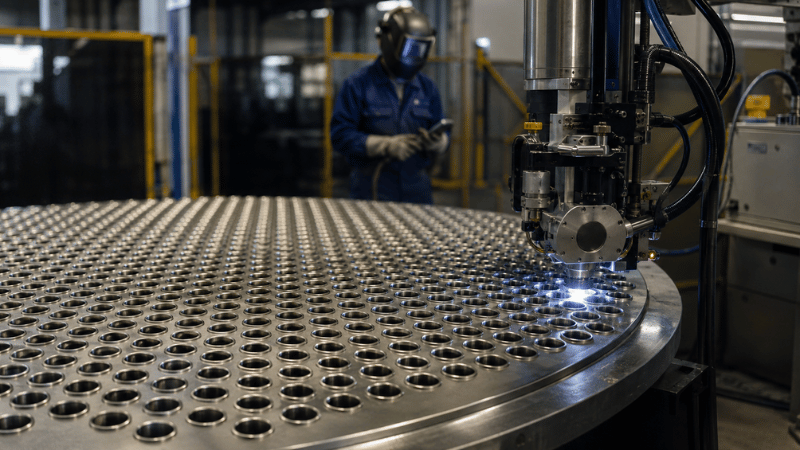
A tube sheet welding machine automates circumferential TIG welding between tubes and tube sheets in heat exchangers, boilers, condensers, and pressure equipment.
The right system should be selected according to tube dimensions, joint design, materials, accessibility, production volume, and inspection requirements—not tube diameter alone.
Portable heads suit flexible or lower-volume work. Suspended, rack-type, and integrated systems can improve ergonomics and throughput in larger production environments.
Before purchasing, run a pilot-weld test using representative materials and joint geometry. The best machine is the one that proves repeatable weld quality under your real production conditions.
What Is a Tube-to-Tubesheet Welding Machine?
Tube-to-tubesheet welding looks straightforward—until the same joint must be repeated hundreds or thousands of times without quality drifting off for an unscheduled coffee break.
A tube-to-tubesheet welding machine is a mechanized or automatic system that joins a tube end to the face of a tube sheet. The workpiece remains stationary while a compact welding head rotates the torch around the tube.
Most machines use orbital TIG, also called gas tungsten arc welding or GTAW. The system controls current, rotation speed, gas timing, overlap, and, when required, filler-wire feeding.
This repeatable motion makes orbital welding systems valuable for heat exchangers containing large numbers of similar joints. The operator no longer has to reproduce the same torch movement manually across an entire shift.
Automation does not eliminate operator responsibility, though. Cleaning, fit-up, program selection, head alignment, tungsten condition, monitoring, and inspection remain essential.
How a Tube Sheet Welding Machine Works
The welding cycle begins with tube and tube-sheet preparation. Oil, oxide, moisture, machining debris, and inconsistent tube projection can destabilize the arc or contaminate the weld.
The operator positions the tube sheet welding head over the tube. A centering mandrel or locating mechanism aligns the torch with the joint.
After the cycle starts, the system performs shielding-gas preflow, arc ignition, programmed rotation, crater filling, arc termination, and gas postflow.
Depending on the configuration, the controller may manage peak and background current, pulse frequency, rotation speed, overlap, gas timing, wire-feed rate, and multi-segment welding programs.
Multi-segment control is useful because heat behavior may change as the torch travels around the joint, particularly when welding in different positions. The program can adjust current or speed during rotation rather than forcing one setting to handle everything.
Autogenous or Filler-Wire Welding?
Autogenous welding fuses the tube and tube sheet without adding filler metal. It offers a compact setup, fewer variables, and potentially shorter cycle times.
It may suit compatible materials, controlled fit-up, thin-wall tubes, and certain seal-weld designs. However, a small gap or inconsistent projection can quickly make an elegant autogenous procedure rather less elegant.
Filler-wire welding adds weld metal to produce a specified profile, accommodate certain joint designs, or satisfy metallurgical requirements. It requires a wire feeder, suitable torch access, and additional parameters to qualify.
Neither method is universally superior. The choice should reflect the material combination, wall thickness, joint profile, fit-up, applicable specification, and approved welding procedure.
Where These Machines Are Used
The most common application is the shell-and-tube heat exchanger. One exchanger may contain hundreds or thousands of tube joints, making weld-to-weld repeatability commercially and technically important.
iKratz provides tube-to-tubesheet welding systems and broader heat exchanger welding solutions for exchanger and pressure-equipment production.
Typical applications include condensers, evaporators, boilers, steam generators, process heat exchangers, and specialized pressure vessels.
Automation provides the greatest value when joint counts are high, materials are difficult or expensive, skilled manual welders are limited, or production requires controlled programs and traceable data.
The heat exchanger welding application page explains how orbital and automated systems can support tube-to-tubesheet, shell, and related exchanger fabrication tasks.
Main Tube Sheet Welding Machine Types
Selecting equipment is not just a matter of finding a model with the right advertised diameter range. The machine configuration affects access, ergonomics, repositioning time, and overall output.
Portable Tube Sheet Welding Heads
Portable heads are manually moved from one tube to the next. They offer flexibility, straightforward setup, and a lower entry cost for small batches or frequently changing workpieces.
The trade-off is operator handling. Head weight, cable drag, and repetitive positioning may reduce productivity during long shifts, especially on large vertical tube sheets.
For smaller tubes, the MWP-38 tube-to-tubesheet welding head is designed for tube dimensions from ID 6 mm to OD 38.1 mm.
For a wider range, the MWP-65 tube sheet welding machine is designed for automated all-position GTAW with tubes from 15 to 63 mm outside diameter.
These ranges are a starting point—not a purchase decision. Pitch, projection, adjacent-tube clearance, wall thickness, and joint design still require verification.
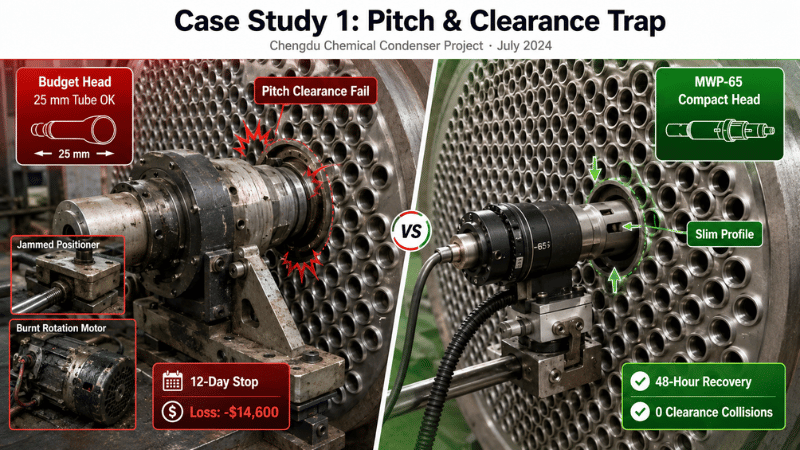
The Head Fit the 25 mm Tube, but Not the Tube Pitch
A condenser manufacturer bought a budget welding head based on its advertised 15–38 mm range. The supplier never checked the tightly packed triangular tube layout.
What Went Wrong
Tube diameter was checked, but surrounding clearance was ignored.
- Gas cup collided with adjacent tubes
- Locating mandrel could not enter the grid
- Forced insertion jammed the assembly
- The rotation motor burned out
What Should Be Checked
A complete application review must cover more than tube diameter.
- Tube pitch and adjacent clearance
- Gas-cup and housing dimensions
- Locating-mandrel geometry
- Full rotation space
The Financial Toll
The iKratz Fix: MWP-65 Compact Welding Head
iKratz reviewed the condenser CAD drawings and deployed the slim-profile MWP-65 with a low-profile gas lens for dense triangular tube layouts.
Suspended or Boom-Mounted Systems
A suspension arm supports the head and cable bundle, allowing the operator to move across a large tube sheet with less physical strain.
This arrangement often provides a sensible middle ground between a fully handheld head and an integrated automatic cell.
Before choosing one, verify reach, balance, cable routing, workpiece loading, and access to the outer rows. A beautifully engineered arm that cannot reach the final two tubes is basically premium workshop decoration.
Rack-Type Welding Machines
A rack-type tube sheet welding machine uses a structured support or positioning arrangement to organize head movement around the workpiece.
It can be well suited to repeated production involving predictable tube-sheet sizes and layouts. Buyers should confirm the work envelope, loading method, head access, repositioning time, and suitability for horizontal or vertical tube sheets.
The term should always be qualified as “rack-type tube sheet welding machine.” Otherwise, online research may lead procurement into the surprisingly deep world of warehouse shelving.
Integrated Automatic Cells
Integrated cells may combine coordinate-based tube location, automatic positioning, program selection, weld counting, and production-data recording.
They offer high throughput but require greater capital investment, stable product designs, disciplined maintenance, and enough annual utilization to justify the system.
For low-volume custom fabrication, buying the highest level of automation can create an impressive machine that spends most of its working life waiting for work.
Compatibility Factors to Check
The correct machine must match the complete joint—not simply the tube outside diameter.
Start with tube dimensions: outside diameter, inside diameter, wall thickness, projection or recess, pitch, and spacing between adjacent tubes.
Next, review tube-sheet thickness, flatness, hole arrangement, edge clearance, nearby obstructions, and available working space. A head may fit the tube yet collide with the next tube or the exchanger shell.
Material selection also affects the process window. Carbon steel, stainless steel, duplex stainless steel, titanium, nickel alloys, and dissimilar-metal joints require different heat-input, cleaning, shielding, and filler-metal strategies.
Joint geometry matters just as much. Flush, protruding, and recessed tube ends create different torch-access conditions. Expanded-and-welded joints also require consistent expansion and projection before welding.
Finally, determine whether the joint is a seal weld or a strength weld. Their engineering functions and acceptance requirements are not interchangeable.
Applicable qualification requirements should be confirmed against the project specification and the relevant edition of ASME BPVC Section IX or another governing standard.
How to Choose the Right System
Begin with the joint drawing, not the supplier’s quotation.
First, define the required weld profile and acceptance criteria. Confirm whether visual inspection, penetrant testing, leak testing, macro examination, or another method is required.
Second, match the welding head to the geometry. Verify diameter, wall thickness, projection, recess, pitch, adjacent-tube clearance, torch angle, and filler-wire access.
Third, select a realistic automation level. Portable equipment may be economical for varied, low-volume production. Suspended systems improve ergonomics for medium volumes, while integrated cells make more sense for standardized, high-volume manufacturing.
Fourth, evaluate the complete welding system. This may include the head, power source, controller, wire feeder, water cooler, support arm, fixtures, cables, tooling, and data interface.
Fifth, assess the supplier—not just the machine. Look for drawing review, sample welding, procedure-development support, installation, commissioning, training, spare parts, and responsive technical service.
Avoid suppliers that promise “defect-free welding” without testing representative samples. Welding is an engineering process, not a magic trick with a touchscreen.
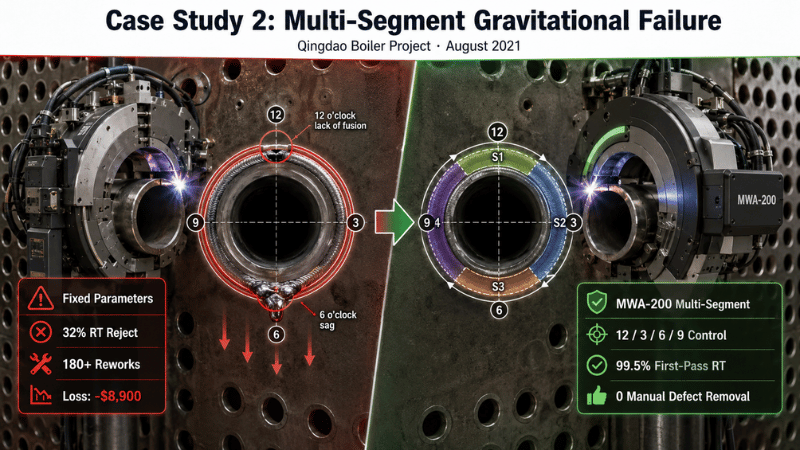
The “One-Click” System Produced a 32% RT Rejection Rate
A boiler manufacturer purchased an automated system without testing it on the actual alloy tubes and vertical tube-sheet geometry.
Fixed Parameters
The same settings were used throughout the full rotation.
- No current adjustment by position
- No pulse compensation
- No gravity control
- No pilot-weld test
Multi-Segment Control
Each orbital section received optimized parameters.
- Current adjusted by position
- Pulse frequency changed by sector
- Heat input matched puddle behavior
- Program verified by pilot welding
The Financial Toll
The iKratz Fix: MWA-200 Multi-Segment Control
iKratz tested the actual alloy materials and divided the orbital path into independently controlled welding sectors.
Never Skip the Pilot-Weld Test
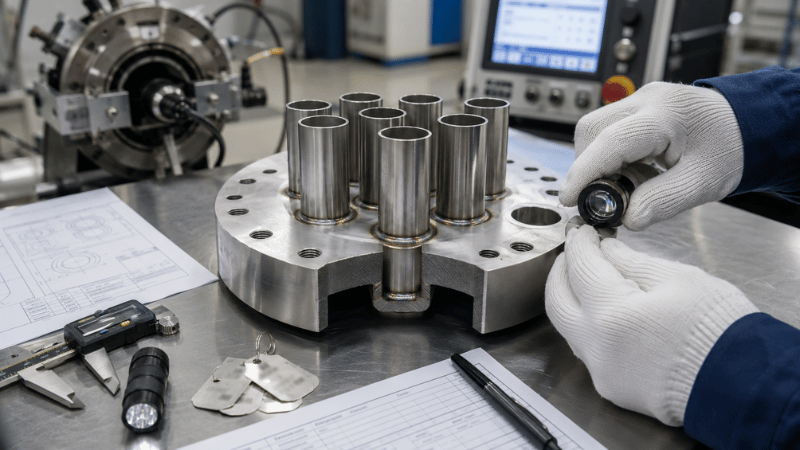
A representative pilot weld is one of the most effective ways to reduce procurement risk.
Send the supplier tube and tube-sheet drawings, material specifications, representative samples, joint details, welding position, acceptance criteria, and target production rate.
Ask for multiple consecutive welds rather than one showcase sample produced after hours of adjustment. One beautiful weld demonstrates possibility; repeated acceptable welds demonstrate process capability.
Measure cycle time, weld-profile consistency, penetration, overlap, defect rate, rework, consumable use, and operator intervention.
The test should also demonstrate program storage, parameter retrieval, arc-start consistency, crater filling, wire-feed performance where required, and realistic head repositioning.
Record the agreed test conditions and acceptance criteria before the trial. Otherwise, a failed test can develop a remarkable number of creative interpretations afterward.
Weld Quality and Traceability
Typical tube-sheet weld defects include porosity, incomplete fusion, insufficient penetration, undercut, oxidation, cracking, burn-through, and inconsistent overlap.
Many problems begin before the arc starts. Poor cleaning, incorrect projection, head misalignment, damaged tungsten, unstable shielding, or the wrong program can undermine an advanced machine.
Check shielding-gas delivery at the torch instead of relying only on the regulator reading. Inspect electrodes, collets, gas lenses, cups, seals, cables, cooling circuits, and rotation components regularly.
Approved programs should have revision control and backups. Password-protected editing can prevent unauthorized parameter changes after qualification.
Weld records may include the program ID, weld number, date, operator, current profile, rotation speed, and alarm history.
However, digital traceability does not replace inspection. A controller may prove that the programmed current was delivered, but it cannot independently confirm fusion, penetration, or leak tightness.
Cost and ROI Considerations
The quoted machine price is only part of the investment. Total cost may include the welding head, controller, power source, wire feeder, cooler, suspension system, tooling, installation, training, procedure qualification, spares, and production-line integration.
Estimate return on investment using annual weld volume, existing labor time per joint, automated cycle time, rework rate, inspection costs, downtime, and additional capacity.
For low-volume custom work, portability and fast changeovers may matter more than maximum welding speed. Medium-volume production may benefit most from a suspended system.
High-volume standardized production can justify automatic positioning, data capture, and line integration.
The least expensive machine is not necessarily the lowest-cost solution. A poorly matched head can create enough repositioning delays and rework to make the original saving look rather cute.
FAQs
What is the difference between a tube sheet welding machine and a general orbital welder?
A tube sheet welding machine joins a tube to the face of a tube sheet. General orbital machines often produce tube-to-tube or pipe-to-pipe butt welds. Their head geometry, centering method, torch position, and access requirements are different.
Can one tube sheet welding machine handle different sizes and materials?
Many machines cover a defined size range using interchangeable tooling, heads, or stored programs. Compatibility must still be confirmed for wall thickness, projection, pitch, material combination, joint design, access, and filler-wire requirements.
Is automatic tube sheet welding always faster than manual TIG?
It is most productive when many similar joints must be welded. Actual output depends on cleaning, positioning, cable handling, inspection, program stability, and product variation—not only arc-on time.
What information is required for an accurate quotation?
Provide tube and tube-sheet materials, tube diameter, wall thickness, sheet thickness, projection or recess, pitch, joint drawings, welding position, production volume, inspection requirements, applicable standards, utilities, and desired automation level.
Conclusion
A tube sheet welding machine should be selected around the real joint, production volume, quality requirements, and working environment. Tube diameter is only the opening question.
Portable, suspended, rack-type, and integrated systems each suit different production conditions. Geometry compatibility, process control, inspection, usability, and supplier support all influence the final result.
Most importantly, require representative pilot welding before approval. The right machine is the one that demonstrates repeatable, inspectable weld quality under your actual production conditions.
Build a System Around Your Actual Joint
iKratz combines orbital welding equipment, heat exchanger manufacturing solutions, application engineering, and automation support. Your recommended configuration can be evaluated around your tube dimensions, materials, joint design, production target, accessibility, and required automation level—not squeezed into a one-size-fits-all package.
Visit the iKratz to explore available systems. Contact the iKratz team today with your drawings and project requirements to request an application review, pilot-weld plan, and project-specific quotation.