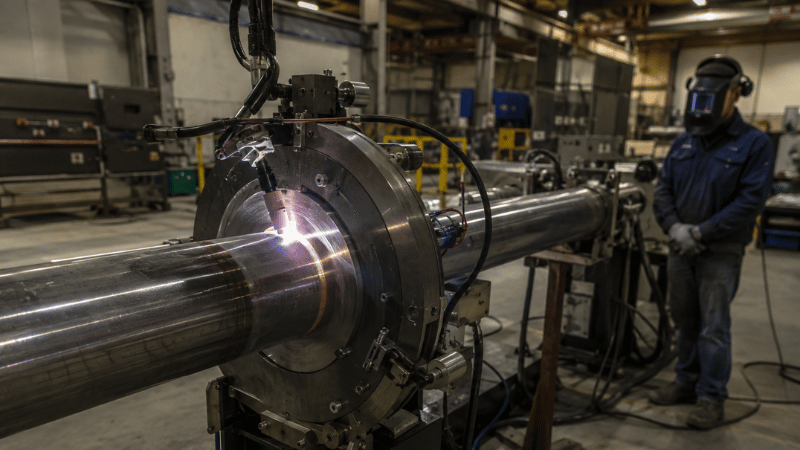
An orbital welding system moves a controlled weld head around a stationary pipe or tube. The correct system depends on diameter, wall thickness, material, joint design, access, production volume, and inspection requirements.
Closed heads suit thin-wall, high-purity tubing. Open heads handle filler wire and thicker pipe, while track-mounted machines serve large-diameter applications. Before purchasing, compare the complete package and confirm performance through representative weld trials.
Choosing by control-screen size alone is risky. The machine must fit the actual application—or it may become a remarkably expensive coat rack.
What Is an Orbital Welding System?
An orbital welding system is automated or mechanized equipment in which the workpiece remains fixed while the welding torch travels around the joint.
According to The Welding Institute’s orbital welding guidance, the process rotates the welding tool around a fixed pipe or tube. Precision applications commonly use TIG or GTAW, while GMAW and FCAW are often selected for larger pipes.
A complete system may include a programmable power supply, orbital weld head, cables, gas controls, cooling unit, purge equipment, wire feeder, oxygen monitor, and data-recording software.
The weld head is only one component. Buyers should evaluate the complete orbital welding system, including tooling, controls, accessories, and support.
As a supplier of orbital welding and automation systems, iKratz provides equipment for high-purity tubing, industrial piping, heat exchangers, and related circumferential welding applications.
How Orbital Welding Works
The process begins with cutting, facing, cleaning, and aligning the tube ends. The operator clamps the head around the joint, starts shielding and backing-gas flow, selects an approved program, and begins welding.
The controller manages current, pulse timing, rotation speed, gas timing, and optional wire feeding. Advanced equipment can also record the operator, welding program, parameters, alarms, and joint identification.
This traceability is valuable in pharmaceutical, semiconductor, aerospace, food-processing, and energy projects.
Automation improves repeatability, but it cannot correct poor preparation. A machine will reproduce a bad setup with impressive consistency.
Main Components
Programmable Power Supply
The power supply controls the arc, torch rotation, gas timing, pulsing, cooling, and filler-wire delivery.
Useful functions include recipe storage, password protection, parameter limits, alarms, and weld-data export. These prevent unauthorized changes to approved programs.
Orbital Weld Head
The weld head clamps around or locates inside the workpiece. Its design determines diameter range, clearance, filler-wire capability, and welding process.
Selection must account for actual fittings, clamps, elbows, and surrounding equipment—not nominal pipe size alone.
Supporting Equipment
A complete package may also require a cooler, wire feeder, oxygen monitor, purge system, cables, tracks, and tube-facing tools.
Preparation accuracy, purge quality, and cooling stability directly influence weld consistency.
Types of Orbital Weld Heads
Closed Weld Heads
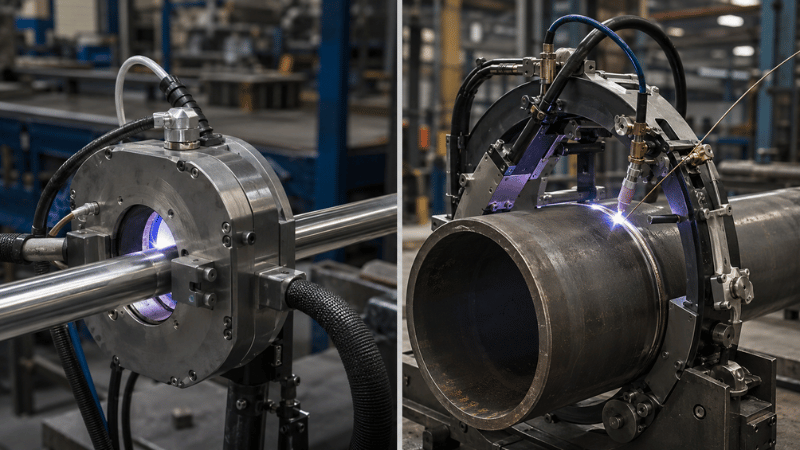
Closed heads enclose the joint inside a shielding chamber. They are commonly used for small-diameter, thin-wall stainless steel and titanium tubing.
They provide excellent gas coverage and repeatability, making them suitable for sanitary and high-purity applications. Most perform autogenous welding without filler wire.
Their limitations include restricted diameter coverage, strict fit-up requirements, and limited clearance.
Open Weld Heads
Open heads expose the torch and support thicker walls, beveled joints, filler wire, and multiple passes.
They are widely used for stainless steel, carbon steel, nickel alloys, petrochemical piping, and power-generation work.
The MWG-90 open pipe orbital welding machine handles pipes from 20 to 89 mm in diameter and wall thicknesses from 1 to 10 mm.
Open heads provide flexibility, but wire alignment, torch position, gas coverage, and cable handling require careful setup.
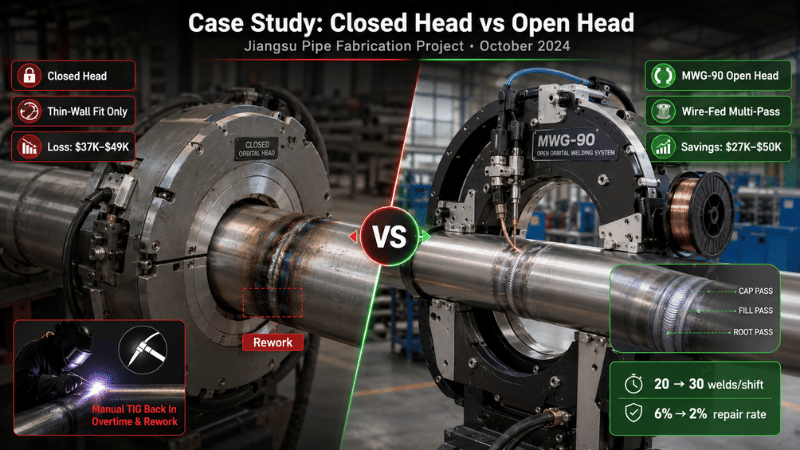
The Closed Head Fit the Pipe— but Not the Welding Process
A fabricator selected a closed orbital welding system for 1,200 stainless steel welds. It could clamp onto the pipe, but could not reliably perform filler-wire, grooved or multi-pass welding.
Closed Head: Wrong Application
Pipe size matched, but the welding process did not.
- Designed mainly for thin-wall autogenous welding
- Could not reliably add filler wire
- Insufficient for groove filling
- Unstable during multi-pass welding
Open Head: Correct Application
Thicker grooved pipe required wire-fed orbital welding.
- Supports thicker wall sections
- Provides controlled wire feeding
- Completes root, fill and cap passes
- Provides better groove access
The Financial Impact
The iKratz Fix: MWG-90 Open Orbital Welding Machine
The MWG-90 matched the project’s pipe range, wall thickness, filler-wire demand and multi-pass groove-welding process.
Tube-to-Tubesheet Heads
These machines are designed for heat exchangers, boilers, and condensers.
Because projects may include hundreds or thousands of similar joints, improvements in positioning, cycle time, and reject rates can deliver substantial savings.
Track-Mounted Machines
Track-mounted systems use a carriage that travels around a guide ring installed on large pipe.
They commonly use GMAW or FCAW for higher deposition rates and are suitable for pipelines and heavy fabrication.
Orbital Welding Equipment Comparison
Match the welding head to the pipe structure, joint design and production process.
| Equipment Type | Best Application | Filler Wire | Main Limitation |
|---|---|---|---|
|
◉
Closed Head
|
Thin-Wall Sanitary Tubing Clean autogenous welds | Usually No | Limited clearance and groove access |
|
C
Open Head
|
Medium- or Thick-Wall Pipe Groove and multi-pass welding | Yes | More setup and parameter variables |
|
◎
Tube-to-Tubesheet Head
|
Heat Exchangers Condenser and boiler tube sheets | Optional | Designed for specialized applications |
|
↔
Track-Mounted Machine
|
Large-Diameter Pipe Heavy industrial pipelines | Yes | Requires track installation and alignment |
Orbital Welding Processes
Autogenous Orbital TIG
Autogenous TIG fuses the tube edges without filler metal. It produces clean welds with precise heat control and suits thin-wall, high-purity tubing.
However, gaps, poor facing, tube ovality, and wall-thickness variation can cause penetration or bead-shape problems.
Wire-Fed Orbital TIG
Wire-fed TIG suits thicker walls, beveled joints, and applications requiring filler metal.
It is slower than GMAW but offers strong control over heat input and weld-pool behavior, making it useful for critical stainless steel and nickel-alloy piping.
Orbital GMAW and FCAW
GMAW and FCAW provide higher deposition rates for large or thick pipe.
They improve productivity but introduce additional variables, including wire feeding, transfer mode, stick-out, torch angle, and interpass control.
How to Select an Orbital Welding Machine
Define the Workpiece
Record the minimum and maximum outside diameter, wall thickness, schedule, tolerance, and ovality.
Check the actual assembly because fittings, clamps, elbows, and surrounding equipment may reduce clearance.
Confirm Material and Joint Design
Material affects heat input, purge requirements, filler selection, and procedure development.
Common materials include stainless steel, carbon steel, titanium, duplex steel, and nickel alloys. Joint designs may include square butt, beveled butt, socket, lap, or tube-to-tubesheet connections.
Thin-wall stainless tubing may suit closed-head autogenous TIG. Beveled carbon-steel pipe usually requires an open head and filler wire.
Check Access and Site Conditions
Measure radial and axial clearance. Confirm electrical supply, shielding gas, purge gas, cooling, cable length, weather protection, and mobility requirements.
Use the real assembly whenever possible. Drawings often show generous access—until someone installs a valve and cable tray beside the joint.
Define Production Requirements
Estimate welds per shift, duty cycle, diameter changes, inspection methods, and documentation needs.
High-volume production may justify barcode identification, controlled permissions, automated program selection, and electronic weld reports. Maintenance work may prioritize portability and fast setup.
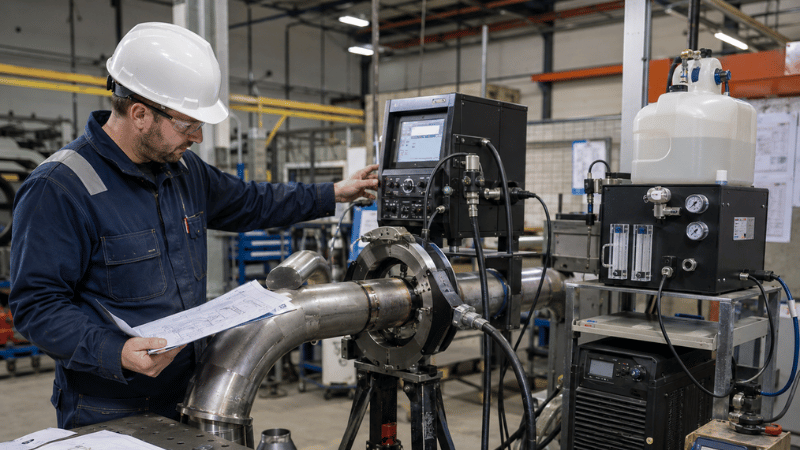
Validate Through Trial Welding
Do not select an automatic pipe welding machine from a catalog demonstration alone.
Ask the supplier to weld your material using representative dimensions, realistic preparation, worst-case acceptable fit-up, and the required inspection method.
The American Welding Society’s WPS guidance explains how welding procedures control process variables. Trial welding should support procedure verification, not merely produce a photogenic sample.
Recommended Systems by Application
Closed-head orbital TIG is generally best for sanitary, pharmaceutical, semiconductor, and food-processing tubing.
Compact open heads may suit aerospace assemblies with restricted access, while tube-to-tubesheet systems serve boilers and heat exchangers.
Petrochemical and power piping often requires open-head wire-fed TIG. Large pipelines typically use track-mounted GMAW or FCAW equipment.
When Orbital Welding Is Not Ideal
Orbital welding performs best when joints are repetitive, dimensions are controlled, and traceability matters.
It may be unsuitable for very low production volumes, irregular joints, inconsistent fit-up, frequently changing assemblies, or severe access restrictions.
Manual TIG, positioners, mechanized carriages, or robotic cells may provide better value in these cases.
Automation also does not remove safety responsibilities. The OSHA welding safety standards cover hazards involving fumes, electrical equipment, radiation, compressed gases, and fire.
Benefits, Costs, and ROI
The main benefits are repeatability, reduced operator variation, lower rework, controlled heat input, and improved traceability.
Limitations include purchase cost, preparation requirements, clearance restrictions, programming, maintenance, and specialized tooling.
Pricing depends on the power supply, weld head, diameter range, wire feeder, cooling unit, software, monitoring tools, training, and support.
For a detailed breakdown, see the iKratz guide to orbital welding machine price.
A practical ROI calculation should include labor hours, welds per shift, reject rates, repair costs, inspection, downtime, and equipment utilization:
Annual benefit = labor savings + rework reduction + added production value − ownership cost
Universal payback claims should be avoided. Results depend on the application and how often the equipment is used.
Common Problems and Fixes
Incomplete penetration may result from poor fit-up, insufficient current, excessive speed, or incorrect electrode position.
Oxidation usually indicates inadequate shielding, purge leaks, moisture, or excessive oxygen.
Uneven beads may come from poor centering, tube ovality, electrode wear, or an inconsistent arc gap.
Arc instability can result from poor grounding, contaminated tungsten, gas problems, or loose connections.
When troubleshooting, change one variable at a time and document the result. Changing everything together may fix the weld, but nobody will know why.
How to Evaluate a Supplier
A qualified supplier should request application details before recommending equipment.
Evaluate its ability to provide application engineering, sample welding, procedure support, commissioning, training, spare parts, maintenance, and clear warranty terms.
Ask for weld samples, inspection results, delivery schedules, and service scope.
A supplier recommending equipment without asking about diameter, material, joint design, access, quality, or production targets is not saving time. It is guessing with your budget.
Frequently Asked Questions
What is the difference between orbital welding and automatic pipe welding?
Orbital welding moves a controlled weld head around a stationary pipe. Automatic pipe welding is broader and may include GMAW, FCAW, robotic, and track-mounted systems.
How do I choose the correct orbital weld head?
Match it to pipe diameter, wall thickness, material, joint type, filler-wire needs, clearance, and production environment. Confirm the choice through trial welding.
How much does an orbital welding system cost?
Cost depends on the power supply, weld head, diameter coverage, cooling, wire feeding, software, accessories, training, and support.
Does orbital welding eliminate skilled operators?
No. Skilled personnel are still required for preparation, setup, program selection, inspection, maintenance, and troubleshooting.
Can one machine handle every pipe size?
Usually not. Each head has specific diameter, wall-thickness, process, and clearance limits. Broad production ranges may require multiple heads or separate systems.
Conclusion
The right orbital welding system must match the pipe dimensions, material, joint, process, access, output, and quality requirements.
Evaluate the full package, including tooling, cooling, purging, monitoring, qualification, maintenance, training, and support.
Most importantly, confirm the proposed configuration through representative weld trials. A system proven on your application is worth far more than one demonstrated on a perfect showroom sample.
Build Your System Around the Application
Your production team needs equipment configured for its actual materials, joints, workspace, output targets, and inspection requirements. iKratz combines orbital welding equipment with application-focused support to improve consistency without adding unnecessary complexity.
Send us your pipe dimensions, drawings, materials, production goals, and quality requirements. Contact us today to request an application review and tailored quotation.