A robotic welding system can ease labor shortages, improve weld consistency, and remove production bottlenecks. But buying a robot arm alone is like buying an engine and claiming you now own a truck.
The right solution combines the robot, welding process, fixtures, sensors, controls, safety equipment, and integration expertise. Here is how to evaluate the whole package without creating a very expensive factory decoration.
What Is a Robotic Welding System?
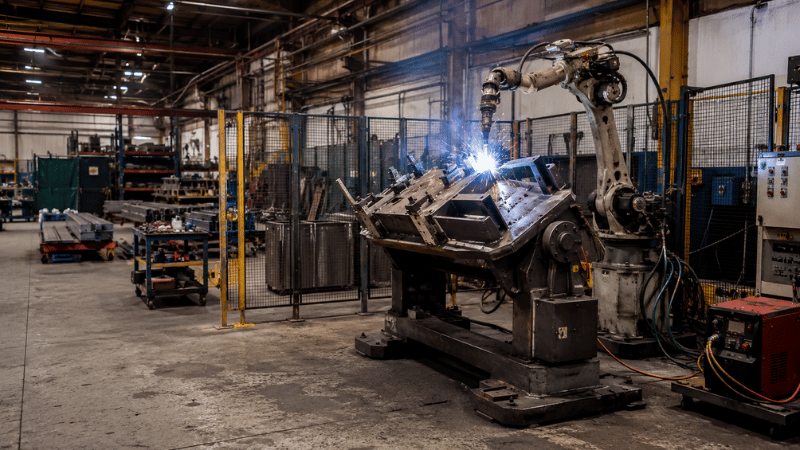
A robotic welding system is a complete automated solution in which a programmable robot moves a welding torch or gun along a defined path.
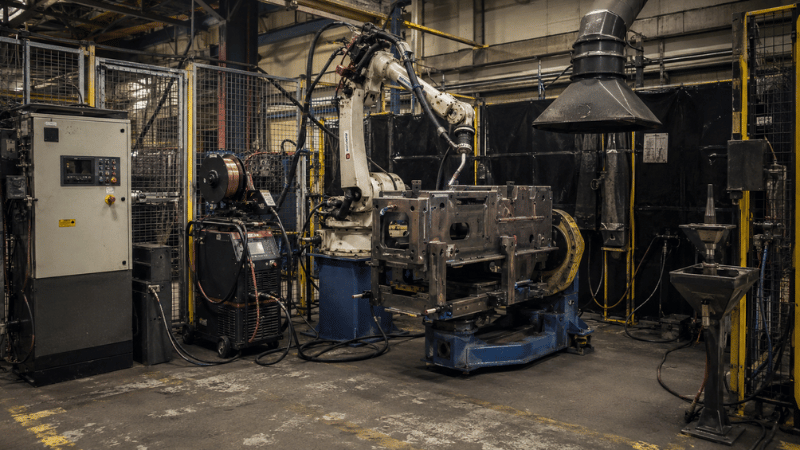
The robot is only one component. A complete robotic welding cell normally includes a controller, power source, wire feeder, torch, fixtures, positioners, sensors, safety guarding, PLC, HMI, fume extraction, and inspection equipment.
The distinction is simple:
- The robot moves the welding tool.
- The cell is the physical production area.
- The system includes engineering, programming, documentation, training, and support.
Common automated processes include MIG/MAG, TIG, plasma, resistance spot welding, and laser welding. The American Welding Society provides technical guidance on processes such as gas metal arc welding.
Fixed automation may suit one simple, unchanging seam. An industrial welding robot offers greater flexibility for multiple weld locations, part orientations, and product recipes.
Is Your Application Suitable for Robotic Welding?
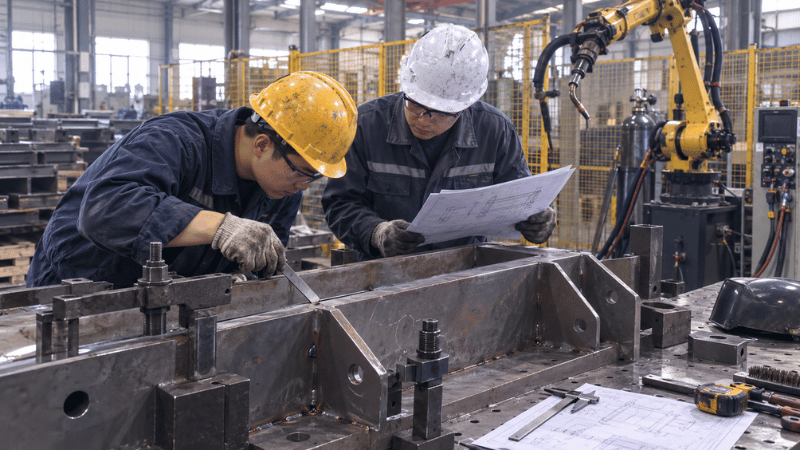
Start with the part, not the robot brochure. Payload charts cannot rescue inconsistent components.
Strong candidates have repeatable dimensions, stable fit-up, accessible joints, controlled materials, and recurring demand. Large gaps, misplaced tack welds, warped parts, or inconsistent preparation will make even a premium robot produce reliably poor results.
Score these six factors from one to five:
| Factor | Low Score | High Score |
|---|---|---|
| Part repeatability | Dimensions vary | Parts locate consistently |
| Weld accessibility | Restricted joints | Clear torch access |
| Production volume | Irregular batches | Stable recurring demand |
| Process stability | Frequent adjustment | Proven procedure |
| Tooling complexity | Difficult clamping | Simple location |
| Changeovers | Frequent manual work | Fast recipe changes |
An average above four indicates a strong candidate. Three to four suggests automation is feasible after tooling or process improvements. Below three means the application needs more development.
In many feasibility reviews, fixture design matters more than robot accuracy. A robot may repeat its path perfectly, but it cannot guarantee that a loosely positioned part is in the correct place.
Provide drawings, CAD models, weld symbols, sample parts, cycle times, defect records, and production volumes. Better input produces a better concept—and fewer expensive surprises later.
Choose the Right Robotic Welding Cell
Pre-engineered cells suit standard parts, modest customization, and faster deployment. They usually cost less to engineer but offer less flexibility.
A custom automated welding system is better for complex geometry, coordinated positioners, multiple fixtures, automatic loading, inspection, or integration with an existing line.
Cobot welding systems can support high-mix, lower-volume production and are often easier to redeploy. However, they may provide lower speed, reach, payload, and duty-cycle capacity than industrial robots.
“Collaborative” also does not mean “hazard-free.” Welding still introduces arc radiation, fumes, hot metal, and dangerous tooling, so a complete risk assessment remains essential.
For higher-volume production, an industrial robot generally delivers greater speed and continuous-duty capability. Multi-station cells can also let an operator unload one fixture while the robot welds another.
For an example of customized production integration, review the iKratz Body Side Welding Line Integration, which combines robotic welding, fixtures, transfer systems, controls, safety, and commissioning.
What a Complete Welding Cell Includes
Core equipment includes the robot, controller, power source, wire feeder, torch, and consumables. Yet these headline components rarely determine project success by themselves.
Robotic welding fixtures locate the part, resist movement, control distortion, and preserve torch access. Positioners rotate the workpiece into more favorable welding orientations.
Touch sensing can locate joints before welding. Seam tracking can compensate for controlled variation, while vision may support joint detection or inspection.
These technologies help, but they are not magic. Seam tracking cannot repair severe fit-up problems or redesign an inaccessible joint while everyone is at lunch.
Safety equipment may include guarding, interlocked doors, scanners, light curtains, emergency stops, and safety PLCs. ISO 10218-2 addresses the safety of industrial robot applications and robot cells.
Supporting equipment may include torch cleaning, anti-spatter systems, wire cutters, fume extraction, calibration tools, and production-data collection.
Always compare system-level performance, not just component brands.
Define Requirements Before Requesting a Quote
A useful RFQ should describe the production problem, not merely request “one welding robot.”
Include annual volume, batch size, shifts, current cycle time, labor, scrap, rework, and expected growth. Provide CAD files, drawings, weld symbols, materials, sample parts, and inspection requirements.
Facility data also matters: floor space, power, gas, compressed air, ventilation, network access, and loading routes.
Your RFQ should define cycle-time targets, product families, weld-quality criteria, FAT and SAT conditions, training, documentation, spare parts, warranty, and service responsibilities.
Clear acceptance criteria protect both buyer and supplier. Without them, “the machine works” can become a surprisingly philosophical argument.
From 35% Leak-Test Failures to a Stable Aluminum Tray Line
A Jiangsu renewable-energy plant replaced a weak robot-and-fixture setup with an integrated iKratz Aluminum Robotic Welding Cell.
Severe Warping
Weak fixturing allowed over 5 mm of distortion, making trays impossible to assemble.
Leak-Test Failures
Poor waveform control created spatter and porosity, causing a 35% failure rate.
💸 Financial Toll
⚙️ The iKratz Fix
Rigid Fixturing
Multi-point pneumatic clamps cut deformation to below 0.5 mm.
Low-Heat Pulse MIG
Digital pulse control reduced heat, spatter, and internal porosity.
Dual-Station Table
Parallel loading and welding pushed utilization above 80%.
Robotic Welding Cell Cost
There is no honest universal price for a robotic welding cell. Cost depends on the process, robot size, tooling, sensors, positioners, safety design, controls, engineering, installation, and support.
Tooling is frequently underestimated. Several product families may require multiple fixtures, quick-change tooling, automated clamps, sensors, and additional programming.
Lifecycle costs matter too. Include consumables, maintenance, spare parts, software updates, training, and future fixture modifications.
A practical budget separates:
- Robot and welding equipment
- Fixtures and positioners
- Sensors, controls, and safety
- Engineering and programming
- Installation and facility preparation
- Validation and training
- Contingency
This structure makes quotations easier to compare and exposes exclusions before they become change orders.
How to Calculate Robotic Welding ROI
Begin with measured current-state data: labor per part, arc-on time, total cycle time, throughput, rework, scrap, overtime, and downtime.
Then model the automated state using realistic cycle time, staffing, uptime, loading, maintenance, and changeover assumptions.
Simple Payback = Total Project Investment ÷ Annual Net Benefit
Benefits may include lower labor, increased capacity, reduced rework, less grinding, improved delivery performance, and better traceability.
Do not calculate output using theoretical robot speed. Use at least three utilization scenarios:
- Conservative: 55–65%
- Expected: 70–80%
- Optimized: 85% or higher
These are planning scenarios, not guarantees. Real utilization depends on loading, part supply, maintenance, alarms, and changeovers.
This utilization-adjusted ROI is more credible than assuming continuous welding. Robots do not take coffee breaks, but upstream processes often do.
NIST notes that manufacturing automation can improve throughput and capacity, while downtime and equipment degradation reduce output. Its robotics and manufacturing automation resources provide broader implementation guidance.
For more selection and ROI context, see the iKratz welding automation systems buyer’s guide.
How to Evaluate a Welding Automation Integrator
The best welding automation integrator is not automatically the company offering the lowest robot price.
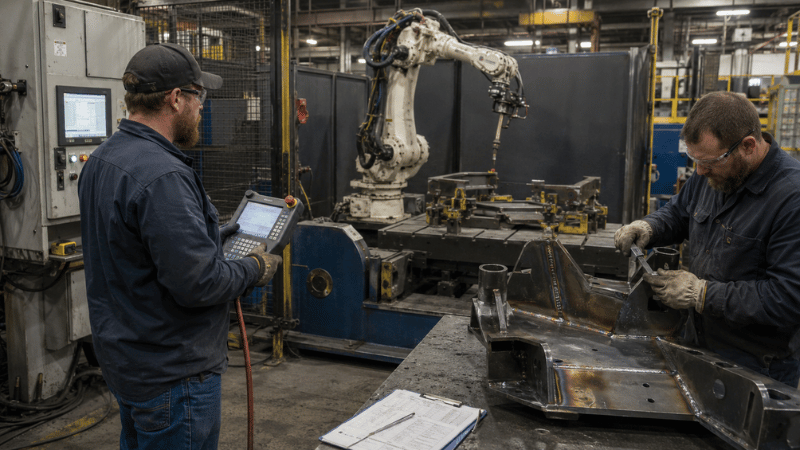
Look for welding-process expertise, fixture engineering, robot and PLC programming, safety engineering, validation, and production support. Ask for projects involving similar materials, joint types, component sizes, processes, and output targets.
A strong proposal should define:
- Equipment, tooling, and exclusions
- Fit-up and part-tolerance assumptions
- Cycle-time and loading assumptions
- Safety responsibilities
- FAT and SAT procedures
- Training, warranty, and service
Red flags include vague fixture scope, guaranteed cycle times without assumptions, missing acceptance standards, and unclear safety responsibility.
NIST also recommends assessing whether the manufacturer has enough internal expertise and project ownership to manage implementation successfully.
Implementation Risks and First 90-Day Metrics
A typical project moves through feasibility, engineering, build, programming, factory testing, installation, training, and ramp-up.
Common delays include late sample parts, incomplete specifications, fixture revisions, missing utilities, and long-lead components. Assigning an internal project owner early prevents decisions from disappearing into endless group emails.
During the first 90 days, track uptime, cycle time, arc-on time, defects, alarms, changeovers, consumable use, and operator interventions.
These metrics show whether lost output comes from tooling, welding parameters, loading, maintenance, or upstream production.
Conclusion
Choosing a robotic welding system begins with repeatable parts, stable fit-up, accessible welds, realistic production targets, and a documented business case. Select fixtures, positioners, sensors, safety equipment, and controls around the application before comparing robot brands.
Successful projects evaluate complete cells, calculate ROI using realistic utilization, and choose an integrator with strong welding and validation capabilities. Explore iKratz for intelligent welding equipment and turnkey automation solutions built around real production requirements.
Build a Welding System Around Your Production
Your factory does not need a generic robot package. It needs a system engineered around your parts, weld standards, cycle-time goals, facility conditions, and future production plans. iKratz combines welding expertise, customized tooling, intelligent controls, validation, and technical support to reduce implementation risk.
Send your drawings, materials, weld requirements, annual volume, and production targets for an application-focused feasibility review. Contact iKratz today to discuss your robotic welding project.
Frequently Asked Questions
1. How do I know whether my parts are suitable for robotic welding?
Suitable parts have repeatable dimensions, stable fit-up, accessible joints, consistent materials, and enough recurring demand. A feasibility review should also examine distortion, tooling, changeovers, and upstream variation.
2. How much does a robotic welding cell cost?
Cost depends on the robot, welding process, fixtures, sensors, safety system, engineering, installation, testing, and support. Compare quotations using identical scope and acceptance criteria.
3. Is a cobot welding system safer than an industrial robot?
A cobot may include force and speed-limiting functions, but the complete welding application still requires a risk assessment because arc radiation, fumes, hot components, and tooling create additional hazards.
4. What should I look for in a welding automation integrator?
Prioritize welding expertise, fixture and controls capability, safety engineering, relevant experience, measurable acceptance testing, documentation, training, spare-parts support, and dependable after-sales service