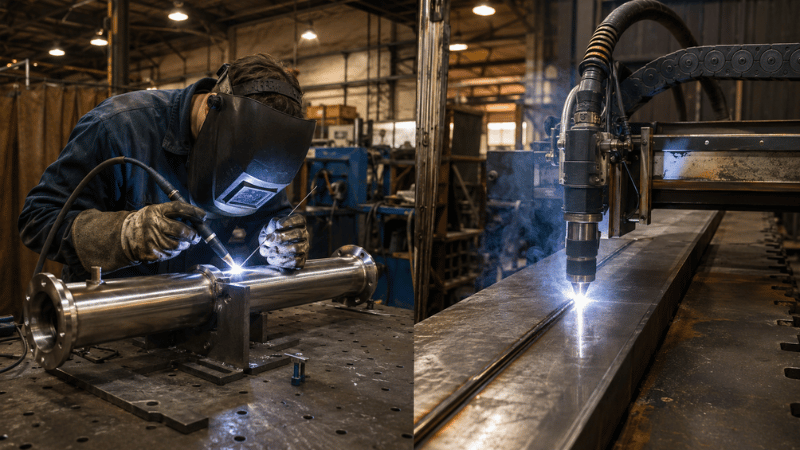
Choosing between plasma welding vs. TIG welding is not about finding one universal winner. TIG offers flexibility and precise operator control, while plasma provides a concentrated arc with strong automation potential.
The right process depends on material, joint geometry, fit-up, production volume, and quality requirements. The weld—not the brochure—gets the final vote.
Plasma Welding vs. TIG Welding at a Glance
Both processes use a non-consumable tungsten electrode and shielding gas. The main difference is that plasma welding forces the arc through a constricting nozzle, creating a narrower, more concentrated heat source.
TIG vs Plasma Welding
A quick comparison of arc behavior, control, speed, and application fit.
| Factor | TIG Welding | Plasma Welding |
|---|---|---|
| Arc shape | Wider and softer | Narrow and concentrated |
| Penetration | Highly controllable | Deeper potential |
| Travel speed | Usually slower | Often faster |
| Thin-material control | Excellent | Excellent in microplasma mode |
| Gap tolerance | More forgiving | Requires controlled fit-up |
| Equipment complexity | Lower | Higher |
| Manual flexibility | Excellent | Limited |
| Automation potential | Strong | Very strong |
| Best fit | High-mix production | Repeatable precision seams |
Choose TIG for changing joints, repair work, low-volume fabrication, and applications requiring manual flexibility.
Evaluate orbital TIG welding for repeatable tube and pipe joints. Consider plasma when deeper penetration, higher speed, or automation can reduce production cost.

How TIG Welding Works
TIG, also called GTAW, creates an arc between a tungsten electrode and the workpiece. Shielding gas protects the molten pool, while filler wire may be added separately.
The American Welding Society identifies TIG as a process known for clean, precise welds. Its greatest strength is fine control of heat and weld-pool movement, especially on stainless steel, aluminum, titanium, and nickel alloys.
TIG can be manual, mechanized, robotic, or orbital. That flexibility makes it suitable for manufacturers handling multiple materials and frequently changing part designs.
Its main limitations are slower travel speed and operator dependence. Torch angle, arc length, filler timing, and fatigue can all influence quality.
Best TIG Applications
TIG is often the better choice for prototypes, repairs, complex joints, low-volume precision parts, and work requiring excellent appearance or controlled heat input.
How Plasma Arc Welding Works
Plasma welding also uses a tungsten electrode, but the arc passes through a precision nozzle before reaching the workpiece. This constriction increases energy density and creates a more directional arc.
Plasma normally operates in three modes:
- Microplasma for thin or delicate parts
- Melt-in plasma for controlled fusion
- Keyhole plasma for deeper penetration
The main advantages are concentrated energy, faster travel, and stable mechanized operation. However, plasma systems require more complex gas control, cooling, torch maintenance, and nozzle management.
Automatic plasma welding is often suitable for longitudinal seams, cylindrical parts, vessels, bellows, strips, and repeatable autogenous joints.
Manufacturers exploring these applications can review iKratz automatic welding equipment.
Technical Differences That Matter in Production
Penetration and Arc Control
Plasma can deliver deeper penetration because its arc is more concentrated. TIG spreads energy across a wider area but provides excellent control.
However, maximum depth is not always the real goal. Production engineers usually need repeatable penetration within an approved range.
Material thickness, joint preparation, torch position, shielding, and filler use can all affect results. Published capability ranges should therefore be treated as starting points, not guarantees.
Speed and Total Cycle Time
Plasma often has a higher arc-on travel speed, but welding speed alone does not determine productivity.
A useful comparison must also include loading, clamping, purging, cooling, unloading, inspection, rework, and downtime.
The better metric is cost per accepted part. A process that welds faster but creates more rejected parts may cost more overall.
Fit-Up and Joint Preparation
Plasma performs best when root gap, alignment, joint location, and surface condition are repeatable.
TIG is often more tolerant because an operator can adjust during welding. However, depending on manual correction is not the same as having a stable production process.
Before automating either process, check cutting, forming, machining, cleaning, and fixture accuracy. A welding machine cannot rescue inconsistent upstream parts forever.
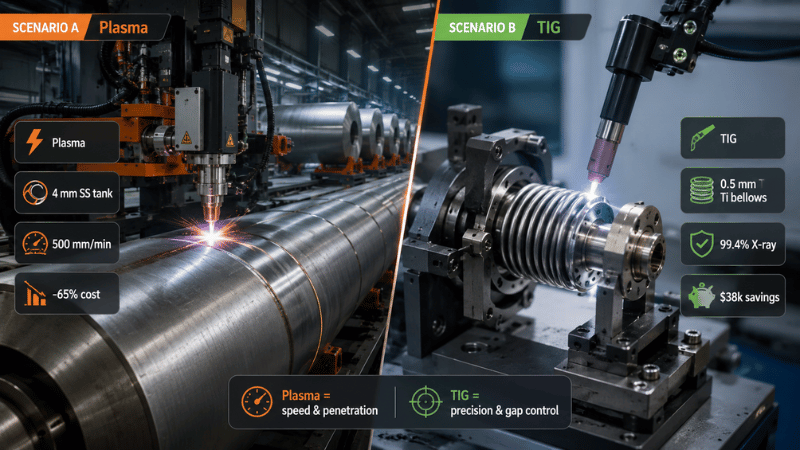
Two Processes, Two Different Wins
iKratz matched each process to the joint and production target.
4 mm Stainless Tank Seams
High-volume welding of 304 stainless tank shells.
MWZF-2000 with keyhole Plasma Arc Welding.
Single-pass penetration, no beveling, and nearly 3× TIG speed.
0.5 mm Titanium Bellows
Titanium bellows with 0.1–0.2 mm gaps.
MWA-200 with precision automated TIG.
Pulsed TIG bridged gaps with zero burn-through.
What Is Orbital TIG Welding?
Orbital TIG uses a programmed weld head to move the TIG electrode around a stationary tube or pipe.
A typical system includes a programmable power source, weld head, cooling unit, gas controls, and optional wire feeding or data logging.
It is widely used for semiconductor tubing, pharmaceutical piping, sanitary systems, aerospace assemblies, and high-purity pipework.
Orbital TIG works best when tube ends are square, clean, aligned, and consistently prepared. Poor preparation remains poor preparation, even with expensive equipment attached.
For industrial pipe applications, the MWG-230 orbital welding head supports repeatable, programmed welding.
TIG, Orbital TIG, or Plasma?
For thin precision parts, compare conventional TIG with microplasma. TIG offers strong flexibility, while microplasma can provide better low-current arc stability during mechanized welding.
For tube and pipe joints, orbital TIG is usually the main benchmark because of its established weld heads, purge control, and recipe-based operation.
For long straight seams, compare mechanized TIG with automatic plasma. Plasma may offer a stronger business case when deeper penetration and faster travel produce measurable savings.
High-mix production generally favors TIG. High-volume production often favors automation—provided the parts, fixtures, and inspection requirements are stable.
Calculate Cost per Accepted Part
Capital investment is only part of the equation. A complete comparison should include equipment, tooling, installation, training, labor, gas, consumables, maintenance, inspection, scrap, and rework.
A practical formula is:
Cost per accepted part = total production cost ÷ conforming parts produced
This calculation prevents a fast but unstable process from appearing artificially attractive.
Qualification costs must also be included for regulated work. ASME BPVC Section IX covers welding procedure and personnel qualification requirements.
A Practical Selection Method
Start by defining the non-negotiable requirements:
- Material and thickness
- Joint geometry
- Penetration
- Distortion limits
- Production volume
- Applicable quality standard
Then compare TIG, orbital TIG, and plasma for speed, gap tolerance, automation maturity, investment, maintenance, and qualification risk.
Weight each factor according to the application. High-mix production should emphasize flexibility. High-volume production should emphasize cycle time, labor, tooling, and yield.
Finally, confirm the decision through weld trials using real production parts.
The AWS A3.0M/A3.0 terminology standard can also help ensure procedures and specifications use consistent welding terminology.
What to Include in a Weld Trial
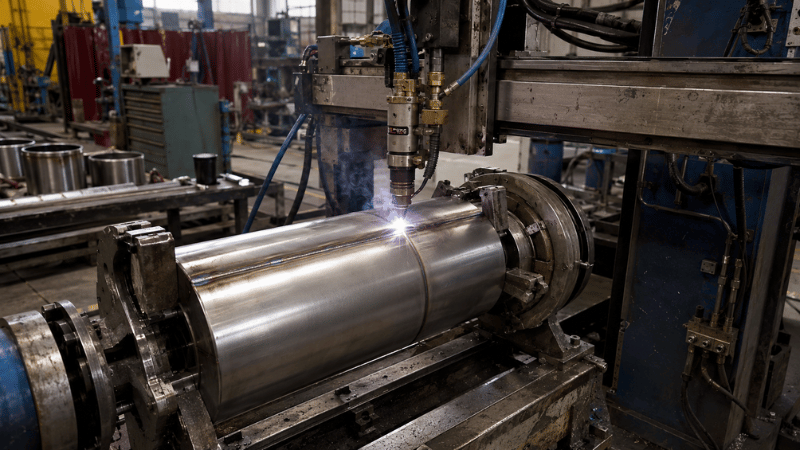
Provide representative material, thickness range, joint drawings, production tolerances, weld length, annual volume, current defects, and acceptance criteria.
Do not test only perfect laboratory samples when actual production parts are warped, oily, or slightly misaligned. Use realistic worst-case components.
Request weld photos, cross-sections, parameter records, inspection results, cycle-time data, and a recommended system configuration.
A successful sample weld is encouraging. A documented production window is what actually pays the bills.
Conclusion
In the plasma welding vs. TIG welding comparison, TIG generally wins on flexibility, process familiarity, and changing production requirements.
Orbital TIG is a proven option for repeatable tube and pipe joints, while plasma becomes attractive when concentrated penetration, speed, and automation reduce cost per accepted part.
The best approach is to shortlist the processes, then confirm the final choice through representative weld trials.
Build a Welding Process Around Your Production
iKratz develops orbital welding and industrial automation solutions based on actual materials, joints, production targets, and quality requirements. Explore iKratz welding solutions to see how programmable systems, engineered fixtures, and application support can improve consistency.
Send your material details, joint drawing, production volume, and acceptance criteria. Contact iKratz today to discuss a weld trial or application review.
FAQs
Is plasma welding better than TIG welding?
Plasma may be better for repeatable seams requiring speed, concentrated penetration, or automation. TIG may be better for changing joints, repairs, and lower-volume production.
What is the difference between orbital TIG and automatic plasma welding?
Orbital TIG moves a TIG electrode around a tube or pipe. Automatic plasma welding uses a constricted plasma arc with linear, rotary, robotic, or customized motion.
Can plasma welding reduce distortion?
It may reduce the width of the heated zone and shorten welding time. Actual distortion still depends on material, thickness, restraint, joint design, and parameters.
When does welding automation justify its cost?
Automation is easier to justify when parts are repeatable, annual volume is sufficient, and labor, rework, cycle time, or operator variation creates measurable cost.