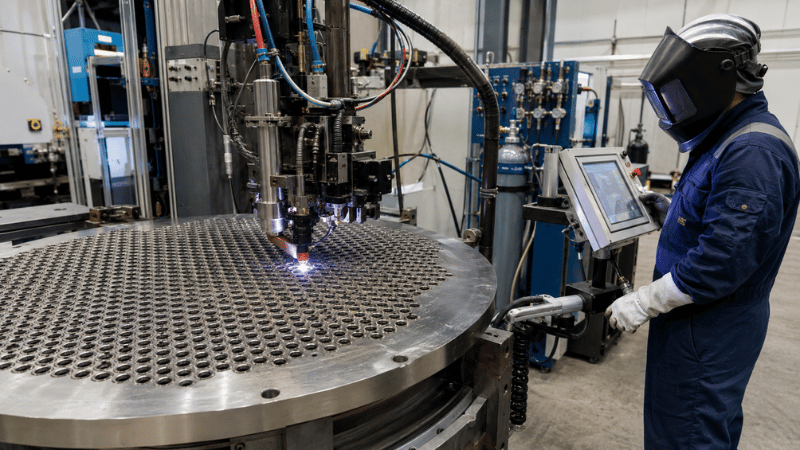
A tube sheet welding machine automates one of the most repetitive—and least forgiving—jobs in heat exchanger fabrication. It controls the circular weld joining each tube to the tubesheet, helping manufacturers improve consistency, productivity, and process traceability.
But buying one based only on tube diameter is a little like choosing a truck by tire size. Joint geometry, materials, tube pitch, production volume, access, and inspection requirements all matter.
What Is a Tube Sheet Welding Machine?
A tube sheet welding machine is specialized equipment used for tube-to-tubesheet welding in heat exchangers, condensers, boilers, evaporators, and pressure vessels.
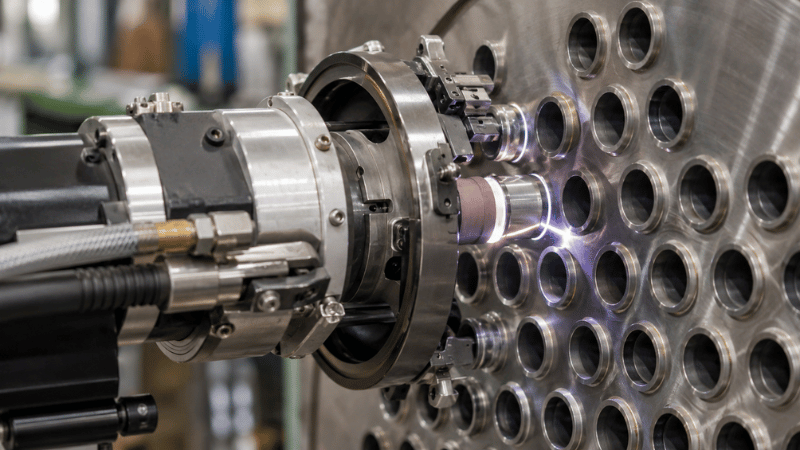
Most systems use the gas tungsten arc welding process, also called TIG or GTAW. The welding head rotates around the tube while the controller manages current, travel speed, shielding gas, arc timing, and optional filler-wire feeding.
The goal is not merely to make the torch go in a circle. The machine must repeat that circle hundreds—or thousands—of times without allowing penetration, oxidation, or bead shape to wander off for a coffee break.
These systems are best suited to repetitive, quality-critical production. For occasional repair jobs with irregular joint geometry, a portable welding head or qualified manual process may be more practical.
How Automatic Tube-to-Tubesheet Welding Works
The process begins long before arc ignition. Tube ends must be cut, cleaned, positioned, and projected from the tubesheet according to the approved joint design.
The operator then aligns the welding head with the tube center, confirms torch clearance, selects the stored welding program, and starts shielding-gas flow. The machine ignites the arc and rotates the torch according to programmed parameters.
A typical automatic tube welding program controls:
- Welding and background current
- Pulse frequency and balance
- Rotation speed
- Arc length or torch position
- Shielding-gas pre-flow and post-flow
- Wire-feed speed, when filler is required
- Start overlap, downslope, and crater filling
Autogenous TIG welding melts the tube and tubesheet without filler wire. It is clean and efficient when joint fit-up and metallurgy allow it.
Wire-fed TIG adds filler metal for joints requiring additional reinforcement, gap tolerance, or metallurgical control. It adds process variables, but sometimes those variables are exactly what keep the weld procedure out of trouble.
For a deeper explanation of controlled circular welding, see this guide to orbital welding principles and applications.
Main Types of Tube Sheet Welding Machines
Rack-Type Welding Machines
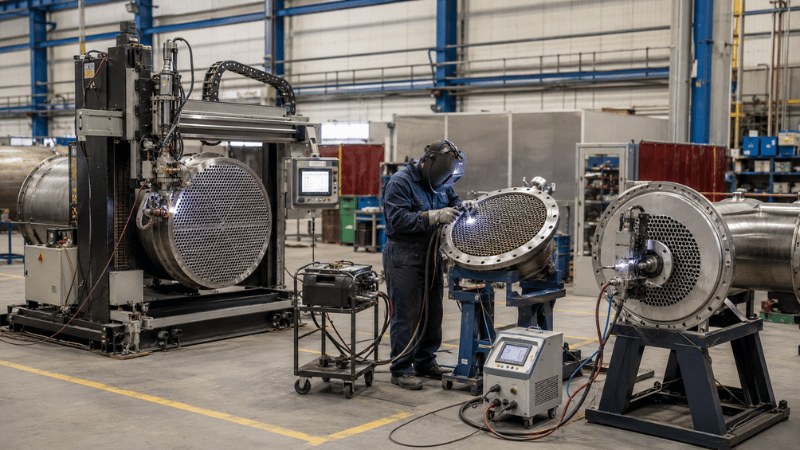
A rack-type system supports and positions the welding equipment on a rigid structure in front of the tubesheet. It is generally the strongest option for high tube counts, standardized products, and repetitive factory production.
Stable positioning reduces operator fatigue and makes movement between tubes more predictable. Depending on the configuration, the rack may support automatic indexing, programmable positioning, or multiple welding heads.
Its disadvantages are a larger footprint, more complex installation, and less enthusiasm for surprise production changes. Rack systems love repeatability. Give them a different tubesheet every afternoon, and the tooling department may begin sending strongly worded emails.
The MWP-65C automatic tube sheet welding machine is an example of a full-position system developed for heat exchangers, condensers, and pressure-vessel applications.
Portable Welding Heads
Portable heads are compact and can be moved manually from tube to tube. They are useful for maintenance, field installation, smaller batches, and factories producing a wide variety of tubesheets.
They require less floor space and can adapt more easily to unusual workpieces. However, productivity and consistency depend more heavily on accurate manual positioning.
A portable machine does not automatically mean an uncontrolled process. It simply means that alignment and sequencing remain more dependent on the operator.
Orbital Tube Welding Systems
An orbital system rotates the electrode around a stationary tube joint. For tube-to-tubesheet work, this provides repeatable circular travel and precise coordination of current, speed, gas, and filler wire.
Orbital tube welding machines are particularly valuable when weld consistency, controlled heat input, and digital parameter storage matter more than brute-force deposition rate.
Tooling access remains a key limitation. The head must fit between adjacent tubes, and the torch must maintain the required angle without colliding with the tubesheet or nearby tube ends.
Single-Head and Multi-Head Systems
Single-head machines are simpler to program, maintain, and change over. Multi-head systems can increase throughput when tubesheets are standardized and production volume justifies the added complexity.
Do not assume that two heads automatically double output. Indexing time, operator loading, gas management, inspection capacity, and fixture access may become the new bottlenecks.
A faster welding machine connected to a slow material-handling process is simply a very expensive machine waiting patiently.
Rack-Type vs. Portable vs. Orbital Systems
A rack-type machine is usually preferred for high-volume production with consistent tubesheet dimensions. Its rigid structure supports repeatable positioning and greater automation.
A portable head is more suitable for repair work, low-to-medium production, large workpieces that cannot easily be moved, or factories with frequent product changes.
An orbital configuration should be prioritized when controlled circular travel, programmable parameters, and weld-to-weld repeatability are central quality requirements.
In practice, these categories overlap. A rack-type machine may use an orbital welding head, while a portable unit may still provide highly advanced digital control.
The better question is not, “Which label sounds most automated?” It is, “Which configuration controls the variables that create defects in our actual joint?”
How to Choose the Right Tube Sheet Welding Machine
Start With Tube and Tubesheet Dimensions
Record the tube outside diameter, wall thickness, tube pitch, projection, tubesheet thickness, and hole pattern.
Tube diameter determines basic tooling compatibility, but pitch often decides whether the welding head can physically access the joint. Two machines may both cover a 25 mm tube, yet only one may fit between tightly spaced neighboring tubes.
The supplier should review a detailed tubesheet drawing rather than relying on a diameter range copied into an email.
Define the Joint Geometry
Tube-to-tubesheet joints may be flush, projected, recessed, expanded-and-welded, or seal-welded. Each geometry changes electrode position, heat flow, filler requirements, and accessibility.
Even a small variation in tube projection can affect arc length and penetration consistency. For this reason, tube preparation and expansion processes must be considered part of welding-machine selection—not someone else’s problem three departments away.
Confirm Material Compatibility
Common combinations include carbon steel, stainless steel, titanium, nickel alloys, and dissimilar metals.
Material choice affects current range, shielding requirements, heat-input tolerance, filler selection, and cooling needs. Titanium, for example, is extremely sensitive to atmospheric contamination at elevated temperatures and therefore demands excellent shielding control.
The machine supplier should develop parameters using the actual material grades whenever possible, not a vaguely similar sample pulled from the corner of the workshop.
Calculate Real Production Requirements
Define the number of tubes per shift, desired cycle time, product mix, changeover frequency, and expected equipment utilization.
A factory welding 3,000 identical joints per week has different priorities from a job shop processing five tubesheet designs in the same period.
For high-volume lines, automatic indexing and recipe management may justify additional investment. For mixed production, fast tooling changeover and flexible programming may generate more value than maximum theoretical speed.
Specify Quality and Documentation Needs
Determine the required penetration, bead profile, leak-testing method, inspection standard, and parameter-recording requirements.
ASME BPVC Section IX contains rules related to qualification of welding procedures and personnel. A machine does not replace procedure qualification; it executes the qualified process more consistently. Review the official ASME Section IX overview when defining project requirements.
For broader welding-quality controls, ISO 3834-1 outlines criteria for selecting an appropriate level of quality requirements for fusion welding.
A Practical Machine Selection Scorecard
Instead of comparing glossy brochures, score each proposed machine from one to five in these areas:
Orbital Welding System Selection Weighting
Prioritize application fit, repeatability, and production performance.
| Selection Factor | Suggested Weight |
|---|---|
| Joint and application compatibility |
25%
|
| Parameter control and repeatability |
20%
|
| Production capacity |
15%
|
| Tube-size and material coverage |
15%
|
| Tooling and changeover flexibility |
10%
|
| Data recording and traceability |
5%
|
| Service, training, and spare parts |
10%
|
Adjust the weightings according to your project. A high-volume factory may increase the production-capacity score, while a multi-product manufacturer should give more weight to tooling flexibility.
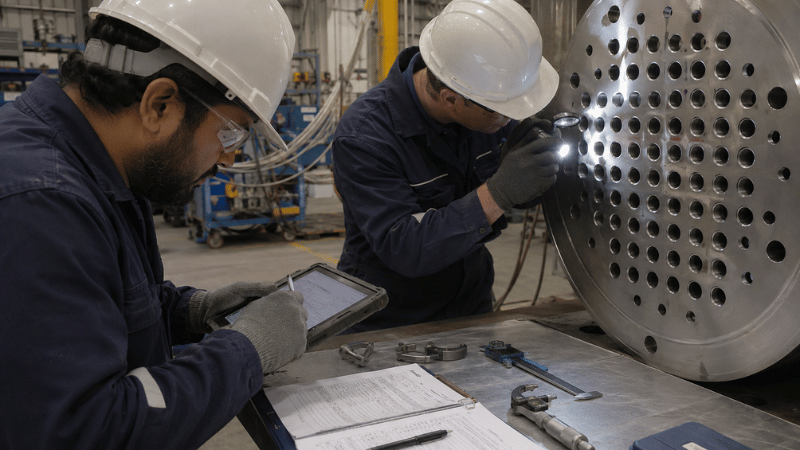
The scoring sheet is useful, but a sample welding trial is the final referee. Test the shortlisted machine using your tube material, tubesheet material, joint dimensions, and acceptance criteria.
Inspect bead uniformity, penetration, discoloration, oxidation, porosity, cycle time, and repeatability across multiple joints. One attractive sample proves that a machine can make one attractive sample. A controlled series proves far more.
Common Tube-to-Tubesheet Welding Defects
Porosity
Porosity is commonly associated with contamination, inadequate shielding, moisture, or poor gas delivery.
Clean the joint area, check gas hoses and fittings, verify flow, and prevent shop drafts from disrupting the shielding envelope. Turning up gas flow without diagnosis can create turbulence and make the situation worse.
Lack of Fusion
Lack of fusion may result from insufficient current, excessive rotation speed, incorrect torch angle, poor alignment, or inconsistent joint fit-up.
Review the entire heat-input relationship rather than changing amperage alone. Current and travel speed are dance partners; adjusting one while ignoring the other usually steps on somebody’s toes.
Burn-Through
Burn-through is more likely with thin-wall tubes, excessive heat input, incorrect tube projection, or delayed travel.
Reduce peak energy, review pulse settings, and confirm that the selected recipe matches the actual wall thickness.
Oxidation and Discoloration
Poor gas coverage, inadequate post-flow, contamination, or an overheated joint can cause discoloration.
The acceptable level depends on the material and service requirements. Cosmetic appearance alone should not be used as the entire quality standard, but severe oxidation is not merely a fashion issue.
Inconsistent Penetration
Variation in tube projection, electrode condition, arc length, alignment, or electrical contact can produce inconsistent penetration even when the program remains unchanged.
This is why repeatable upstream preparation matters. Automation repeats the process it receives—including the bad parts.
Verify These Details Before Production
Before production release, confirm tooling fit, electrode position, torch clearance, cooling performance, gas coverage, stored recipes, and inspection criteria.
Run trial welds at different tubesheet locations. Center joints may behave differently from edge joints because access, heat distribution, or positioning changes.
Operators should be trained to recognize abnormal arc behavior rather than simply pressing the start button. Parameter locking can prevent accidental changes, but trained personnel still need to understand what a healthy process looks and sounds like.
Welding also introduces fumes, ultraviolet radiation, burns, electrical hazards, and other risks. The official OSHA welding safety resources summarize common hazards and control measures.
Productivity, Cost, and ROI
The purchase price is only one part of the investment. Include tooling, power supply, cooling equipment, installation, commissioning, training, maintenance, consumables, fixtures, and software customization.
Potential gains include more predictable cycle times, lower rework, faster operator training, improved traceability, and less dependence on scarce manual welding skills.
However, there is no universal payback period. ROI depends on annual tube count, machine utilization, labor cost, current defect rate, inspection expense, and product variety.
For additional context on where automation creates value—and where it does not—read this robotic TIG welding ROI guide.
A realistic ROI calculation should compare current total cost per accepted joint against the projected automated cost per accepted joint. The word “accepted” matters. Producing defective welds faster is not productivity; it is merely accelerated disappointment.
What to Send With Your Quotation Request
An accurate proposal begins with accurate application data. Provide:
- Tubesheet and joint drawings
- Tube and tubesheet material grades
- Tube outside diameter and wall thickness
- Tube pitch, projection, and quantity
- Joint design and expansion details
- Required output per shift
- Welding and inspection requirements
- Available power supply and installation space
- Preferred automation level
- Photos or videos of the current workstation
Material certificates, existing weld samples, current production records, and acceptance-test requirements are also useful.
This information allows the supplier to evaluate head access, tooling, power-source capacity, wire-feed requirements, cooling, and automation options before issuing a quotation. It also reduces the risk of discovering after delivery that the welding head fits everywhere except inside the actual tube pattern.
Frequently Asked Questions
What is the difference between rack-type and portable machines?
A rack-type machine provides stable positioning for repetitive factory production and can support higher levels of automation. A portable machine is easier to move and better suited to repair work, large stationary workpieces, changing job locations, or lower-volume production.
Which process is commonly used for tube-to-tubesheet welding?
TIG or GTAW is widely used because it provides precise control of heat input and bead formation. Depending on the joint and material, the process may be autogenous, wire-fed, pulsed, or performed with an orbital welding head.
Can one machine weld different tube materials?
Many systems can support several materials, but each material and joint combination requires suitable tooling, shielding, power-source capacity, filler selection, and qualified parameters. Compatibility should be confirmed through an application review and sample trial.
Conclusion
The right tube sheet welding machine depends on joint geometry, tube pitch, materials, production targets, accessibility, and inspection requirements—not one headline specification.
Rack-type systems generally suit standardized, high-volume production, while portable and orbital configurations provide different balances of flexibility and control. Whatever the configuration, the most reliable validation method is a documented sample-welding trial using actual project materials.
Build a Welding System Around Your Application
iKratz helps heat exchanger manufacturers evaluate joint geometry, tube dimensions, materials, production targets, and quality requirements before recommending equipment. This application-first approach gives buyers a configuration based on real manufacturing conditions rather than a machine selected from a catalog checkbox.
Send your tubesheet drawing and production requirements to request a sample-welding plan and customized technical proposal. Contact iKratz today to discuss your application.