Searching for an orbital welder for sale sounds simple—until you realize you’re buying far more than a machine. You’re buying repeatability, weld quality, documentation, training needs, tooling, and purge control.
This guide helps industrial buyers compare every orbital welding machine factor before requesting a quote.
Why Industrial Buyers Search for an Orbital Welder for Sale
Most buyers start with price. Fair enough—procurement departments enjoy predictable numbers, not financial jump scares.
But the better question is: will this machine fit your pipe size, material, wall thickness, weld volume, QA requirements, and operator skill level?
The right orbital welder for sale can improve consistency on repetitive industrial pipe welding projects. The wrong one can become an expensive shop decoration with cables.
Buy vs Rent: Quick Decision Logic
Renting works well for short-term jobs or trial projects. Buying makes sense when weld volume, documentation needs, and quality requirements are recurring.
Who This Guide Is For
This guide is for welding engineers, fabrication managers, procurement teams, QA/QC departments, and industrial contractors.
It is not ideal for hobby welding, low-volume repair work, or applications where manual flexibility matters more than repeatability.
What Competitor Articles Usually Miss
Many articles explain what orbital welding is, then stop. Useful? A little. Enough for a buying decision? Not really.
Industrial buyers also need price ranges, rental logic, weld head selection, purge control, tooling requirements, and quote-readiness guidance. That is where this guide goes deeper.
What Is Orbital Welding?
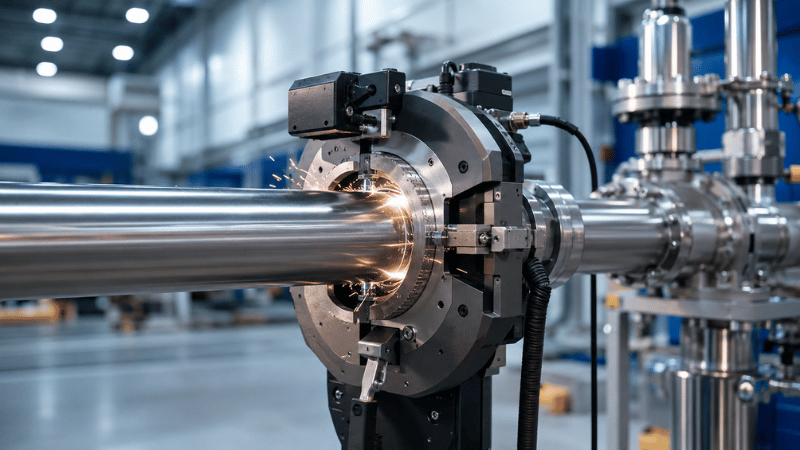
Orbital welding is an automated process where the torch travels around pipe or tube in a controlled circular path. In most pipe and tube applications, it refers to orbital TIG welding, also called orbital GTAW.
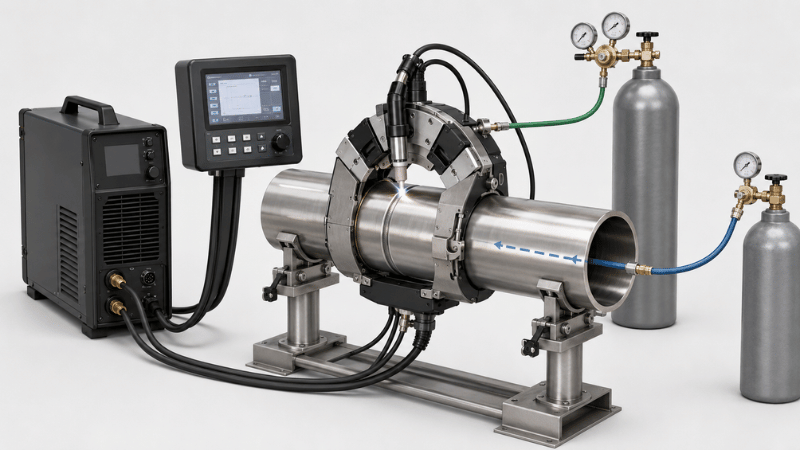
A typical system includes a power supply, weld head, clamp or fixture, shielding gas, purge gas, programmed parameters, and sometimes weld data logging. Swagelok notes that orbital systems control variables such as weld current, electrode speed, shielding gas, and purge gas flow to support consistent weld results.
External reference: Swagelok orbital welding guidance.
Why Gas Shielding and Back Purging Matter
Shielding gas protects the outside weld zone. Back purging protects the inside of the pipe or tube. Poor purge control can cause oxidation, discoloration, porosity, or internal contamination.
For high-purity welding, purge quality is not a side note—it is the difference between a clean weld and an expensive redo.
A useful engineering note: purge flow depends on pipe diameter, gas velocity, and internal geometry. Reynolds Number, Re = ρvD / μ, helps describe whether flow is laminar or turbulent. In plain English: more argon is not always better. Sometimes it just creates expensive chaos.
Common Materials and Pipe Types
Orbital welding is commonly used for stainless steel tubing, sanitary tubing, thin-wall tube, high-purity process piping, and industrial pipe systems.
You will often see it in pharmaceutical, semiconductor, biotech, food and beverage, chemical processing, aerospace, and precision manufacturing environments.

Orbital Welding vs Manual Welding
Manual welding still has its place. A skilled welder can adapt to awkward repairs, variable fit-up, and field surprises.
Orbital welding shines when welds are repetitive, access is tight, documentation matters, and quality must be consistent from joint to joint.
Manual welding may still be better for low weld counts, poor fit-up, unusual repairs, or budget-limited jobs.
When an Orbital Welding Machine Is Worth It
An orbital welding machine becomes attractive when weld volume is high, rework is expensive, trained labor is limited, or documentation is required.
It is especially useful in sanitary piping, cleanroom systems, high-purity lines, and production environments where every weld must meet the same standard.
But here is the honest part: orbital welding does not fix bad preparation. Poor cutting, poor alignment, dirty tube ends, or weak purge control will still cause problems—just more efficiently.
How Much Does an Orbital Welder Cost?
Exact pricing varies by pipe diameter range, weld head type, power supply, documentation needs, condition, accessories, training, and service support.
As a practical range:
Do not compare base machine price only. Total cost may include orbital weld heads, collets, fixtures, purge equipment, cutting and facing tools, oxygen monitoring, training, calibration, maintenance, and spare parts.
Main Types of Orbital Welding Machines
Closed weld heads are commonly used for high-purity tube welding. They surround the tube and create a controlled weld environment, making them ideal for sanitary, biotech, and semiconductor applications.
Open weld heads suit larger pipe sizes or applications requiring filler wire. They offer more flexibility but require careful setup.
Orbital welding power supplies control weld programs, current, travel speed, pulse settings, data logging, and weld schedule repeatability.
Portable systems work well for field use. Shop-based systems usually offer better workflow stability and production control.
How to Choose the Right Orbital Welder for Sale
Start with the pipe or tube—not the brand brochure.
Confirm your outside diameter range, wall thickness, material grade, joint type, weld volume, filler wire requirements, access limits, documentation needs, and purge requirements.
Before requesting a quote, prepare:
| Information Needed | Why It Matters |
|---|---|
| Pipe size range | Confirms weld head fit |
| Material grade | Affects parameters and purge |
| Wall thickness | Determines heat input |
| Weld volume | Supports buy/rent decision |
| Documentation needs | Determines data logging |
| Industry requirements | Affects compliance |
| Jobsite conditions | Affects portability |
The more specific your information, the less likely you are to receive a vague quote that says, politely, “Maybe this works.”
Magnatech, Orbitalum North America, and Other Brands
Brand matters, but application fit matters more. A famous logo cannot compensate for the wrong weld head.
When evaluating a Magnatech orbital welding machine, compare weld head options, power supply features, pipe capability, service availability, parts support, and used-equipment condition.
When reviewing Orbitalum North America, pay attention to the complete tube preparation workflow: cutting, facing, clamping, welding, and documentation.
| Brand Factor | What to Compare |
|---|---|
| Weld heads | Diameter range, closed/open heads |
| Portability | Field or shop use |
| Documentation | Weld logs, program storage |
| Service | Parts, repair, calibration |
| Training | Operator support |
A good supplier asks detailed application questions. A weak supplier only asks how soon you want to buy.
New vs Used vs Rental Orbital Welding Equipment
Buy new when you need warranty support, long-term production, strict QA documentation, or high-purity performance.
Used equipment can make sense for budget-sensitive buyers, lower-volume jobs, backup capacity, or teams able to inspect equipment properly.
Before buying used, check the power supply, weld head wear, cable condition, calibration records, software, accessories, parts availability, and seller support.
Renting is smarter for short projects, trial runs, temporary capacity increases, or uncertain project pipelines.
Outsourcing may be better when you have no trained operators, a tight deadline, critical qualification requirements, or very low weld count.
Orbital Welding Cost Factors and ROI
Machine price is only one part of the cost. ROI often comes from reduced rework, faster repeat welds, lower rejection rates, better QA documentation, and reduced dependence on scarce manual welding labor.
Score your project from 1 to 5 across weld volume, weld criticality, rework cost, documentation needs, operator availability, and project duration. Higher scores usually support buying or long-term rental.
Still, be realistic. ROI depends on fit-up quality, purge control, material, training, project volume, and inspection standards.
Best Applications for Industrial Pipe Orbital Welding
Orbital welding is especially valuable in pharmaceutical and biotech piping, semiconductor gas lines, food and beverage sanitary tubing, chemical processing, energy systems, aerospace assemblies, and precision tube fabrication.
These applications benefit from clean welds, repeatable parameters, and reliable documentation. In regulated or high-purity environments, that consistency is not a luxury—it is the whole point.
External references to support this section may include ASME standards resources, AWS welding guidance, OSHA welding safety information, and manufacturer technical manuals.
Common Buyer Mistakes
The first mistake is buying for price instead of application fit. A cheap system becomes expensive when it cannot handle the real pipe range or QA requirement.
The second mistake is ignoring weld head compatibility. A power supply without the right head is like a truck without tires: technically impressive, practically useless.
Other common mistakes include underestimating training, neglecting pipe preparation, assuming orbital welding fixes poor joint fit-up, overlooking purge gas flow, and forgetting service, calibration, and spare parts.
Safety, Quality, and Compliance
Orbital welding still involves electricity, heat, shielding gas, fumes, and hot work hazards. Operators should follow proper PPE, ventilation, gas handling, and site safety procedures.
For critical projects, confirm whether you need qualified welding procedures, inspection records, oxygen-level control, borescope inspection, or WPS/PQR documentation.
When the project involves regulated systems or critical weld quality, involve a qualified welding engineer, inspector, or procedure specialist. Hope is not a compliance strategy.
How to Request an Orbital Welder Quote
Before contacting a supplier, prepare your pipe OD, wall thickness, material, weld count, joint design, application, documentation needs, jobsite conditions, and purchase preference.
Ask the vendor:
| Question | Why Ask It |
|---|---|
| What pipe sizes are supported? | Confirms fit |
| Which weld heads are compatible? | Avoids mismatch |
| Is training included? | Reduces startup risk |
| Are parts stocked locally? | Supports uptime |
| Is calibration available? | Supports QA |
| Can it log weld data? | Helps documentation |
| What purge setup is recommended? | Protects weld quality |
Red flags include vague compatibility answers, no training, no service support, unclear warranty terms, missing calibration records, or no discussion of purge gas.
FAQs
What is the difference between orbital welding and manual welding?
Orbital welding uses automated torch movement around pipe or tube for repeatable welds. Manual welding relies more on operator hand control, making it more flexible but also more variable.
How much does an orbital welding machine cost?
Used portable systems may start around $8,000–$15,000. Mid-range systems often cost $15,000–$35,000. New high-purity systems can reach $35,000–$60,000+, depending on weld heads, controls, accessories, and support.
Is orbital welding worth it for industrial pipe projects?
Yes, when the project involves high weld volume, strict quality requirements, high-purity piping, tight access, documentation needs, or expensive rework risk.
Can orbital welding replace skilled welders?
No. It changes the skill requirement. Operators still need training in setup, programming, purge control, fit-up, troubleshooting, and inspection. The machine improves repeatability, but skilled people keep the process honest.
Conclusion: Is an Orbital Welder the Right Investment?
An orbital welder for sale is worth serious consideration when your work demands repeatable, high-quality pipe or tube welds—especially in regulated, high-purity, or high-volume environments.
Manual welding still wins for low-volume, repair-heavy, or highly variable work. But when consistency, documentation, and rework reduction matter, the right orbital welding machine can become one of the smartest investments in the shop.
Request an Orbital Welding Machine Recommendation
Choosing the right system should feel less like gambling with capital equipment and more like engineering with good data. Share your pipe size, material, wall thickness, weld volume, QA needs, and application requirements, and our team can help match you with a practical orbital welding machine setup.
Contact us today to request a quote or get a fit-based equipment recommendation.