Carbon steel is strong, affordable, widely available, and only occasionally dramatic. But carbon steel uses vary greatly depending on carbon content, hardness, weldability, heat treatment, and wear resistance.
Choose poorly, and your “cost-saving material” may become a very expensive paperweight.
Quick Summary: Carbon Steel Selection Guide
For most carbon steel uses, the right choice depends on carbon content percentage, hardness, strength, weldability, wear resistance, and processing needs.
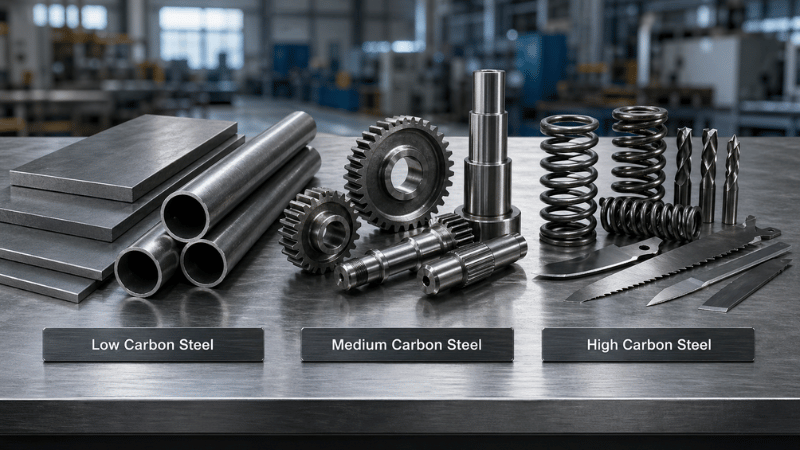
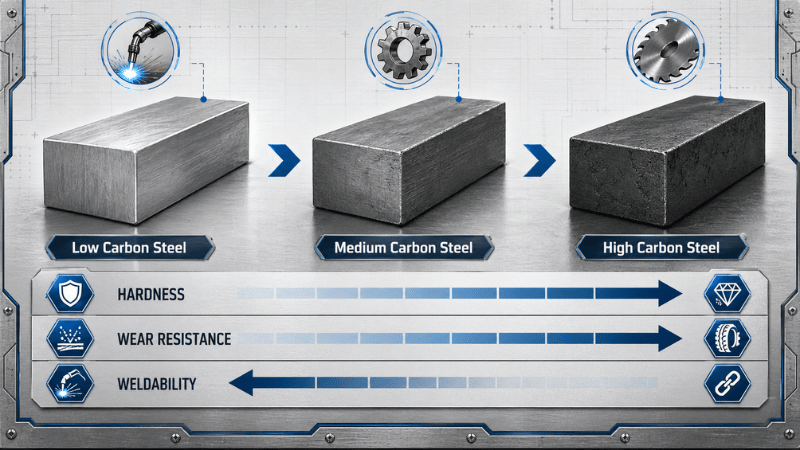
- Low Carbon Steel (<0.25% C): Best for weldability and formability. Used for structural beams, automotive panels, pipes, brackets, frames, and high-volume fabrication.
- Medium Carbon Steel (0.25%–0.60% C): Best for strength and toughness. Used for shafts, axles, gears, crankshafts, couplings, and machinery parts needing quenching and tempering.
- High Carbon Steel (>0.60% C): Best for hardness and wear resistance. Used for cutting tools, blades, springs, high-strength wire, dies, punches, and edge-retention parts.
Carbon Steel Selection Framework
Start with the job, not the grade. A welded frame, rotating shaft, and cutting blade do not want the same steel.
First, define the main goal: strength, hardness, wear resistance, toughness, ductility, weldability, machinability, or cost.
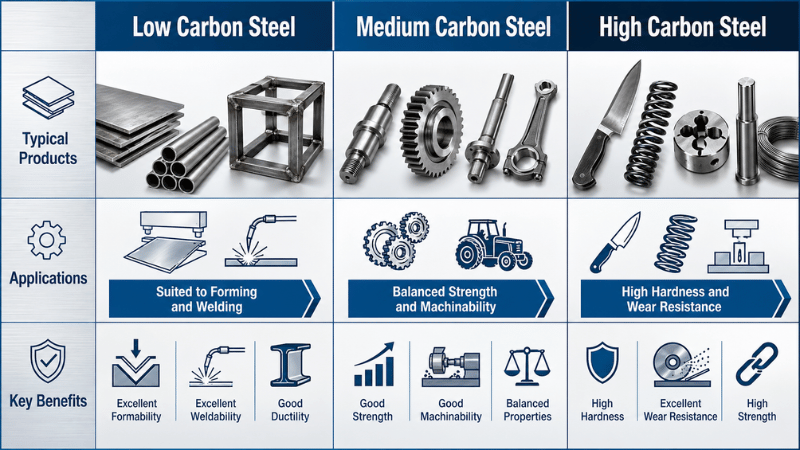
Then choose the steel family. Use low carbon steel for forming and welding, medium carbon steel for strength and toughness, and high carbon steel for hardness and wear resistance.
Next, check welding, machining, forming, heat treatment, coating, and tolerance needs. Finally, confirm the exact steel grade, standard, supplier data, and mill test reports.
Key Technical Metrics Behind Carbon Steel Uses
Carbon Content Percentage
Low carbon steel is commonly under 0.25% carbon. Medium carbon steel is often 0.25%–0.60% carbon. High carbon steel is typically above 0.60% carbon, though exact ranges vary by standard and grade.
As carbon increases, steel gains hardening potential, but usually loses ductility and becomes harder to weld. For more background, see this overview of medium carbon steels.
Hardness: HRC and HB
Rockwell hardness HRC is often used for harder steels and cutting tools. Brinell hardness HB is common for broader industrial steel comparison.
High carbon steel is selected for edge retention, abrasion resistance, and spring performance, which is why it appears in blades, punches, dies, springs, and high-strength wire.
Yield Strength and Tensile Strength
Yield strength shows when steel begins permanent deformation. Tensile strength shows maximum stress before failure. Both are measured in MPa.
AISI 1045, a common medium carbon steel, is used for shafts, gears, axles, and machine components because it balances strength, machinability, and heat-treatment response. See typical AISI 1045 mechanical properties.
Weldability and Fabrication Risk
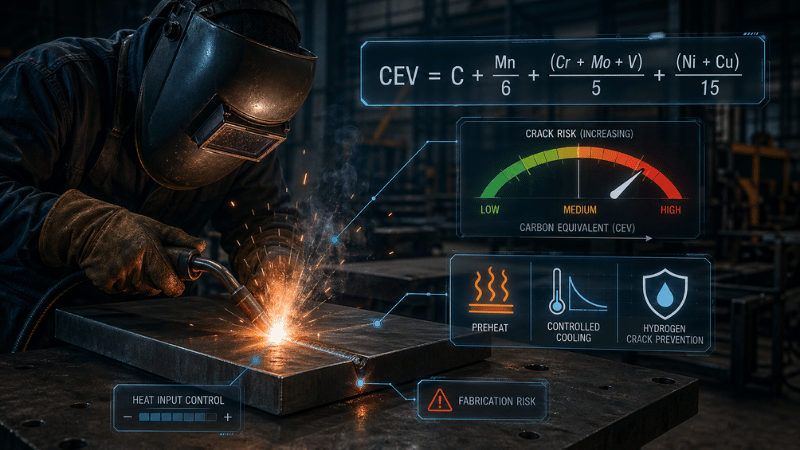
Higher carbon content can increase welding crack risk, especially in thick sections. Weldability also depends on carbon equivalent, preheat, filler metal, joint design, and cooling rate.
A useful checkpoint is Carbon Equivalent (CE):
CE = C + Mn/6 + (Cr + Mo + V)/5 + (Ni + Cu)/15
Steels with CE below about 0.40 are generally easier to weld. When CE rises above about 0.45, cracking risk increases, so preheating, interpass temperature control, and qualified procedures matter more.
We explains how preheating helps reduce hydrogen cracking risk in this guide to weldability and hydrogen cracking.
Carbon Steel Uses at a Glance
Low carbon steel is used for sheets, pipes, structural parts, automotive panels, brackets, frames, and general fabrication.
Medium carbon steel is used for shafts, axles, gears, crankshafts, couplings, forged parts, and machinery components.
High carbon steel is used for cutting tools, blades, springs, high-strength wire, dies, punches, bearings, and wear-resistant parts.
| Requirement | Best-Fit Carbon Steel |
|---|---|
| Weldability | Low carbon steel |
| Formability | Low carbon steel |
| Balanced strength and toughness | Medium carbon steel |
| High hardness | High carbon steel |
| Wear resistance | High carbon steel |
| Cutting edges | High carbon steel |
Low Carbon Steel Uses
Low carbon steel is the friendly neighbor of the steel world. It bends, welds, forms, and fabricates without turning every project into a metallurgy seminar.
Common low carbon steel uses include construction components, sheet metal, pipes and tubing, automotive body panels, wire products, brackets, frames, and non-wear-critical parts.
It works well because it offers good ductility, strong formability, easier welding, and attractive cost. It suits bending, rolling, stamping, forming, cutting, and general fabrication.
Low carbon steel is not ideal for cutting edges, high-wear parts, heavy-duty gears, high-strength springs, or parts requiring high hardness.
Medium Carbon Steel Uses
Medium carbon steel is chosen when parts need better strength than low carbon steel but still require usable toughness.
Typical medium carbon steel uses include shafts, axles, gears, crankshafts, couplings, railway components, machinery parts, and forged parts.
This family offers improved strength, better wear resistance, and stronger heat-treatment potential. Many grades can be quenched and tempered to improve hardness and strength.
Use medium carbon steel when the part carries repeated mechanical load, needs better wear resistance, or must balance toughness with strength. Before choosing it, ask whether the part will be heat treated, welded, or machined after hardening.
High Carbon Steel Uses
High carbon steel is the specialist. It is not always easygoing, but when you need hardness, edge retention, and wear resistance, it earns its keep.
Common high carbon steel applications include cutting tools, knives, blades, springs, high-strength wire, bearings, dies, punches, and wear-resistant parts.
Higher carbon content increases hardening potential. With proper heat treatment, high carbon steel can achieve the hardness needed for cutting, abrasion, and repeated elastic stress.
But there are limits. High carbon steel is harder to weld, less ductile, more crack-sensitive, and less forgiving during heat treatment. Before using it, confirm required HRC or HB hardness, wear resistance, heat treatment plan, joining method, machining difficulty, and surface protection.
Low vs Medium vs High Carbon Steel Applications
| Application | Common Choice |
|---|---|
| Structural fabrication | Low carbon steel |
| Automotive panels | Low carbon steel |
| Pipes and tubing | Low carbon steel |
| Shafts and axles | Medium carbon steel |
| Gears and crankshafts | Medium carbon steel |
| Springs and wire | High carbon steel |
| Blades and cutting tools | High carbon steel |
| Bearings and wear parts | High carbon steel or alloy steel |
These ranges are practical reference values, not final specifications. Exact hardness, yield strength, and weldability depend on grade, section size, heat treatment, and supplier data.
Hidden Processing Limits Many Buyers Miss
Carbon steel selection is not only about what the material can do. It is also about what the material refuses to do politely.
For medium carbon steel, machining can become more difficult after heat treatment. Once hardness rises, tool wear, cutting speed, and dimensional control need closer attention.
For high carbon steel, electroplating, acid pickling, and aggressive cleaning may introduce hydrogen embrittlement, especially in springs, wire, and high-hardness components.
The wrong steel may meet the strength target, then fail during welding, machining, coating, or heat treatment. That is not a material choice; that is a production plot twist.
Common Pitfalls When Choosing Carbon Steel
The first mistake is choosing the highest carbon content by default. High carbon steel can be impressively hard, but hardness often reduces ductility and increases cracking risk.
The second mistake is ignoring weldability. Higher carbon content can make welding more difficult and may require preheating, post-weld treatment, or careful filler selection.
The third mistake is forgetting heat treatment. Some carbon steel uses depend on quenching, tempering, normalizing, or stress relieving. Poor heat treatment can cause brittleness, distortion, or inconsistent hardness.
The fourth mistake is overlooking corrosion protection. Carbon steel can rust when exposed to moisture, so consider paint, coating, galvanizing, plating, oiling, or controlled storage.
The final mistake is using category-level advice instead of grade-level data. “High carbon steel” sounds specific, but it is not enough for a drawing, purchase order, or safety-critical part.
Carbon Steel Uses by Industry
In construction and infrastructure, carbon steel appears in structural members, plates, pipes, fasteners, brackets, supports, and reinforcement-related components.
In automotive and transportation, it is used for body panels, shafts, axles, crankshafts, gears, springs, and many formed or machined parts.
In manufacturing and machinery, carbon steel supports machine components, tooling, dies, wear parts, couplings, guards, frames, and fixtures.
In tools and cutting applications, high carbon steel is used where hardness and edge retention matter most, including hand tools, knives, blades, punches, and cutting edges.
When discussing requirements with suppliers, share the application, hardness target, strength requirement, heat treatment, tolerance, surface finish, and compliance standard.
Safety Notes and Assumptions
This guide is for engineering students, procurement teams, fabricators, welders, manufacturing buyers, and technical researchers who need an application-based starting point.
Get professional material guidance for safety-critical parts, pressure vessels, lifting equipment, automotive safety systems, aerospace components, medical devices, and load-bearing structures.
Material suitability depends on exact steel grade, heat treatment, size, loading, environment, manufacturing method, and inspection requirements. Carbon steel categories are starting points, not final engineering approvals.
FAQs
What is carbon steel most commonly used for?
Carbon steel is commonly used for structural parts, pipes, sheet metal, machinery components, automotive parts, tools, springs, blades, wire, bearings, and general fabrication.
What is high carbon steel used for?
High carbon steel is used for applications that need high hardness and wear resistance, such as cutting tools, knives, blades, springs, high-strength wire, bearings, dies, punches, and wear-resistant parts.
How do I choose between low, medium, and high carbon steel?
Choose low carbon steel for weldability and formability, medium carbon steel for balanced strength and toughness, and high carbon steel for hardness, edge retention, spring performance, or wear resistance.
Is carbon steel good for welding?
Low carbon steel generally has the best weldability. Medium carbon steel and high carbon steel can be welded in some cases, but they often require tighter procedure control, preheat, suitable filler metal, and cracking-risk management.
Conclusion
Carbon steel uses should be selected by performance requirement first, not by category name alone. Low carbon steel is best for weldable, formable, economical parts. Medium carbon steel fits stronger shafts, axles, gears, and machinery components. High carbon steel is ideal for hardness, wear resistance, cutting tools, blades, springs, and wire.
The right choice depends on carbon content, hardness, yield strength, weldability, heat treatment, fabrication method, and cost. Final specifications should always be verified with grade-level standards, supplier data, and engineering requirements.
Need Help Choosing Carbon Steel?
Choosing carbon steel should not feel like decoding ancient shop-floor runes. Share your application, strength target, hardness requirement, welding needs, machining process, and surface finish expectations. Our team can help compare suitable carbon steel types, grades, and supply options.
Contact us today to request a material recommendation or quote for your next carbon steel project.