Choosing between fusion orbital welding and wire-feed orbital welding sounds simple: no wire versus wire. Unfortunately, welding decisions rarely behave that politely.
Wall thickness, fit-up, metallurgy, purge quality, inspection criteria, and production conditions all get a vote. This guide explains where each process works best—and where orbital TIG may not be the smartest answer.
What Is Orbital TIG Welding?
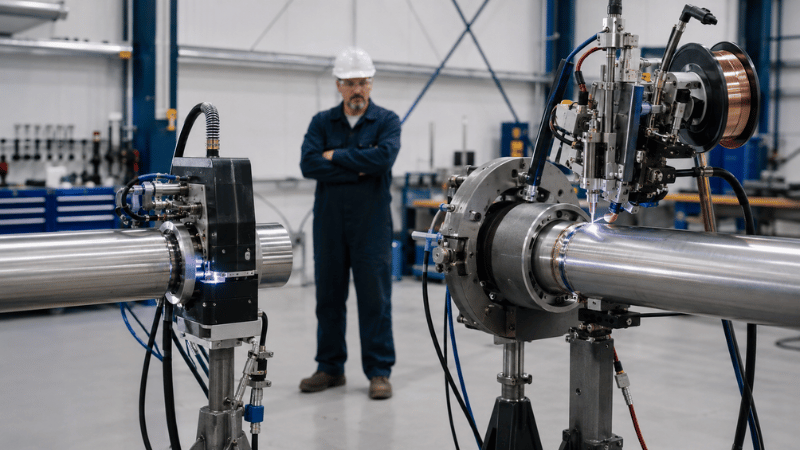
In orbital TIG welding, also called orbital GTAW, the tube or pipe remains stationary while a tungsten electrode travels around the joint. A programmable controller regulates variables such as current, rotation speed, pulse timing, shielding gas, and, when required, filler-wire delivery.
The result is a controlled, repeatable welding cycle. However, “automatic” does not mean “push one button and go for coffee.” Skilled personnel still need to prepare the joint, select or develop the program, position the weld head, verify purge conditions, inspect test coupons, and monitor production.
NASA’s orbital tube GTAW process specification illustrates how seriously critical applications treat procedure control, documentation, inspection, and quality assurance.
Tube Welding Is Not Quite Pipe Welding
Tube is normally specified by outside diameter and wall thickness, while pipe is commonly defined by nominal pipe size and schedule. That distinction affects clamps, weld-head sizing, joint preparation, and parameter development.
Thin, dimensionally consistent tubing is often ideal for closed-head fusion welding. Medium- or heavy-wall pipe may require an open weld head, prepared groove, filler wire, oscillation, and multiple passes.
For a broader explanation of equipment and applications, see this orbital welding guide.
What Is Fusion Orbital Welding?
Fusion orbital welding is an autogenous process: the arc melts and joins the prepared joint edges without continuously adding filler metal.
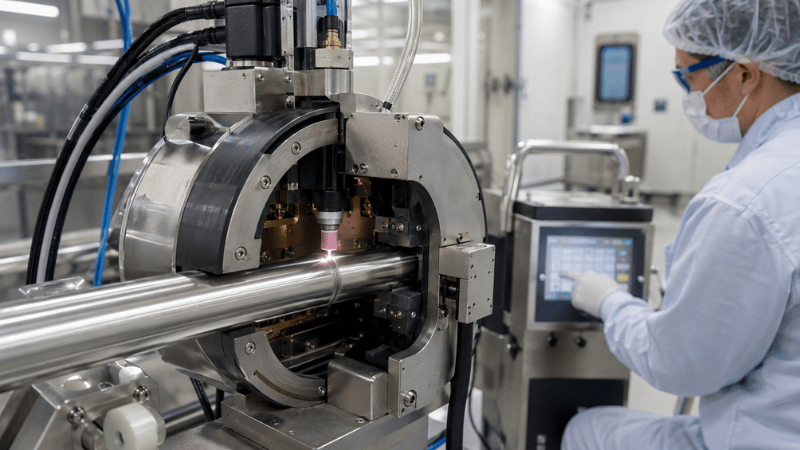
It is commonly performed with a closed orbital weld head that clamps around the tube. The enclosed chamber provides local shielding while the electrode rotates through a programmed 360-degree cycle.
Where Fusion Welding Works Best
Fusion orbital TIG is particularly effective for thin-wall stainless-steel tubing used in semiconductor gas delivery, pharmaceutical processing, biotechnology, food and beverage production, instrumentation, aerospace assemblies, and other high-purity systems.
These applications often involve repetitive joints with consistent tube dimensions. When preparation, alignment, and purge conditions are controlled, autogenous orbital welding can produce smooth, repeatable welds with clean internal profiles.
The process also uses fewer consumables and can work in tight spaces because no external wire feeder or wire-positioning assembly is required.
The Catch: Fusion Demands Excellent Fit-Up
Fusion welding cannot deposit extra metal to rescue a poor joint. Excessive root gap, mismatch, uneven facing, contamination, or tube ovality can quickly produce incomplete penetration, suck-back, or an inconsistent bead.
Wall thickness is another limitation. There is no universal thickness cutoff because penetration depends on material, diameter, joint geometry, equipment, procedure, and acceptance criteria. Still, as thickness increases, achieving full penetration without filler becomes progressively less practical.
Material chemistry matters too. In an autogenous weld, the weld-metal composition comes almost entirely from the parent material. Certain alloys or service conditions may require filler metal to control cracking, corrosion resistance, or mechanical properties.
Fusion is elegant, but it is not a magician. It cannot make bad fit-up disappear in a puff of argon.
What Is Wire-Feed Orbital Welding?
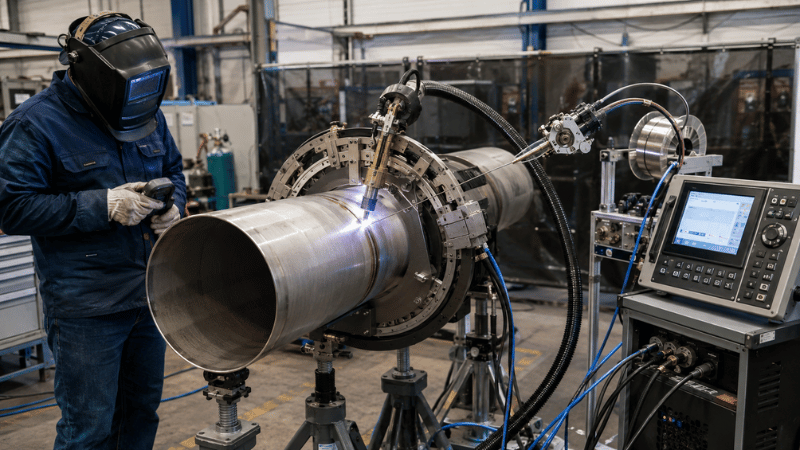
Wire-feed orbital welding adds controlled filler wire to the molten weld pool. The system may use an open orbital weld head or another wire-compatible configuration capable of controlling torch travel, wire position, feed speed, and sometimes arc length and oscillation.
Wire feed may be used for a single-pass joint, but it becomes especially important for prepared grooves, thicker walls, multi-pass welds, and applications requiring a specific filler alloy.
When Filler Wire Becomes Necessary
Wire-feed orbital TIG is usually the stronger candidate when the joint requires added weld metal, the wall exceeds the qualified fusion range, or the procedure calls for multiple passes.
It is also useful when joint geometry includes a controlled root opening or bevel. The filler wire provides metal to fill the groove and helps create the required weld profile.
For medium-wall industrial piping, an open system such as the MWG-90 orbital welding machine supports pipe diameters from 20 to 89 mm and wall thicknesses from 1 to 10 mm, making it relevant where closed-head fusion equipment would be too restrictive.
More Capability Means More Variables
Adding wire expands the process window, but it also increases setup complexity. Wire-feed speed, wire angle, wire-to-puddle position, torch position, pass sequence, interpass temperature, and groove fill must all remain stable.
A bent wire guide, dirty liner, incorrect wire angle, or poor feeder calibration can turn a promising weld into an expensive stainless-steel sculpture.
Wire-feed systems also require more consumables and maintenance. That additional complexity is worthwhile when the application genuinely needs filler metal—not simply because “more equipment must be better.”
Fusion vs Wire-Feed Orbital Welding
The most useful comparison is not which process is superior. It is which process matches the joint.
Fusion vs Wire-Feed Orbital Welding
Compare joint fit, wall thickness, programming, and production use.
| Decision Factor | Fusion Orbital Welding | Wire-Feed Orbital Welding |
|---|---|---|
| Filler metal | Not normally used | Continuously or intermittently added |
| Typical joint | Square butt joint | Square butt or prepared groove |
| Fit-up tolerance | Very low | Better joint-fill capability |
| Wall thickness | Usually thin wall | Medium to thicker wall |
| Passes | Commonly one | Single or multiple |
| Weld head | Often closed head | Usually open or wire-compatible |
| Programming | Comparatively simpler | More variables and pass control |
| Consumables | Lower | Higher |
| Best fit | High-purity repetitive tubing | Process pipe and thicker joints |
Choose fusion orbital welding when the material and dimensions are consistent, the joint closes tightly, the wall thickness falls within a tested range, and cleanliness is a priority.
Choose wire-feed orbital welding when the joint needs filler metal, uses a bevel or root opening, requires multiple passes, or needs a filler alloy for metallurgical or code-related reasons.
Five Variables More Important Than Pipe Diameter
Pipe diameter is easy to put on a quotation form, but it rarely tells the whole story. Five other variables often have more influence on process selection.
1. Wall-Thickness-to-Diameter Relationship
Two tubes with the same diameter can behave very differently when one has a 1 mm wall and the other has an 8 mm wall. Thickness affects heat flow, penetration, required amperage, pass count, and weld-head duty cycle.
2. Joint Consistency
Fusion depends heavily on repeatable facing, alignment, and root conditions. Wire feed offers more filling capability, but it still cannot compensate for uncontrolled gaps or wildly inconsistent bevels.
Good joint preparation is cheaper than rework. It is also less dramatic, which is probably why people sometimes ignore it.
3. Filler-Metal Chemistry
Some joints require filler metal to meet mechanical, corrosion, or metallurgical requirements. Dissimilar metals and crack-sensitive alloys deserve particular attention.
The correct decision should come from the applicable welding procedure and engineering assessment—not from whichever wire spool happens to be closest.
4. Purge Control
Root shielding is critical for many stainless-steel, nickel-alloy, and titanium joints. Poor purge control can cause heavy oxidation, contamination, loss of corrosion resistance, or an unacceptable internal surface.
TWI’s guidance on TIG and GTAW equipment highlights the role of specialized torches and supporting equipment in mechanized pipe welding.
5. Inspection Requirements
A visually attractive external bead does not guarantee full penetration or an acceptable internal profile.
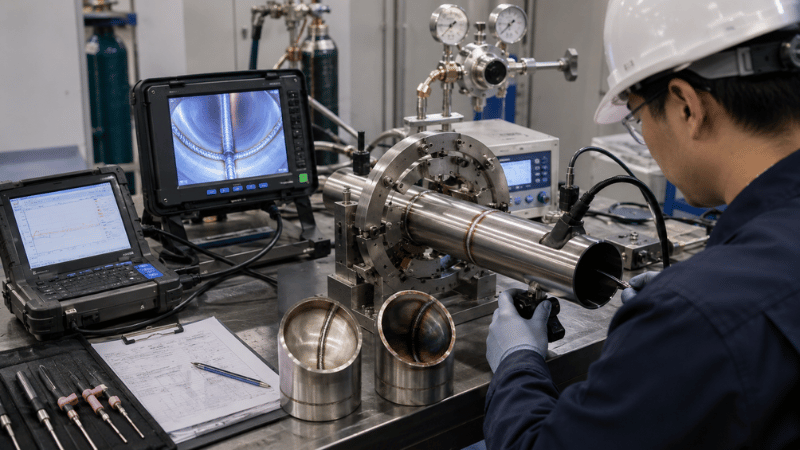
Borescope inspection, radiographic testing, ultrasonic testing, leak testing, or destructive examination may be required depending on the application. The process must be selected around the acceptance standard, not around the prettiest sample weld in the showroom.
A Practical Process-Selection Framework
Start by documenting the material grade, outside diameter, wall thickness, tube or pipe specification, and production quantity.
Next, evaluate the joint. Is it a square butt joint or a prepared groove? What root gap is allowed? How much mismatch or ovality occurs in real production? Is there enough radial clearance for the intended weld head?
Then define the quality target. Consider penetration, internal weld profile, surface oxidation, allowable discontinuities, inspection method, traceability, and applicable code.
Finally, assess production conditions. A compact cleanroom installation has different needs from a windy refinery site. Portability, cooling, gas availability, operator skill, access, and environmental protection can completely change the answer.
For repetitive thin-wall tubing, the MWF Series closed-pipe orbital welding systems provide an enclosed configuration suited to controlled fusion applications involving stainless steel, titanium, and nickel alloys.
Productivity and Cost: Look Beyond Arc Time
Fusion welding may reduce consumable use and simplify each welding cycle. Wire-feed welding may reduce the number of manual operations needed for thicker, prepared joints.
Neither process is automatically faster once the entire workflow is counted.
Real productivity includes tube cutting, facing, cleaning, alignment, head installation, purge stabilization, sample welding, inspection, repositioning, documentation, and rework. A fast arc cycle does not help much when operators spend ten minutes wrestling with poor fit-up before every weld.
Hidden costs also matter: procedure development, qualification testing, training, calibration, spare parts, preventive maintenance, and rejected production.
The best system is therefore not the one with the highest advertised travel speed. It is the one that delivers the lowest qualified cost per accepted weld.
Common Problems and Practical Fixes
Incomplete penetration often points to incorrect preparation, excessive travel speed, inadequate current, poor heat balance, or an unverified program transfer.
Internal oxidation usually means the purge setup needs attention. Check seals, flow rate, gas purity, purge time, oxygen level, and possible air entry through downstream openings.
An inconsistent bead may result from tube mismatch, unstable arc length, incorrect tungsten position, worn clamping components, or dimensional variation.
Wire-feeding instability requires inspection of the spool, liner, guide tip, feed rolls, wire angle, and calibration. Changing feed speed before checking the physical wire path is the welding equivalent of restarting a computer and hoping for spiritual healing.
Field Notes: What Actually Improves Results
On the shop floor, better tube preparation often delivers a larger quality improvement than aggressive parameter tweaking. A square, burr-free, clean joint gives the program a repeatable starting condition.
Purge setup is equally influential. A program that produces a bright, clean internal bead on a test coupon may generate oxidation in production when hose length, sealing method, system volume, or gas displacement changes.
That is why a successful coupon should not be treated as universal proof. Run a representative sample using the real material batch, tooling, purge arrangement, joint geometry, and production environment.
Record rejected welds as carefully as accepted ones. Failure data reveals which variables are drifting and helps prevent the team from repeating the same expensive lesson.
Qualification, Quality, and Safety
Orbital automation improves repeatability, but the welding procedure still needs to be developed and validated for the specific joint. Operators require training in preparation, setup, programming, monitoring, inspection, and equipment maintenance.
Before production, verify the material, dimensions, joint preparation, tungsten condition, gas supply, cooling system, loaded program, clamp position, and inspection plan. Any meaningful change should trigger a review and, where required, requalification.
Welding also involves arc radiation, hot surfaces, electrical hazards, fumes, gases, and moving components. OSHA’s welding hazards and solutions guidance outlines essential controls such as ventilation, protective equipment, and safe work practices.
Frequently Asked Questions
Does fusion orbital welding require filler wire?
No. Fusion orbital welding is normally autogenous, meaning the prepared joint edges are melted together without continuously adding filler metal. It requires consistent dimensions, accurate alignment, suitable material, and a wall thickness that can be reliably penetrated under the qualified procedure.
When should wire-feed orbital TIG be used?
Use wire feed when the joint needs additional weld metal, includes a bevel or root opening, requires multiple passes, exceeds the practical fusion thickness range, or needs a specific filler alloy for mechanical, corrosion, or metallurgical reasons.
Is orbital TIG welding fully automatic?
The machine can automatically control variables such as current, rotation, pulse timing, gas flow, arc length, and wire delivery. Skilled personnel are still responsible for preparation, programming, setup, monitoring, inspection, maintenance, and procedure qualification.
Can one orbital welding program be used for every pipe size?
No. Changes in material, diameter, wall thickness, joint preparation, shielding arrangement, weld head, or production conditions can alter heat flow and weld behavior. Programs should be tested and approved for the actual application rather than copied blindly between jobs.
Conclusion: Let the Application Decide
Fusion orbital welding is an excellent fit for clean, consistent, thin-wall joints that can be welded without added metal. Wire-feed orbital TIG expands the working range for thicker walls, prepared grooves, multi-pass joints, and applications requiring controlled filler chemistry.
The final decision should reflect material, thickness, joint design, fit-up, purge conditions, inspection requirements, production environment, and welding standards. Validate the choice through application review, representative sample welding, and a qualified procedure. Welding equipment appreciates informed decisions. So does your rework budget.
Configure an Orbital Welding System Around Your Joint
Your production team needs more than a machine with an impressive specification sheet. iKratz combines orbital welding equipment, programmable controls, application engineering, and configuration support to help you match the weld head and process to your pipe dimensions, quality targets, site conditions, and production volume.
Send us your material grade, diameter, wall thickness, joint drawing, and inspection requirements. Contact iKratz today to request an application review, recommended system configuration, or representative sample-welding plan.