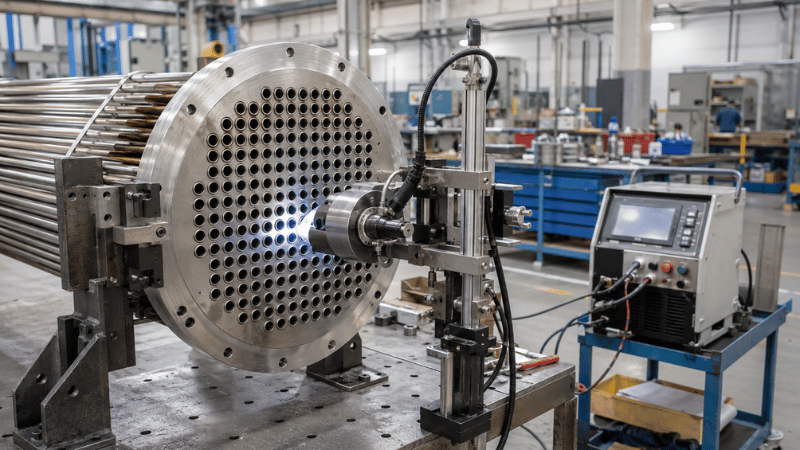
Hundreds—or thousands—of nearly identical tube joints can turn manual welding into a test of stamina, consistency, and caffeine tolerance. One bad weld may also mean leakage, rework, delayed inspection, or an uncomfortable conversation with the production manager.
A tube to tubesheet welding machine automates repetitive GTAW operations, but not every machine fits every tubesheet. This guide explains how to compare machines based on your actual joint, production target, quality requirements, and total cost.
What Is Tube-to-Tubesheet Welding?
Tube-to-tubesheet welding joins the end of a tube to a drilled tubesheet, creating a sealed or load-bearing connection. These joints are commonly found in heat exchangers, condensers, boilers, pressure vessels, and chemical or power-generation equipment.
Unlike ordinary tube-to-tube welding, the torch must rotate around a tube end while working within the limited space between neighboring tubes. The tube pitch, projection, tubesheet edge, and nearby dividers can therefore matter just as much as tube diameter.
A seal weld primarily prevents leakage between the tube and tubesheet. A strength weld must also carry a specified mechanical load and normally requires more demanding penetration, procedure qualification, and inspection.
The final joint design must follow the project specification and applicable construction code. A tidy bead is lovely, but sadly, “it looks pretty” is not an engineering acceptance criterion.
How an Automatic Welding Machine Works
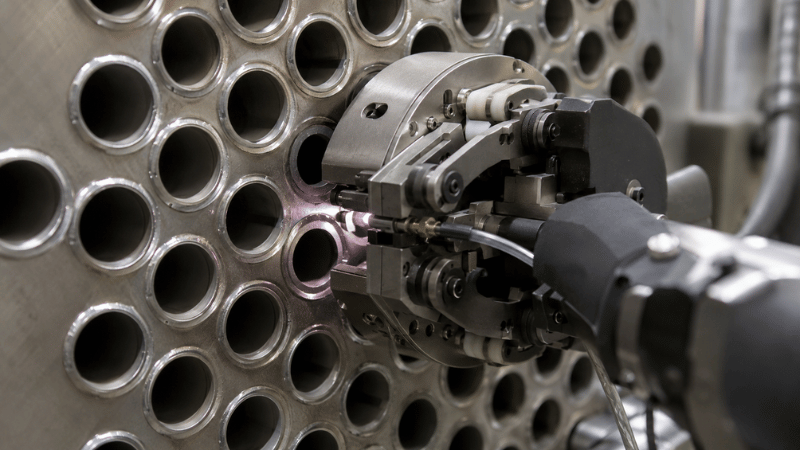
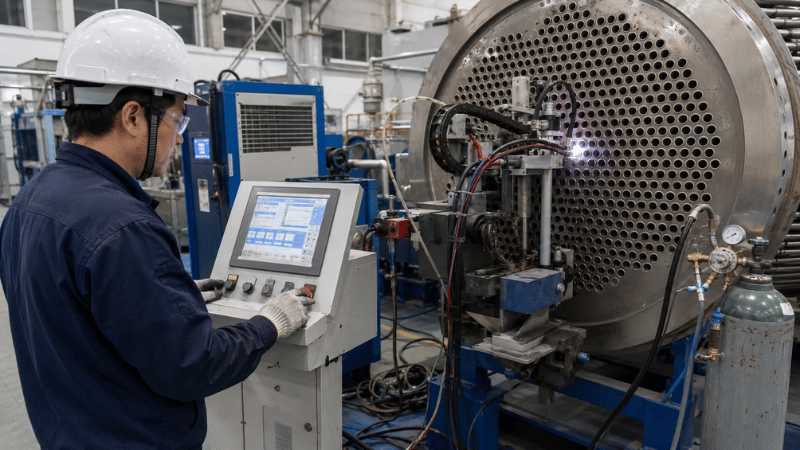
An automatic system typically combines a programmable power source, controller, orbital welding head, cooling unit, shielding-gas circuit, and optional wire feeder.
During welding, the head is positioned and centered on the tube. The operator selects a stored program, starts the cycle, and the electrode rotates automatically while the controller manages current, speed, pulse timing, shielding gas, and other programmed variables.
GTAW uses a non-consumable tungsten electrode and inert shielding gas to protect the molten weld pool. It may be performed with filler metal or autogenously, depending on the joint design and qualified procedure. The American Welding Society’s GTAW overview provides a useful explanation of the process.
The main advantage is not simply speed. It is controlled repetition. Once a suitable program has been validated, the machine can reproduce the same movement and parameter sequence across a large tubesheet without getting tired, distracted, or mysteriously disappearing five minutes before shift change.
Manual TIG vs Automatic Tube-to-Tubesheet Welding
Manual TIG remains practical for repairs, prototypes, one-off fabrication, and joints with irregular access. It also has a lower initial equipment cost and gives an experienced welder considerable flexibility.
However, manual results depend heavily on torch angle, travel speed, arc length, filler addition, and operator concentration. Maintaining identical technique over hundreds of joints is difficult even for a highly skilled welder.
An automatic tube welding machine provides greater value when production involves high tube counts, repeated tubesheet designs, multiple shifts, strict weld consistency, or traceability requirements. Orbital welding is widely used for tube-to-tube and tube-to-tubesheet applications because computer-controlled movement can improve repeatability with limited operator intervention, as explained by TWI’s orbital welding guide.
Automation still requires proper setup. A perfectly programmed machine will reproduce a poor fit-up with impressive consistency. That is efficient, technically speaking, but not particularly helpful.
How to Choose a Tube-to-Tubesheet Welding Machine
The best tube to tubesheet welding machine is not necessarily the model with the longest feature list. It is the system that fits your tube dimensions, joint geometry, material, production volume, and acceptance requirements.
Start With Tube Dimensions
Confirm the tube outside diameter, wall thickness, tube projection, and pitch. Do not evaluate diameter alone.
A welding head may accept the tube diameter yet remain too large to fit between adjacent tubes. Closely spaced tubes, edge rows, divider plates, and recessed joints often determine whether the head can physically complete the job.
For example, the MWP-65 tube sheet welding machine is designed for automated GTAW across a specified tube-size range and includes circulating water cooling for repetitive operation. Always compare the published range with your drawing, tooling, and access conditions rather than assuming “close enough” will behave itself.
Review Joint Geometry
Check tubesheet thickness and whether tubes are flush, projecting, or recessed. Confirm whether the drawing specifies a seal weld, strength weld, groove, or another joint preparation.
Also examine the least convenient tubes—not just the friendly ones in the middle. Ask whether the proposed orbital welding head can reach edge tubes, divider-area tubes, and joints near clamps or fixtures.
A machine that welds 95% of a tubesheet automatically may still create an awkward manual-welding bottleneck in the remaining 5%.
Match the Process to the Material
Common combinations include carbon steel, stainless steel, duplex stainless steel, titanium, nickel alloys, and dissimilar metals. Each can require different current ranges, shielding practices, filler materials, heat-input limits, or cleaning procedures.
Send the supplier complete material designations rather than descriptions such as “some kind of stainless.” Technical ambiguity is cheap before the purchase order and surprisingly expensive afterward.
Choose Autogenous or Filler-Wire Welding
Autogenous welding melts the joint without adding filler wire. It can simplify the welding head and reduce consumable handling when the joint fit-up and procedure are suitable.
Filler-wire welding may be required for certain joint designs, material combinations, gap conditions, or strength requirements. It adds a wire feeder, more parameters, more setup time, and another consumable that can misbehave at exactly the wrong moment.
The choice should come from the drawing, welding procedure, and trial results—not from whichever configuration happens to cost less.
Evaluate Controls and Traceability
Useful controller functions include recipe storage, multi-level user permissions, program revision control, weld numbering, actual-parameter recording, and data export.
Program storage reduces setup variation between operators. Parameter records help QA teams investigate deviations and demonstrate that approved settings were used.
However, distinguish between programmed parameters and actual recorded values. A controller that displays a target current is not automatically proving what occurred throughout the weld cycle.
Check Installation Requirements
Confirm electrical supply, cooling capacity, shielding-gas quality, cable length, grounding, and available workshop space.
Long cable runs, restricted access, high ambient temperatures, and multi-shift duty can affect the required configuration. Ask what is included in the quoted system: power source, head, controller, cooling unit, cables, mandrels, collets, tungsten holders, wire feeder, and startup spares.
Otherwise, the attractively priced “complete machine” may arrive complete in the same way that a hotel room is complete without breakfast.
Use a Machine Evaluation Scorecard
A weighted scorecard prevents one impressive demonstration from dominating the purchase decision.
Give application compatibility 30%, covering tube range, pitch, joint geometry, access, and materials. Assign 20% to process control, 15% to repeatability and traceability, 10% to productivity, 15% to training and technical support, and 10% to lifecycle cost.
Some requirements should remain pass-or-fail regardless of the total score:
- The head fits every required joint location.
- The machine supports the specified material and weld type.
- The tooling covers the actual tube range.
- A sample weld passes the agreed inspection.
- The supplier can support commissioning and spare parts.
A machine that fails one critical geometry check should not win merely because its touchscreen has excellent graphics.
From Tight-Pitch Collisions to 100% Hydro-Test Qualification
Tight-Pitch Collision
The bulky head could not reach restricted tubes, forcing 25% manual welding.
Hydro-Test Leaks
Current instability caused weld-pool sagging and a 12% leak rate.
💸 Financial Toll
⚙️ The iKratz Fix
Ultra-Slim Access
Reached every edge and partition tube without collision.
Gravity Compensation
Sector-based pulsing stopped pool sagging at 6 o’clock.
Faster Production
Automated welding tripled speed over manual TIG.
Demand a Pre-Purchase Weld Trial
A sample weld trial is one of the strongest ways to reduce purchasing risk. Supply representative tubes, a tubesheet sample, material certificates, drawings, and acceptance criteria.
The trial should reproduce real tube projection, pitch, joint preparation, material thickness, and access restrictions. Testing one conveniently positioned tube on a flat coupon proves far less than suppliers occasionally pretend it does.
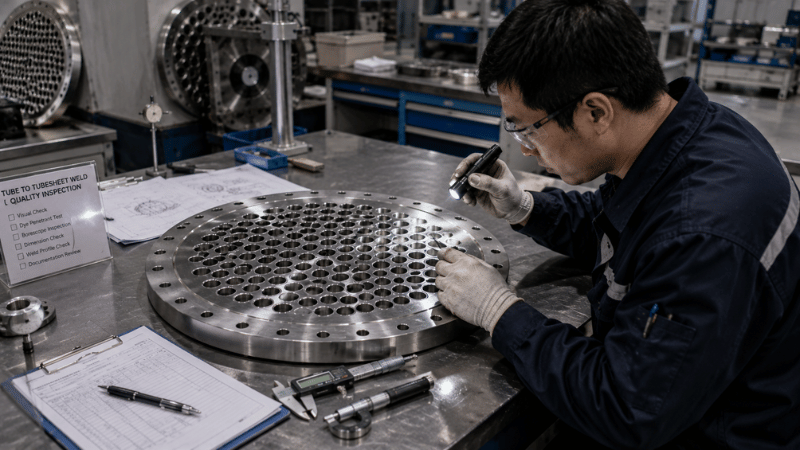
Record the setup time, welding time, parameter changes, cooling behavior, and consumable wear. Then inspect the weld using methods appropriate to the project, which may include visual examination, leak testing, liquid penetrant testing, macro examination, or other specified techniques.
Request the final program and trial report. The useful result is not “the machine successfully produced a weld.” It is the machine produced an inspectable weld on a representative joint using documented settings.
Quality and Code Compliance
Automation improves control, but it does not independently guarantee compliance.
Production still depends on correct fit-up, verified materials, clean surfaces, qualified procedures, trained personnel, suitable inspection, and maintained equipment. The machine is an important part of the quality system—not a metallic box that grants automatic code approval.
For pressure-equipment work, confirm the applicable construction standard and project specification. ASME BPVC Section IX contains rules related to welding procedure and personnel qualification when invoked by the relevant construction code.
Useful production records may include the program revision, operator ID, weld number, actual parameters, date, inspection result, and repair status. These records make deviations easier to investigate and provide stronger evidence than a spreadsheet named “final-weld-data-v7-really-final.”
Calculate Cost and ROI Realistically
System cost may include the power source, controller, weld head, water cooler, tooling, cables, wire feeder, software, training, commissioning, replacement parts, and inspection equipment.
A practical ROI estimate can be expressed as:
Annual benefit = labor savings + reduced rework + added production value − annual operating costs
Use measured manual and automatic cycle times. Include tube positioning, program selection, tungsten changes, inspection, setup, maintenance, training, and downtime.
For example, calculate annual labor savings by multiplying time saved per joint by annual joint volume and the fully burdened labor rate. Add documented rework savings and the contribution from genuinely usable extra capacity.
Avoid building the business case around the fastest demonstration cycle. Production includes people, fixtures, gas bottles, paperwork, and occasionally a tungsten electrode that chooses chaos.
Evaluate the Supplier, Not Just the Machine
A capable supplier should review your drawings, confirm welding-head access, recommend tooling, perform sample welding, and explain the limits of the proposed configuration.
Ask for operating-range tables, sample-weld reports, macro sections, training plans, warranty terms, spare-parts availability, and support procedures. Remote diagnostics and responsive application engineering can be more valuable than a minor difference in purchase price.
Explore the broader iKratz orbital welding systems to compare tube, pipe, tubesheet, and automated welding configurations. For application-specific equipment, the heat exchanger welding solutions page shows how automated welding can be integrated into heat-exchanger manufacturing.
Information to Include in Your RFQ
A useful request for quotation should state the tube OD, wall thickness, material, tubesheet material, pitch, projection, joint design, welding position, filler-wire requirement, tube count, production target, inspection standard, and data-recording needs.
Attach drawings and photographs whenever possible. Ten minutes spent preparing good application information can prevent weeks of emails in which everyone politely asks what “standard tube size” was supposed to mean.
FAQs
What is the best machine for tube-to-tubesheet welding?
The best machine matches the tube diameter, wall thickness, pitch, material, joint design, weld type, access conditions, production volume, and inspection requirements. A representative weld trial should confirm suitability before purchase.
Can one machine weld different tube sizes and materials?
Often, yes. The usable range depends on the welding head, mandrels, tooling, power source, wire-feed configuration, and qualified procedures. Changing materials may also require different shielding, tungsten, filler wire, or parameter programs.
Is automatic welding always faster than manual TIG?
Not always. Automation usually delivers greater consistency and productivity in repetitive, high-volume work. Manual TIG may remain more economical for repairs, prototypes, tiny batches, and irregular joints where automatic setup would consume more time than it saves.
Does an automatic machine guarantee code-compliant welds?
No. It improves parameter control and repeatability, but compliance also requires an approved joint design, qualified procedure, verified materials, correct fit-up, trained personnel, inspection, and documentation under the applicable project specification and construction code.
Conclusion
Choose a tube to tubesheet welding machine around the joint—not around the product name or headline amperage. Verify tube range, head access, material suitability, weld type, control functions, and installation requirements first.
Most importantly, validate the proposed system through representative sample welding. The best machine is the one proven to produce repeatable, inspectable joints on your actual tubesheet while fitting your production and support requirements.
Get a Welding System Built Around Your Application
iKratz helps manufacturers evaluate tube dimensions, materials, joint geometry, access limitations, productivity targets, and traceability requirements before recommending equipment. This application-focused approach helps you avoid oversized features, incompatible tooling, and expensive surprises after installation.
Contact iKratz today to request an application review, machine recommendation, and representative sample-weld trial for your tubesheet project.