Labor shortages, rising wages, and tighter deadlines—welcome to modern fabrication. If your welders are stretched thin (and slightly grumpy), you’re not alone.
Cobot welding is gaining traction fast—but here’s the catch: it’s not magic. This guide breaks down when it actually makes sense—and when it’s just an expensive arm waving around.
What Is Cobot Welding? (And How It Actually Works)
Simple Definition (Non-Technical)
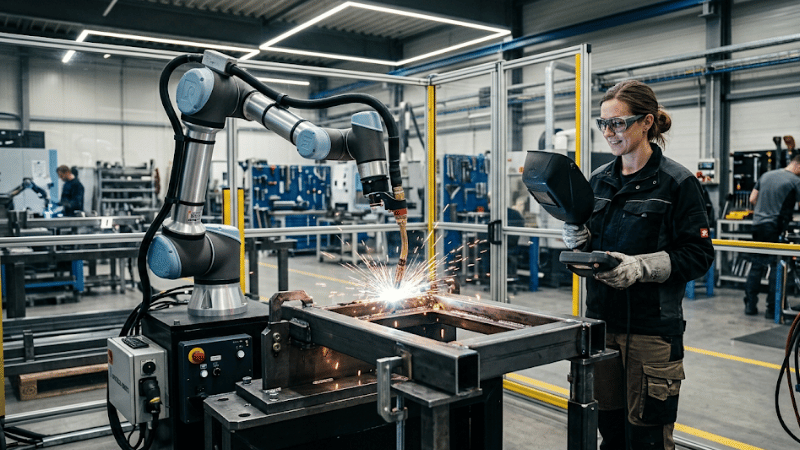
Cobot welding uses collaborative robots designed to work safely alongside humans. Instead of replacing welders, they handle repetitive welds while humans manage setup and quality.
Think of it as giving your best welder a tireless assistant who never asks for coffee breaks.
Key Components of a Welding Cobot System
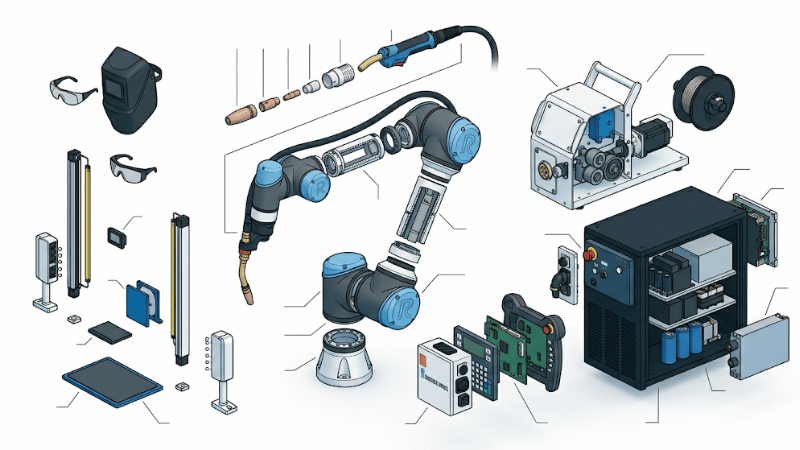
A typical setup includes:
- Robot arm (the visible “star”)
- Welding power source (MIG/TIG)
- Torch and wire feeder
- Safety sensors
- Programming interface (often teach-by-hand)
Most people obsess over the robot—but the real magic lives in integration and setup.
Supported Welding Processes (MIG, TIG, etc.)
Most cobot systems support:
- MIG welding automation (most common)
- TIG (less frequent but possible)
- Flux-cored arc welding
The 20/80 Rule of Automation Success (Integration Perspective)
Why the Robot Arm Is Only 20% of the Equation
Here’s the uncomfortable truth: the robot arm is the least of your worries.
It’s the shiny part everyone buys—but rarely the part that determines success.
The Critical 80%: What Actually Determines Success
- Fixturing systems (repeatability is everything)
- Process tuning (parameters make or break weld quality)
- Workflow integration (how parts move through the cell)
If your parts aren’t positioned consistently, your cobot will consistently produce bad welds.
Reality Check: “An Expensive Robot That Just Wastes Electricity”
Bad fixturing = bad results.
And no, buying a more expensive robot won’t fix it.
How Cobot Welding Differs from Traditional Methods
Cobot vs Manual Welding
Manual welding is flexible but inconsistent and labor-heavy.
Cobot welding delivers:
- Repeatability
- Reduced fatigue
- Scalable output
Cobot vs Industrial Robot Welding
Industrial robots:
- Require complex programming
- Excel at high-volume production
Cobots:
- Easy to program (teach-by-hand)
- Perfect for high-mix, low-volume environments
| Metric | Manual Welding | Industrial Robots | Cobot Welding |
|---|---|---|---|
| Adaptability | Very High | Very Low | VERY HIGH |
| Programming Difficulty | None | Very High | VERY LOW |
| Changeover Time | Fast | Slow | FAST |
| Footprint | Small | Large | COMPACT |
When Cobot Welding Makes Sense (Use Case Fit)
Ideal Scenarios
- High-mix, low-volume production
- Repetitive weld paths
- Skilled welder shortages
- Medium complexity parts
If your shop runs dozens of small batches, cobots are practically built for you.
When It Does NOT Make Sense
- Ultra-high volume (industrial robots win)
- One-off custom fabrication
- Poor part consistency
Cobot Welding Benefits (With Real-World Context)
Productivity Gains
Cobots don’t get tired. Humans do.
A cobot can run continuously while operators handle multiple tasks, boosting throughput significantly.
Weld Quality & Consistency
Once dialed in, cobots produce:
- Consistent bead profiles
- Reduced defects
- Lower rework rates
The Welder Multiplier Effect (Reframing Labor)
Here’s the real win:
- One skilled welder supervises multiple cobots
- Output scales without hiring more welders
- Example: 1 welder → 3 cobots → 3× output
This isn’t labor replacement—it’s labor amplification.
| Metric | Manual Welding | Industrial Robots | Cobot (ikratz Method) |
|---|---|---|---|
| HMLV Adaptability | Very High | Very Low | EXTREME |
| Programming | None | Complex Code | Teach-by-Hand |
| Safety Needs | Personal PPE | Locked Fences | Side-by-Side |
Safety Improvements
Cobots reduce exposure to:
- Fumes
- Heat
- Repetitive strain injuries
For reference, see OSHA welding safety guidelines.
Real Costs of Cobot Welding (Transparent Breakdown)
Upfront Investment
Typical range:
- $35,000–$120,000+
Depends on:
- Brand
- Welding package
- Integration complexity
Ongoing Costs
- Maintenance
- Consumables
- Electricity
Hidden Costs Most Articles Ignore
- Fixturing design & iteration
- Workflow redesign
- Training downtime
These hidden costs often determine whether your project succeeds—or quietly fails.
ROI of Cobot Welding: How to Calculate It
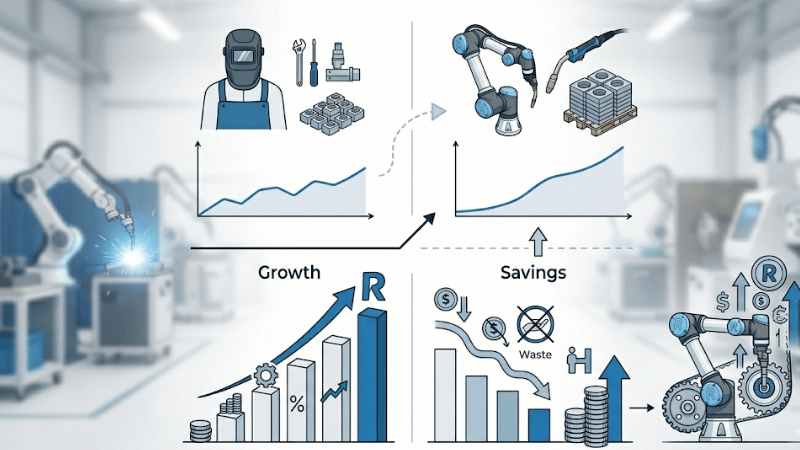
Key ROI Drivers
- Labor savings
- Increased throughput
- Reduced scrap
Variable Definition:
- P: Payback Period (Years)
- Ctotal: Total System & Integration Cost
- Lw: Hourly Labor Wage Rate
- Ha: Annual Automated Hours
- Ep: Productivity Gain Factor (Efficiency)
- Mcost: Annual Maintenance & Operating Cost
* Note: If the denominator is negative, the automation setup will not achieve ROI under current parameters. Optimization is required.
Realistic ROI Timeline
Most shops see payback in:
- 6–24 months
But only if the system is properly integrated and utilized.
My Field Notes: What I Learned from Real Cobot Deployments
What Works Surprisingly Well
- Simple, repetitive welds
- Shops with disciplined workflows
What Shops Underestimate
- Setup time
- Fixturing complexity
Biggest Mistakes I’ve Seen
- Buying before planning
- Ignoring operator training
The pattern is always the same: rush the purchase, regret the implementation.
Step-by-Step Implementation Roadmap
Step 1: Identify the Right Welding Tasks
Focus on repetitive, stable parts.
Step 2: Evaluate Parts & Volume
Consistency matters more than volume.
Step 3: Select System + Integration Strategy
Don’t just buy hardware—plan the workflow.
Step 4: Fixturing Design (Critical Step)
This is the make-or-break stage.
Step 5: Train Operators & Optimize
Continuous improvement is key.
Common Pitfalls (and How to Avoid Them)
Ignoring Fixturing Precision (The #1 Failure Point)
Robots repeat perfectly—even mistakes.
A 0.5 mm deviation can ruin weld alignment.
Buying Based on Hype, Not Fit
Not every shop needs a cobot.
Poor Workflow Integration
Automation without flow is chaos.
Lack of Operator Buy-In
If your team resists it, adoption fails.
Decision Framework: Is Cobot Welding Right for You?
Quick Self-Assessment Checklist
- Do you have repeatable welds?
- Is labor a bottleneck?
- Are parts consistent?
Scoring Model (1–5 System)
Score each factor:
- 4–5 → Strong fit
- 2–3 → Evaluate carefully
- 1 → Probably not suitable
What Competitor Articles Usually Miss
Most articles focus on:
- Robot specs
- Price tags
They ignore:
- Integration reality (20/80 rule)
- Fixturing as the real success factor
- Labor amplification mindset
Best Practices for Maximizing Cobot Welding Success
Start Small, Then Scale
Pilot projects reduce risk.
Invest in Fixturing First, Not Last
Fixturing determines success—not the robot.
Standardize Where Possible
Consistency improves automation efficiency.
Combine Human + Cobot Strengths
Humans handle variability; cobots handle repetition.
Conclusion
Cobot welding isn’t about buying a robot—it’s about building a system that works.
The real differentiators are fixturing, workflow design, and use-case fit. Get those right, and ROI follows. Get them wrong, and even the best robot won’t save you.
CTA: Ready to See If Cobot Welding Fits Your Shop?
Stop guessing and start planning. We help fabrication shops evaluate real-world cobot welding opportunities—focusing on ROI, workflow, and integration (not just hardware).
Contact us today to get a tailored cobot welding strategy based on your actual production setup.
Frequently Asked Questions
Is cobot welding suitable for small fabrication shops?
Yes—especially for high-mix, low-volume production where flexibility is critical.
What is the biggest hidden risk in cobot welding projects?
Fixturing. Poor positioning leads to poor welds—every time.
How fast can a cobot welding system pay for itself?
Typically 6–24 months, depending on utilization and implementation quality.