In 2026, hydrogen does not politely behave like “just another industrial gas.” It is a “ghost” in traditional piping systems—tiny, mobile, and unforgiving at weak joints, poor prep points, and vague specifications. While the global shift toward H2 infrastructure is accelerating, many engineering teams are still applying legacy oil-and-gas logic to a medium that requires molecular-level precision.
This guide moves beyond the “use stainless steel” cliché. We connect material science with automated fabrication to provide a unified decision logic for Hydrogen Tubing, Fittings, and Pipeline Selection. More importantly, we offer solutions for the two biggest risks in 2026: Hydrogen Embrittlement (HE) and the Skilled Labor Gap.
Designing these systems requires strict adherence to international safety codes, and all selections should be validated against the ASME B31.12 safety standards to ensure long-term operational integrity.
Why Hydrogen Service Changes the Material Selection Equation
Hydrogen’s small molecular size makes leak prevention a first-order design objective. At 70 MPa (H70 standard), hydrogen can find its way through micro-fissures that are invisible to standard nitrogen or oxygen leak tests.
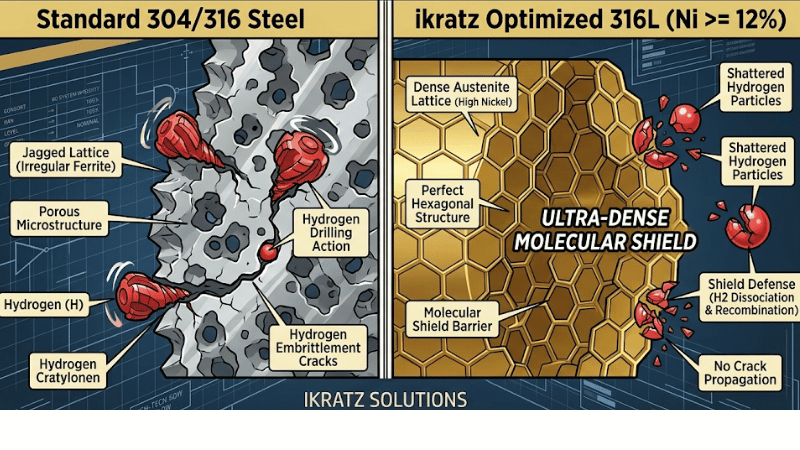
The Invisible Enemy: Hydrogen Embrittlement (HE)
HE is a mechanical gremlin that significantly reduces a metal’s ductility, leading to catastrophic failure under pressure. For validated data on alloy performance under high-pressure gaseous hydrogen, engineers should consult the Sandia National Laboratories Technical Reference for hydrogen compatibility.
The ikratz Standard: While most competitors suggest any 316L, we mandate the 12% Nickel Rule. In 2026, austenitic stainless steel with Ni ≥ 12% is the baseline for ensuring a stable microstructure. This is critical for preventing HE, especially when combined with a precise back purging strategy to protect the heat-affected zone from oxidation during welding.
Hydrogen Tubes vs. Pipelines: The Scoping Checklist
A “hydrogen gas tube” search often implies small-bore instrumentation panels, while “hydrogen pipelines” refer to larger process lines. Before finalizing your Bill of Materials (BOM), define your operating envelope:
- Pressure Class: Is the system rated for 35 MPa (H35) or 70 MPa (H70)?
- Purity Level: Are you delivering industrial fuel or Grade D (99.97% purity) for fuel cells? (ISO 14687)
- Accessibility: If a joint is buried in a cabinet or skid, it must be welded. Mechanical joints in inaccessible areas are a maintenance time-bomb.
Welded Joints vs. Fittings: The ikratz Decision Framework
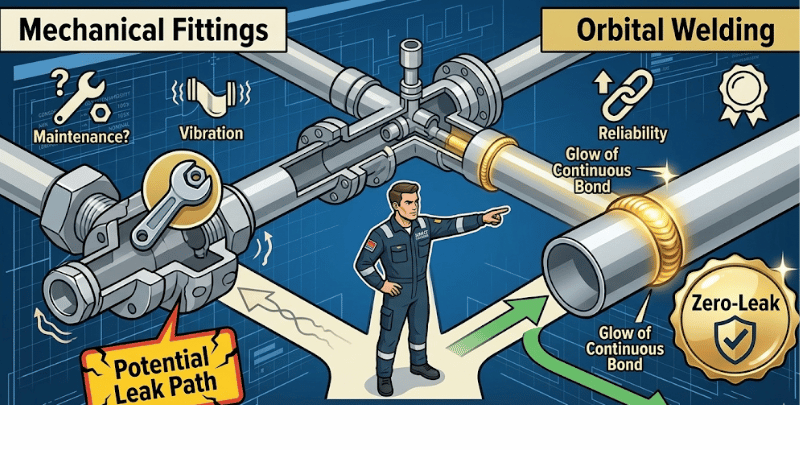
The choice between mechanical fittings and orbital welding is often framed as “speed vs. cost.” In 2026, the real metric is Total Cost of Ownership (TCO).
The H2 Connection Decision Tree
- Inaccessible or High-Vibration Zone? → Must Weld. Mechanical fittings can loosen over thousands of H2 pressure cycles. Orbital fusion welding creates a molecular bond, eliminating the leak path entirely.
- Maintenance-Heavy Modules? → High-Quality Compression Fitting. Where components must be replaced regularly, fittings offer necessary flexibility.
- Tight Space Constraints? → ikratz MWF Series. Our narrow-gap heads are designed for dispenser manifolds where manual welding is physically impossible.
Surface Finish (Ra) vs. Gas Purity: The Quantitative Layer
“Clean” is not a specification; it’s a wish. In high-purity hydrogen systems, micro-burrs and surface roughness (Ra) create physical “valleys” where particles accumulate and pitting starts. Detailed guidance on maintaining metallurgical integrity can be found in the Nickel Institute’s technical library.
The Solution: ikratz planetary tube cutting achieves a repeatable Ra < 0.4 μm end-prep. This precision is non-negotiable for semiconductor-grade hydrogen delivery and long-term fitting seal integrity.
Fabrication Quality: Engineering Out the Skill Gap
The talent shortage is the primary risk to 2026 hydrogen projects. Relying on a veteran welder’s “feel” for high-pressure H2 lines is no longer a scalable strategy.
Adaptive Pulse Control: Solving the HAZ Vulnerability
Improper cooling rates during welding lead to sensitization in the Heat-Affected Zone (HAZ), making it a prime target for hydrogen molecules. The ikratz Expert Parameter Library codifies master-welder logic into the system, automatically generating Adaptive Cooling Curves to ensure the weld pool solidifies into a dense, embrittlement-resistant structure every time.
Winning the Audit: Digital Traceability as a Shield
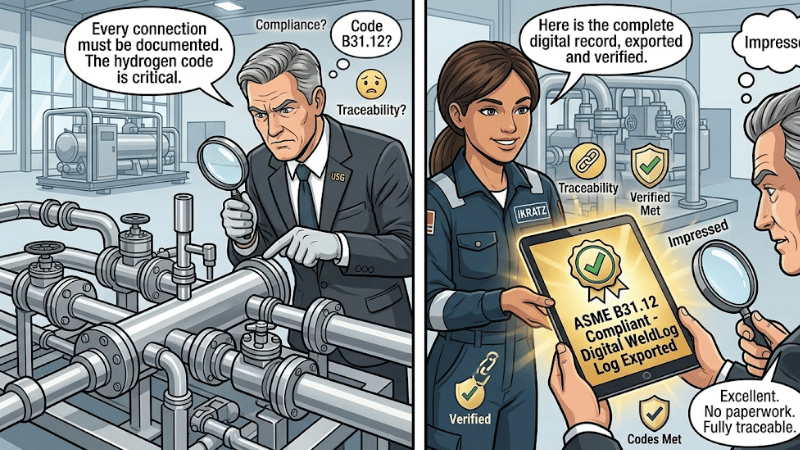
As government safety audits for hydrogen projects become increasingly rigorous (ASME B31.12-2026), manual paper logs have become a liability.
The ikratz “Weld Birth Certificate”: Our systems utilize automated digital weld log software to record every pulse, second, and gas flow. Instead of weeks of paperwork, you provide a one-click PDF export that proves 100% compliance.
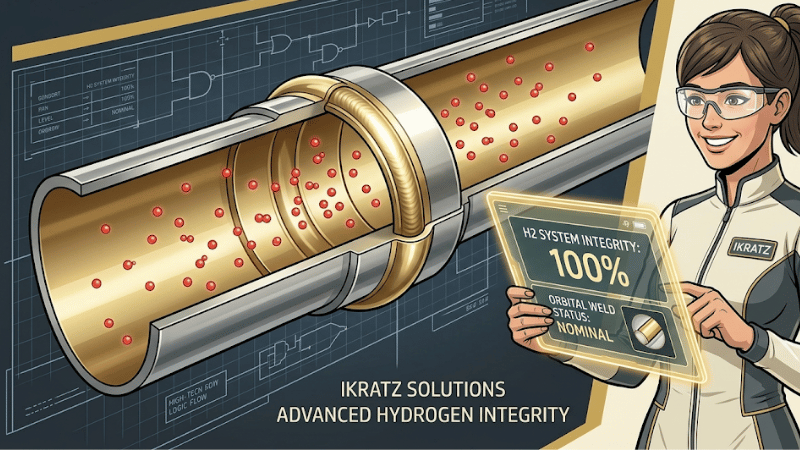
Analyze Your Hydrogen System Integrity: ikratz Auditor
Theoretical models are useful, but seeing the impact on your specific H2 production line drives better decisions. Use our auditor below to quantify your risk.
ikratz Hydrogen System Auditor
Estimate leak path reduction and audit efficiency for H2 projects.
ikratz Implementation Impact:
📄 Audit Speed Improvement: +300%
Conclusion
Selecting materials for hydrogen service is no longer an isolated engineering task—it is a system-wide commitment to integrity. As we move further into the 2026 H2 economy, the margin for error has vanished.
To succeed, project teams must shift from “buying components” to “securing connections.” This involves a three-pronged strategy: Material Precision (Ni ≥ 12%), Connection Logic (favoring orbital welds in high-risk zones), and Digital Fabrication (automated parameter libraries). By standardizing on these principles, you aren’t just building a pipeline—you are building a future-proof molecular fortress.
FAQs
Q1: What material is commonly used for hydrogen tubing?
A: 316/316L Stainless Steel is the industrial baseline, but for hydrogen service, it must be verified for a nickel content of Ni ≥ 12% to ensure austenite stability and prevent embrittlement.
Q2: When should hydrogen systems use welding instead of fittings?
A: Welding is preferred for inaccessible joints, high-vibration manifolds, and ultra-high-pressure (70 MPa+) systems where leak prevention is more critical than modular maintenance.
Q3: Why does surface finish matter in hydrogen gas systems?
A: High-quality surface finish (Ra < 0.4 μm) and burr-free prep reduce particle traps and eliminate micro-fissures that can act as initiation points for hydrogen-assisted cracking.
CTA: Turn Hydrogen Design Intent Into a Buildable Spec
If your team is comparing hydrogen tubes, fittings, and pipeline materials, the real value is not just product supply—it is getting the specification right before fabrication starts.
[Request a Hydrogen System Component Review]
Speak with a technical specialist today to validate your tubing, fitting, and material choices before procurement locks in the wrong assumptions.