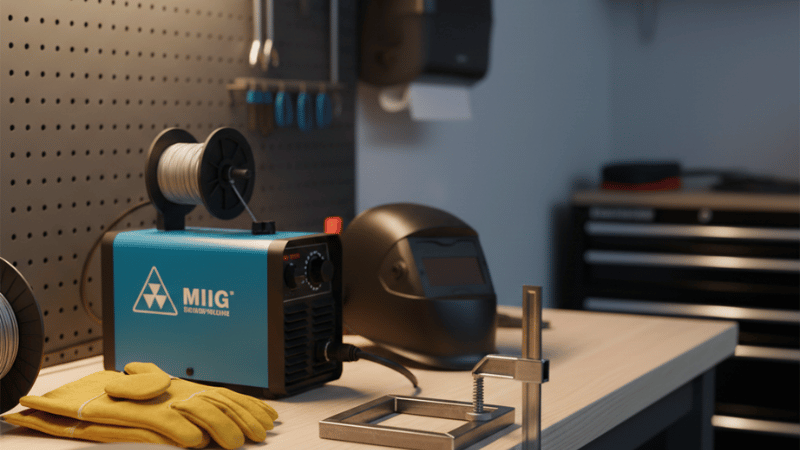
The best welder for beginners isn’t the one with the loudest “MAX AMPS!!!” sticker. It’s the one that fits your real projects, your garage power, and your patience level—so your first weekend welding doesn’t end in a return label and existential dread.
This guide gives you a simple decision engine, a beginner-proof checklist, and realistic “portable welder” expectations—so you buy once and learn fast.
What Competitor Articles Usually Miss (and What You’ll Learn Here)
A decision engine (not a random top-10 list)
Score each welder 1–5:
- Project fit (thickness/material)
- Power fit (120V/240V reality)
- Budget fit (machine + essentials)
- Portability fit (do you truly need it?)
Pick the highest total. That’s your “best”—not some influencer’s.
Real total cost of ownership (TCO)
Your welder is just the main character. The supporting cast includes wire, tips, gas (maybe), PPE, grinder discs, clamps, and the one thing everyone forgets: a better ground clamp.
Portable welder reality check
“Portable” often means “great for light repairs,” not “magically welds thick steel forever.” We’ll show what to verify so you don’t buy a lunchbox that promises battleship welds.
Insert: why iKratz tends to work well for first-timers
If your goal is “easy to start, less fiddling,” beginner-focused machines matter. Many buyers look for clear controls, stable arc behavior, and easy-to-find consumables—this is exactly the lane iKratz welding machines are positioned for: newbie-friendly setup and practical home-use choices without turning welding into a PhD.
Welding Machine Basics (Fast Definitions So Specs Make Sense)
Welding processes in plain English
- MIG (GMAW): wire feeds automatically, usually with shielding gas. Smooth learning curve indoors.
- Flux-core (FCAW): wire feeds automatically, but the wire creates shielding. Better outdoors, more cleanup.
- Stick (SMAW): electrode rod, great on dirty/rusty metal and thicker steel.
- TIG (GTAW): slow, precise, pretty—also harder to learn.
Specs that actually matter
- Amperage range: your real working range matters more than “peak.”
- Duty cycle: how long you can weld in a 10-minute window before overheating.
- Input voltage: 120V vs 240V welder (or dual-voltage)
- Wire size support (MIG/flux), and wire drive quality
- Consumables availability + warranty/service support
Specs that are often fluff
- Unrealistic thickness claims (especially without prep details)
- “Industrial” labels with vague duty cycle info
- Peak amps used as a marketing confetti cannon
MIG vs Flux-Core vs Stick vs TIG — Which Is Best for Beginners?
MIG welding (usually easiest at home)
Best for: clean metal, garage work, sheet to medium thickness.
If you’ll weld indoors and want cleaner beads with less mess, mig welders are typically the most beginner-friendly.
Flux-core (no gas, better outdoors)
Best for: windy driveways, quick setup, no gas cylinder.
In the classic flux core vs mig for beginners debate: flux-core wins outdoors, MIG wins indoors for cleanliness and easier learning.
Flux-core uses self-shielded flux-cored wire, which is convenient—just plan for more spatter and fume management.
Stick (tough repairs, dirty metal)
Best for: rusty steel, farm repairs, thicker material, outdoor work.
Harder on thin sheet, but excellent for “this metal is questionable” situations.
TIG (precision, slower curve)
Best for: stainless/aluminum looks, thin work, high control.
Most beginners do better starting MIG (or flux-core) and adding TIG later.
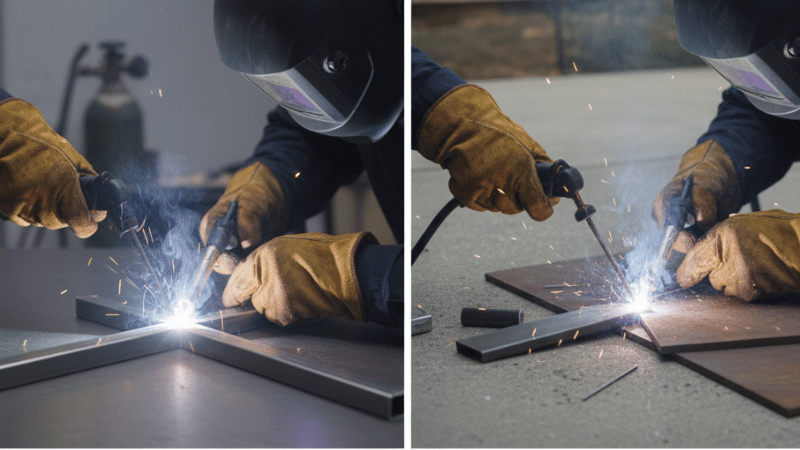
Beginner shortcut
- Mostly garage welding → MIG or MIG/flux-capable
- Mostly outdoor welding → flux-core or stick
- Want pretty stainless/aluminum later → MIG now, TIG later
Match the Welder to Your Projects (Thickness, Materials, Location)
Typical home projects (what they really need)
- Auto body: thin sheet → MIG with small wire and careful heat control
- Brackets/repairs: 1/8″ common → 120V MIG/flux often fine
- Gates/trailers: 3/16″–1/4″ common → 240V or dual-voltage recommended
- Furniture frames: thin tubing → MIG is forgiving and clean
Thickness-to-capability (rule-of-thumb)
- Thin sheet: 120V MIG is happiest
- 1/8″: 120V can do it comfortably with good prep
- 3/16″: 120V is possible but near limits; 240V feels easier
- 1/4″: doable with prep/multi-pass on some 120V setups, but far less frustration on 240V/dual
Materials checklist
- Mild steel: easiest
- Stainless: process + wire + gas choices matter
- Aluminum: look for spool-gun readiness or plan TIG later
Where you weld matters
- Indoors: ventilation and welding fumes control
- Outdoors: wind fights MIG gas coverage
- Extension cords: voltage drop can make your arc act like it drank three coffees
120V vs 240V Welders for Home Use (Reality, Not Fantasy)
When 120V is enough
- Learning basics
- Thin material and small repairs
- Occasional weekend welding
When 240V is smarter
- Frequent welding
- 3/16″–1/4″ shows up often
- You want longer beads without constant cooldown breaks
Dual-voltage = “buy once” option
Dual-voltage is often the best compromise: learn on 120V today, grow into 240V later.
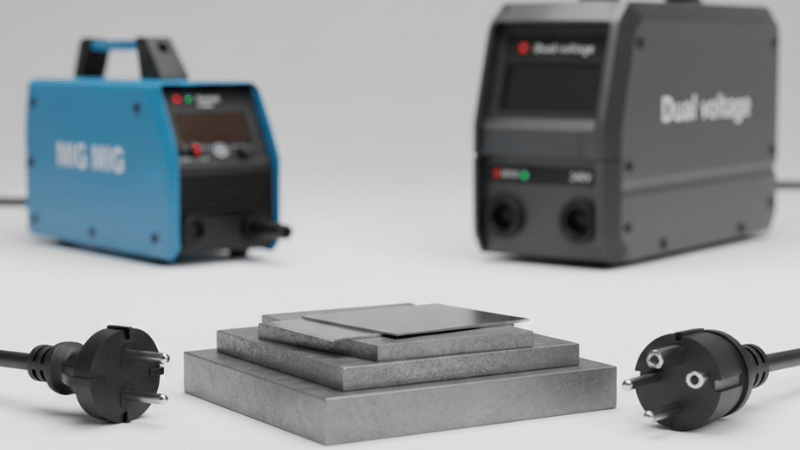
how iKratz fits the home-garage power situation
A lot of beginners don’t know whether they’ll stick with welding. That’s why many people choose beginner-friendly welders that keep controls simple and offer a path to level up later—especially if you might add a 240V outlet down the road.
The Beginner-Proof Spec Checklist (Bring This When You Shop)
Must-haves
- Stable arc (your weld should feel predictable)
- Solid wire feed (if MIG/flux)
- Common consumables (tips/nozzles you can source easily)
- Clear duty cycle + real warranty support
Nice-to-haves
- Synergic settings (faster dial-in)
- Thermal protection
- Spool-gun compatibility (if aluminum is on your horizon)
- Clear manual/spec sheet (seriously, it’s a green flag)
Red flags
- Inflated thickness claims without conditions
- Duty cycle hidden or vague
- Proprietary consumables you can’t find
- No support channels or unclear warranty terms
Budget & Total Cost of Ownership (TCO)
Realistic starter tiers
- Entry: light flux-core learning setup
- Mid: stronger MIG/dual-process with better wire drive
- “Buy once”: dual-voltage/multi-process you can grow into
Gas vs no-gas costs
MIG with gas is cleaner but may require cylinder + refills + regulator/flowmeter. Flux-core avoids gas but costs you more cleanup and fume attention.
Hidden costs beginners forget
- Better clamps and a decent ground
- Angle grinder + flap discs
- Ventilation basics
- Fire extinguisher (because sparks don’t care about your plans)
Best Welder for Beginners — Picks by Use Case (Shortlists, Not a Giant List)
No endless product dump here—just practical “choose-your-own-adventure” picks.
Best overall for most home garages (MIG/dual capable)
Look for a MIG that can also run flux-core, with:
- Reliable wire feed
- Easy controls
- Common consumables
- Support/warranty you can actually use
If you want “open the box and start learning without drama,” check the iKratz welder lineup for beginner-first machines—especially options that emphasize simple setup, predictable arc behavior, and home-use practicality.
Best budget beginner option (learning + light projects)
Go flux-core if:
- you want minimal setup
- you’ll weld outdoors sometimes
- you accept more spatter/cleanup
Just don’t expect it to behave like a high-end shop MIG on thin sheet.
Best for outdoor repairs (flux-core/stick leaning)
Prioritize:
- Wind tolerance (flux-core/stick)
- Decent leads/clamps
- Clear specs and duty cycle info
Best “grow with you” option (dual-voltage + future-proofing)
If you suspect 3/16″–1/4″ will show up often, dual-voltage is the “less regret later” choice.
Recommended beginner bundles
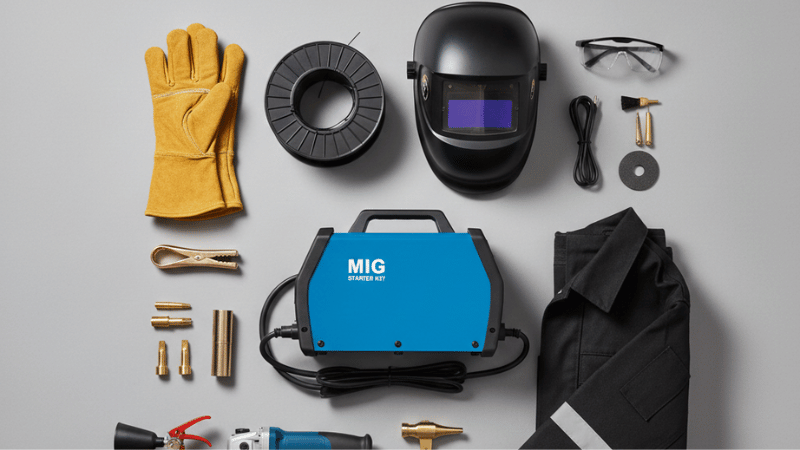
Minimum viable setup
- Welder + correct wire
- Auto-dark helmet, gloves, jacket
- Grinder + flap discs
- Wire brush/chipping hammer (flux-core)
- Better clamp/ground
Frustration-free setup
- Everything above +
- Gas setup (if using MIG with gas)
- Simple fume management plan (fans, airflow, local exhaust if possible)
“Portable” Welders (Including Saker-Style Units) — What to Check First
What people expect (and what physics allows)
People expect a tiny unit to weld thick steel all day. Tiny units often deliver: light-duty capability with heat limits and short duty cycles.
Legitimacy checklist
Verify:
- Clear input power requirements
- Duty cycle disclosure
- Warranty terms + real support
- Realistic thickness claims
Who it’s okay for (and who should skip)
Okay for: occasional light repair, quick tacks, small projects.
Skip for: structural/safety-critical work, thick steel as a main job, or anything where failure ruins your day (or your toes).
Safer alternatives
Choose compact machines from sellers with:
- transparent specs
- accessible consumables
- support channels
- clear manuals
Safety, Setup, and “Don’t Burn Your Garage Down” Basics
PPE essentials
- Helmet (correct shade range for your process)
- Gloves + welding jacket/sleeves
- Safety glasses (yes, under the hood)
- Respiratory protection if ventilation is limited
Fire safety checklist
- Clear the spark zone (it’s bigger than you think)
- Keep flammables away
- Keep the extinguisher reachable
- Hot metal looks exactly like cold metal (ask every welder ever)
Experience — My “First Weekend Welding” Checklist (So You Learn Faster)
What I wish I knew
- Most beginner issues are bad ground, dirty metal, or wrong settings
- Polarity matters (especially flux-core)
- Fit-up matters more than your ego wants to admit
60-minute setup routine
- Clean metal to bright steel
- Polarity check
- Wire tension + feed test
- Gas flow check (if MIG gas)
- Test beads on scrap of same thickness
- Adjust one thing at a time (not five)
Authority & Verification — How to Validate Claims Before You Buy
What to verify in manuals/spec sheets
- Input requirements (breaker/outlet reality)
- welder duty cycle meaning and duty cycle at usable output
- Recommended thickness ranges (and whether they assume beveling/multi-pass)
Service network and parts availability
- Can you buy tips/nozzles locally?
- Is warranty support real?
- Is the return policy sane?
Conclusion
For most home garages, MIG (or a MIG/flux-capable machine) is the easiest way to start getting clean welds fast. The right choice comes down to your material thickness, where you’ll weld (indoors vs outdoors), and whether you truly have 120V or 240V available.
Skip the “max amps” hype and buy for real-world performance: a stable usable range, honest duty cycle, solid wire feed, and dependable support. Do that, and you’ll spend more time welding—less time troubleshooting popcorn-sounding chaos.
Take the Next Step
Built for Real-World Beginner Welder Buying
Choosing the best welder for beginners works only if it matches your projects, your 120V/240V power, and where you weld. Use the checklist, budget for essentials (wire, tips, PPE, gas if needed), and skip the “buy twice” trap.
➡️ Visit iKratz to Explore Beginner-Friendly Welding Machines
Talk to People Who Understand the Trade-Offs
Every pick has trade-offs: MIG vs flux-core, 120V convenience vs 240V capability, portability vs duty cycle. iKratz specialists can turn your project list and power setup into a clear shortlist and starter bundle for day-one results.
➡️ Submit an Inquiry & Your Project Details Today
Frequently Asked Questions
Q1: Is MIG or flux-core better for a beginner?
A: MIG is usually easier indoors on clean metal; flux-core is simpler without gas and works better outdoors, but needs more cleanup and fume control.
Q2: Can a 120V welder weld 1/4-inch steel at home?
A: Sometimes with perfect prep and multiple passes, but it’s often frustrating; if 1/4″ is common, a 240V or dual-voltage machine is the safer choice.
Q3: Are portable welding machines worth it (like Saker-style compact units)?
A: They can be fine for light repairs and quick jobs, but verify duty cycle, real input power, warranty/support, and avoid using them for structural or safety-critical welds.