
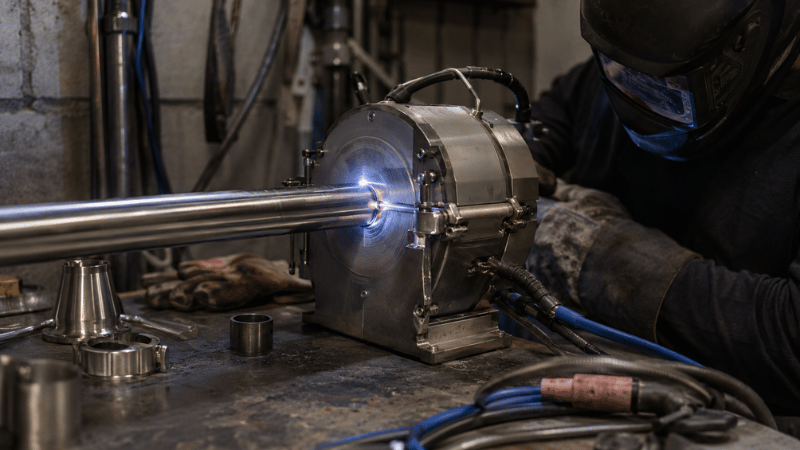
Choosing a closed orbital welding head is not as simple as matching a number on a tube chart. Diameter matters, naturally, but wall thickness, fittings, clearance, purge control, and power-source compatibility can turn an apparently perfect match into an expensive metal paperweight.
This guide explains how to qualify the complete application before comparing models.
What Is a Closed Orbital Welding Head?
A closed orbital welding head clamps around a stationary tube joint while a tungsten electrode rotates 360 degrees around it. The enclosed chamber surrounds the welding zone with shielding gas, helping protect the molten weld pool from atmospheric contamination.
Most closed heads are designed for autogenous orbital welding, meaning the tube ends are fused without filler wire. This makes them particularly useful for repeatable tube-to-tube welds in pharmaceutical, biotechnology, semiconductor, food-processing, instrumentation, and aerospace systems.
The weld head, however, is only one part of the machine. A complete orbital tube welding machine normally includes a programmable power supply, head cables, cooling equipment, gas-control components, tube inserts, tungsten electrodes, and joint-preparation tools.
In other words, buying only the head is a little like buying a steering wheel and expecting a complete car to arrive.
Start With the Tube Application
The first question should not be, “Which head handles this diameter?” It should be, “What exactly are we welding?”
Record the tube outside diameter, actual wall thickness, material grade, joint configuration, fitting dimensions, production environment, and inspection requirements. Also note whether the application involves straight tube, elbows, tees, reducers, ferrules, or other compact fittings.
A head may physically accommodate a 25 mm tube but still fail to clamp around a short elbow tangent. Mechanical capacity does not automatically mean application compatibility.
Sanitary and high-purity projects may also require weld-program storage, operator access control, batch records, or traceable welding data. These requirements influence the power supply and control platform as much as the head itself.
For an overview of available equipment configurations, explore the iKratz orbital welding systems.
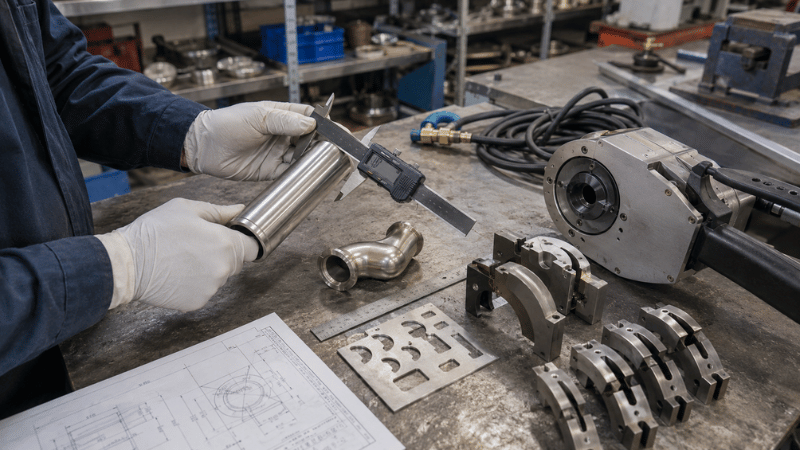
Closed vs. Open Orbital Welding Heads
Closed and open heads are not competing versions of the same tool. They solve different welding problems.
A closed orbital welding head provides an enclosed shielding chamber and compact, repeatable electrode movement. It is usually the stronger choice for smaller-diameter, thin-wall tubing and autogenous sanitary welds.
An open head provides more access around large pipes, heavy walls, unusual fittings, and joints requiring filler wire. It is generally more flexible, but it does not provide the same fully enclosed gas environment around the joint.
| Selection Factor | Closed Head | Open Head |
|---|---|---|
| Typical Workpiece | Small or medium tubing | Medium or large pipe |
| Wall Thickness | Thin wall | Thin to heavy wall |
| Filler Wire | Usually unavailable | Often available |
| Shielding | Enclosed chamber | External gas coverage |
| Joint Access | Limited by housing | More flexible |
| Common Applications | Sanitary and high-purity tubing | Process piping and heavy fabrication |
Choose a closed head when the application needs repeatable enclosed fusion welding. Consider an open head when the joint requires filler metal, greater wall-thickness capability, or more geometric freedom.
Is a Closed Head Suitable for Sanitary Tubing?
Yes—provided the entire process is properly controlled.
Sanitary tube welds typically require consistent penetration, a smooth internal bead, minimal oxidation, low heat tint, and repeatable documentation. Enclosed shielding helps create a stable welding environment, especially where shop drafts or field conditions could disturb external gas coverage.
Materials commonly welded include 304L and 316L stainless steel. Titanium and nickel alloys may also be processed, but their shielding and metallurgical requirements should be reviewed individually.
The current ASME BPE standard addresses equipment and piping used in bioprocessing applications. Meanwhile, ASTM A270/A270M covers stainless-steel sanitary tubing used in dairy, food, and related hygienic applications. Project specifications should determine which requirements apply.
A closed chamber improves shielding, but it cannot rescue contaminated tube ends, excessive mismatch, unstable purge pressure, or a badly prepared joint. Sadly, even sophisticated equipment has not yet learned how to negotiate with poor workmanship.
Seven Factors for Selecting a Closed Head
1. Tube Outside Diameter
Confirm the actual outside diameter rather than relying only on a nominal tube designation. Also verify that correctly sized clamping inserts are available.
The insert must hold the joint concentrically without deforming the tube. Loose inserts can produce misalignment; overly tight inserts can mark or distort thin-wall material.
2. Wall Thickness
Wall thickness determines the heat needed for full penetration and whether autogenous fusion is practical.
Very thin tubing is vulnerable to burn-through, distortion, concavity, and collapse. Thicker tubing may require more heat than a compact closed head can deliver efficiently, or it may require filler metal.
Do not assume that every sanitary joint is automatically suitable for fusion welding.
3. Material
Stainless steel, titanium, nickel alloys, and other materials respond differently to heat input and shielding conditions.
Material grade influences peak current, pulse balance, rotation speed, purge duration, electrode selection, and acceptable discoloration. Reactive alloys may require extremely low residual oxygen levels before the arc begins.
4. Joint Geometry
Tube-to-tube joints are normally the easiest applications to enclose. Tube-to-fitting joints require more careful checking.
Measure elbows, tees, ferrules, reducers, and valve connections. A fitting may fall within the diameter range but provide too little straight clamping length for the head.
This is one of the most common—and most avoidable—selection mistakes.
5. Available Clearance
Check radial clearance around the tube, axial access along the joint, and the space required to open and close the head.
A compact cleanroom skid, instrument panel, or installed process line may offer very little room. Create a simple clearance drawing or provide photographs before requesting a recommendation.
For tight small-diameter applications, the MWF-12 mini closed orbital welding head is one example of a compact enclosed-head configuration that should be evaluated against the actual joint dimensions.
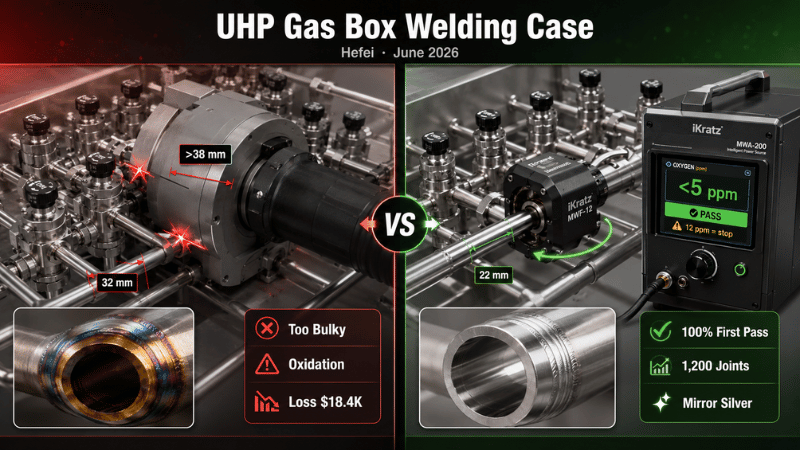
The Head Fit the Tube— but Not the 32 mm Gas Box
A UHP contractor used a bulky generic orbital head for 1/4-inch EP 316L tubing. It collided with nearby valves and allowed oxygen into the weld chamber.
Generic Closed Head
Tube diameter matched, but clearance and gas sealing failed.
- Housing collided with adjacent valve bodies
- Could not rotate inside the 32 mm spacing
- Leaking seals allowed ambient air inside
- Internal welds developed yellow-purple oxidation
MWF-12 + MWA-200
A compact head and oxygen interlock solved both failures.
- Only 22 mm radial clearance
- Full 360° rotation without collision
- Precision high-temperature chamber sealing
- Arc locked until oxygen falls below 5 ppm
The Financial Toll
The iKratz Fix: MWF-12 Micro Head + MWA-200 Control
The replacement system matched the compact gas-box geometry and automated oxygen verification before every welding cycle.
6. Production Environment
A shop workstation, cleanroom, construction site, and high-volume production line place different demands on equipment.
Field users may prioritize portability and rugged cables. Cleanrooms may require controlled materials and easy-to-clean surfaces. Production facilities may need rapid changeovers, high duty cycles, recipe storage, and data export.
The “best” head is therefore not universal. It is the one that behaves sensibly in your real production environment—not just in a suspiciously spotless brochure photograph.
7. Quality and Documentation
Determine how weld quality will be verified and recorded.
Requirements may include stored weld schedules, operator identification, parameter monitoring, alarm records, calibration history, coupon documentation, or borescope inspection. These features are usually controlled through the power supply and software, so head selection must be coordinated with the complete system.
The AWS guide for welding austenitic stainless-steel piping and tubing provides useful technical context, although the applicable project code and qualified welding procedure must remain the final authority.
Thin-Wall Welding Process Controls
Thin-wall welding has a narrow operating window. Too little energy creates incomplete penetration. Too much energy creates burn-through or excessive internal concavity. Somewhere between those two lies the acceptable weld—the metallurgical version of threading a needle while wearing gloves.
Critical variables include peak current, background current, pulse timing, rotation speed, arc gap, and weld-level programming. The procedure may divide the tube circumference into sectors to compensate for changing weld-pool behavior around the joint.
Fit-up is equally important. Tube ends should be square, flat, concentric, and nearly gap-free unless the qualified procedure specifies otherwise. Burrs, oil, moisture, abrasive residue, and cutting particles must be removed without cross-contaminating the surface.
Purge flow also requires balance. Insufficient purge can cause oxidation and discoloration. Excessive internal pressure may push the molten weld pool outward, creating concavity or an irregular bead.
Do not solve every purge problem by opening the regulator farther. Argon is useful, but it is not magic seasoning.

What a Complete System Should Include
A functional system normally includes:
- A programmable orbital welding power supply
- A compatible closed weld head and cable assembly
- A water-cooling system where required
- Tube-specific clamping inserts
- Shielding and purge-gas regulators
- Purge plugs, dams, or venting components
- Prepared tungsten electrodes and arc-gap gauges
- Tube cutting, facing, deburring, and cleaning tools
- Inspection and documentation equipment
Compatibility must be checked across electrical connections, communication protocols, cooling requirements, current capacity, cable length, and head-control functions.
The MWF Series closed-pipe welding systems provide several enclosed-head options for different tube sizes and application requirements.
Mini Application Example: 316L Sanitary Tube
Consider a 316L stainless-steel sanitary tube used in a pharmaceutical process skid. The joint is autogenous, the wall is thin, and internal discoloration must remain tightly controlled.
The initial selection should consider tube diameter, wall thickness, fitting tangent length, radial clearance, required weld records, and the power source already available. The proposed configuration would include a closed head, matching inserts, programmable power supply, cooling unit, purge equipment, and facing tools.
Representative coupons should then be welded using production material. Technicians should establish stable purge conditions, adjust current and pulse settings, verify arc gap, and inspect both internal and external weld profiles.
The most influential detail may not be tube diameter. It could be a short ferrule tangent, inconsistent facing, or excessive purge pressure. This is why sample welding provides more decision value than capacity charts alone.
Common Selection Mistakes
Selecting by diameter alone remains the classic error. Always include wall thickness, material, fitting geometry, clearance, and inspection needs.
Another mistake is ignoring power-source compatibility. A mechanically suitable head may not communicate with the existing controller or receive adequate cooling.
Some buyers also reuse one welding program across several tube sizes. A stored schedule is repeatable, but repeatably using the wrong schedule is not a quality strategy.
Finally, do not treat manufacturer operating ranges as guaranteed procedure windows. Published ranges are useful for initial screening. Final acceptance should come from representative trials and qualified procedures.
Before Requesting a Quotation
Prepare the tube outside diameter, wall thickness, material specification, fitting drawings, joint photographs, available clearance, expected weld volume, applicable standard, inspection method, and documentation requirements.
Also list existing power supplies, coolers, cables, and tooling. This helps identify whether you need a complete system or only compatible components.
Providing these details early reduces quotation revisions and prevents the dreaded post-delivery discovery that the head fits the tube beautifully—as long as there is no fitting attached.
Conclusion
The right closed orbital welding head must match the complete application: tube diameter, wall thickness, material, fitting geometry, clearance, environment, quality requirements, and power-source platform.
Use manufacturer size ranges as a starting filter, not final approval. For sanitary and thin-wall tube welding, validate the proposed system through representative preparation, controlled purge trials, sample welds, and inspection before production release.
Match the Head to Your Real Application
iKratz provides application-focused orbital welding solutions for sanitary, high-purity, aerospace, semiconductor, and industrial tube systems. Instead of simply recommending the first head that matches your diameter, our team can review your joint geometry, clearance, production requirements, and complete system compatibility.
Contact iKratz today to request an application review, equipment recommendation, or sample-welding discussion.
Frequently Asked Questions
What is the difference between closed and open orbital heads?
A closed head encloses the joint and is normally used for thin-wall autogenous tube welding. An open head provides greater access for larger pipes, heavier walls, unusual joints, and applications requiring filler wire.
Can a closed head weld sanitary stainless-steel tubing?
Yes. Closed heads are widely suited to sanitary stainless-steel applications when tube preparation, fit-up, purge conditions, welding parameters, and inspection requirements are properly controlled and validated.
What information is needed to select a weld head?
Provide tube outside diameter, wall thickness, material, joint type, fitting dimensions, clamping length, available clearance, weld volume, power-source information, applicable standards, and documentation requirements.
Does fitting within the published diameter range guarantee compatibility?
No. The diameter range only confirms basic mechanical capacity. Fitting geometry, straight clamping length, head clearance, wall thickness, material, duty cycle, and power-source compatibility must also be reviewed.