A longitudinal seam welding machine turns a difficult straight weld into a controlled, repeatable process. For tanks, cylinders, pipes, and rolled shells, that means fewer leaks, less distortion, and fewer mysterious weld defects appearing halfway through a shift.
This guide explains how the machine works, which welding process suits your application, and what to prepare before requesting a quotation.
What Is a Longitudinal Seam Welding Machine?
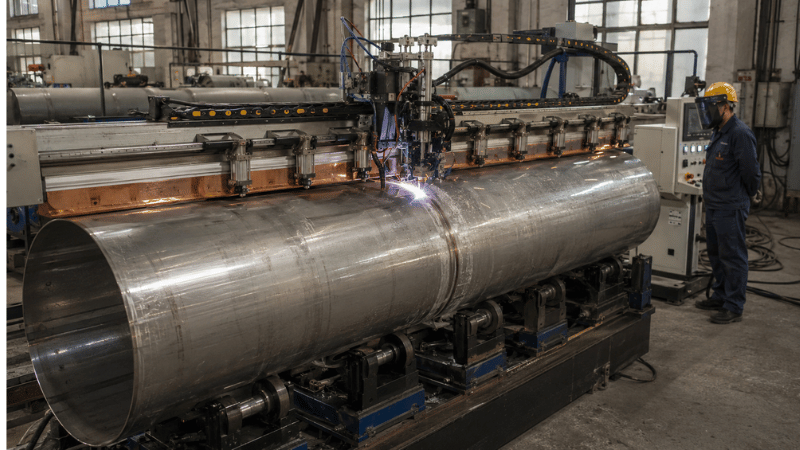
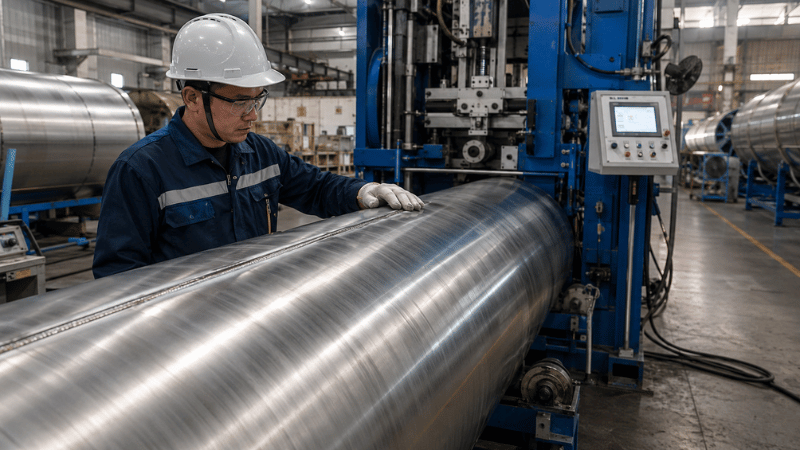
A longitudinal seam welding machine produces a straight weld parallel to the axis of a cylindrical or formed metal part. It is commonly used after sheet metal has been rolled into a tank shell, pipe section, drum, duct, or pressure-vessel body.
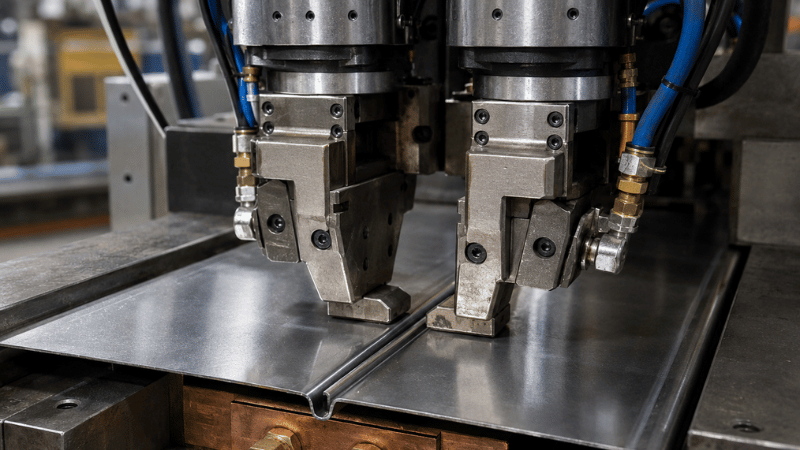
A proper long seam welder aligns the joint, clamps both edges, supports the weld root, and moves the torch at a controlled speed. Typical components include a rigid frame, torch carriage, pneumatic clamping fingers, copper backing bar, welding power source, PLC, HMI, gas control, and water cooling.
At iKratz, seam welding systems can be configured around the actual workpiece rather than treated as one-size-fits-all equipment. That matters because a thin stainless-steel duct and a heavy pressure-vessel shell may both have straight seams, but their welding requirements are worlds apart.
How the Welding Cycle Works
The operator loads the rolled shell over the backing mandrel and positions the joint above the copper backing bar. The clamping fingers then apply uniform pressure along both sides of the seam.
Once the part is secured, the controller starts shielding gas, initiates the arc, and moves the torch along the programmed weld length. Current, voltage, wire-feed speed, gas timing, and travel speed can be stored as recipes for repeat production.
At the end of the seam, programmed downslope, crater fill, or run-off tabs help reduce end defects. The clamps release after the weld cools sufficiently to control distortion.
Longitudinal vs. Circumferential Welding
A longitudinal machine welds in a straight line along the shell. A circumferential machine welds around the component’s diameter.
Many tanks and cylinders need both processes: one to close the rolled shell and another to attach heads, flanges, or end caps.
A dedicated seam welder also differs from a robot. Robots offer flexibility for complex weld paths, but they still require accurate fixturing. For high-volume straight seams, dedicated equipment often provides faster loading, simpler programming, and more reliable restraint.
Typical Applications
A tank welding machine may be used for water tanks, food-processing vessels, chemical containers, fuel tanks, and storage shells. These applications often prioritize leak tightness, appearance, corrosion resistance, and low distortion.
A cylinder welding machine can produce air receivers, water-heater shells, gas-cylinder bodies, filter housings, fire-extinguisher shells, and pressure-vessel sections.
Regulated pressure products must follow the applicable construction and inspection requirements. The ASME Boiler and Pressure Vessel Code covers requirements for pressure-vessel design, fabrication, inspection, and testing.
Other applications include HVAC ducts, chimneys, metal drums, appliance shells, transformer cases, and large-diameter pipes.
How to Specify the Right Long Seam Welder
Start with the part drawing, not the brochure. The key specifications are weld length, diameter, material, thickness, joint design, quality standard, and production target.
The machine stroke should cover the full seam plus clearance for arc starting, stopping, and torch access. Future product sizes should also be considered. Saving money on stroke length today can become expensive when next year’s shell is slightly longer.
Diameter range affects the mandrel, loading method, support system, and operator access. Small shells may need internal support, while large shells may require rollers or powered loading equipment.
Material and thickness determine the welding process, power-source capacity, backing design, cooling demand, and travel speed. Stainless steel, carbon steel, aluminum, and titanium all respond differently to heat, contamination, and restraint.
Joint design must also be clearly defined. Specify whether the seam is butt, lap, or flanged, along with root gap, edge mismatch, and tack-weld arrangement. Automation cannot compensate for uncontrolled fit-up. It simply repeats the conditions it receives.
The MWZF-2000 longitudinal seam welding machine is one example of equipment designed for cylindrical shells using TIG, MIG, MAG, or plasma welding processes.
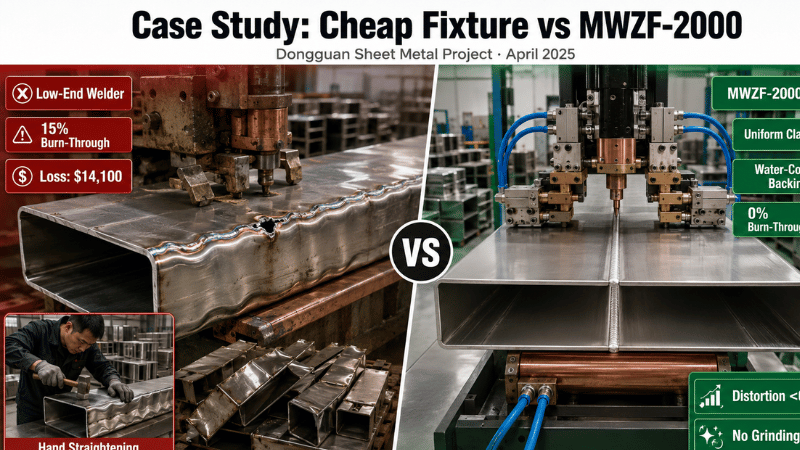
The Cheap Fixture Turned Straight Ducts into Wavy Scrap
A sheet metal shop used a low-end longitudinal welder for 0.8 mm stainless steel ducts. Uneven clamping and an uncooled copper backing bar caused severe distortion and a 15% burn-through rate.
Low-End Seam Welder
The machine could make a longitudinal seam, but could not control the thin sheet during heating.
- Uneven clamping pressure along the seam
- Uncooled copper backing bar trapped heat
- Sheet edges expanded into a wavy profile
- Frequent burn-through and unstable weld roots
MWZF-2000 Precision Control
The upgraded system controlled both sheet movement and heat buildup.
- Uniform pressure across the full seam length
- Water-cooled backing mandrel
- Argon backing grooves protected the weld root
- Clean seams with no post-weld grinding
The Financial Toll
The iKratz Fix: MWZF-2000 Longitudinal Seam Welder
The factory stopped production and introduced a precision system designed to stabilize thin sheet edges and remove heat from the weld zone.
TIG, MIG, Plasma, or Laser?
TIG is widely used for stainless steel, titanium, and thinner materials where bead appearance and process control are important. It produces clean welds but usually travels more slowly than wire-fed processes.
MIG or MAG offers higher deposition rates and is often suitable for medium-thickness carbon steel or stainless steel. The trade-offs include spatter, consumable management, and more wire-feed variables.
Plasma welding provides concentrated heat and strong penetration. It can increase speed, but it requires accurate joint preparation and stable process control.
Laser welding offers high speed, low heat input, and reduced distortion. However, it demands tight fit-up, stronger safety measures, and a much higher investment.
There is no universally best process. Representative sample welding is the most reliable way to confirm penetration, appearance, distortion, and cycle time.
Why Clamping and Copper Backing Matter
Buyers often focus on the welding power source, but tooling can influence weld quality just as much as amperage.
Pneumatic clamping fingers should apply even pressure along the seam. Inconsistent pressure can cause the joint to open, shift, or develop uneven penetration.
The copper backing bar supports the molten root, removes heat, and helps shape the underside of the weld. TWI’s guidance on weld backing notes that metal backing bars may be water cooled and grooved to support root formation.
Backing bars must also remain clean. Oxides, debris, and spatter can affect heat transfer or mark the next component.
Common Weld Problems
Incomplete penetration may result from low heat input, excessive travel speed, poor root-gap control, torch misalignment, or unsuitable backing geometry.
Burn-through usually indicates excessive heat, excessive gap, poor support, or insufficient cooling.
Porosity often comes from contamination, gas leaks, drafts, or inadequate cleaning. Seam wandering may indicate inaccurate loading, uneven clamping, part ovality, or incorrect torch position.
Distortion is controlled through stable heat input, uniform restraint, correct travel speed, backing-bar cooling, and suitable clamp-release timing.
Programmed gas pre-flow, post-flow, upslope, downslope, and crater fill can improve starts and stops. After all, a nearly perfect weld can still fail because of its final few millimeters.
Automation Features Worth Considering
Recipe storage allows operators to recall approved parameters for different products. This reduces setup errors and makes changeovers more consistent.
Seam tracking is useful when incoming parts have unavoidable geometric variation, but it should not replace proper joint preparation.
Parameter logging, alarm records, weld counters, and user-access controls improve traceability. Quick-change fixtures and adjustable tooling can also reduce downtime between products.
When comparing automatic welding equipment, evaluate changeover time as carefully as welding speed. A fast weld followed by a long fixture change is not much of a productivity win.
Safety features should include guarding, interlocks, arc shielding, emergency stops, and fume extraction. OSHA’s welding and cutting requirements address ventilation and other protective measures.
How to Validate the Machine
Drawings show nominal dimensions, but real components bring springback, ovality, inconsistent trimming, and material variation.
A supplier trial should use representative production materials. Record material grade, thickness, seam length, joint preparation, process, current, voltage, travel speed, gas flow, and cooling conditions.
The trial should verify loading time, alignment, start and stop quality, penetration, surface appearance, distortion, and total cycle time.
Inspection may include visual checks, macrosection testing, leak testing, pressure testing, or nondestructive examination. Acceptance criteria should be agreed before the factory acceptance test, not debated after the sample is welded.
Cost and ROI
Machine price depends on weld length, diameter range, material, thickness, welding process, tooling complexity, tracking, controls, and loading automation.
The total investment also includes fixtures, freight, installation, utilities, training, procedure development, maintenance, qualification, and spare parts.
Calculate the current cost per acceptable part, including labor, grinding, rework, consumables, scrap, inspection, leak-test failures, and downtime.
Then compare it with the expected automated cycle time, operator attendance, maintenance cost, and first-pass yield. Automation often creates value through repeatability and reduced rework, not merely faster torch movement.
Conclusion
The right longitudinal seam welding machine should be selected around the actual component. Weld length, diameter, material, thickness, joint design, quality requirements, and production output determine the correct configuration.
Clamping, alignment, backing, cooling, and sample validation are just as important as the welding process itself. Choose a supplier that can prove acceptable weld quality on representative parts.
Get a Welding System Built Around Your Part
iKratz combines application review, process selection, customized tooling, automated controls, and sample-weld validation to help manufacturers improve seam consistency and reduce rework.
Send your drawing, material, dimensions, production target, and quality requirements.
Contact iKratz today to discuss a preliminary configuration, testing plan, and quotation.
Frequently Asked Questions
What is the difference between longitudinal and circumferential welding?
Longitudinal welding creates a straight seam along the axis of a shell. Circumferential welding creates a weld around the component’s diameter.
Which welding process is best for tanks and cylinders?
The best process depends on material, thickness, fit-up, penetration, appearance, speed, and budget. TIG, MIG/MAG, plasma, and laser each suit different applications.
What information is needed for a quotation?
Provide a drawing, seam length, diameter, material, thickness, joint design, production volume, quality criteria, inspection method, and facility requirements.
Can one machine weld several product sizes?
Yes, provided the stroke, diameter range, clamping system, power source, and tooling cover the full product range. Adjustable supports and stored recipes can simplify changeovers.