Searching underwater welding machine can feel like shopping for a “welder that swims.” In wet welding, the power source usually stays topside. What really matters is the whole system that safely delivers current to the arc underwater.
This quick guide explains the core underwater welding equipment chain, what to look for, and a simple framework to choose a compatible wet welding setup.
Why “underwater welding machine” is a confusing term
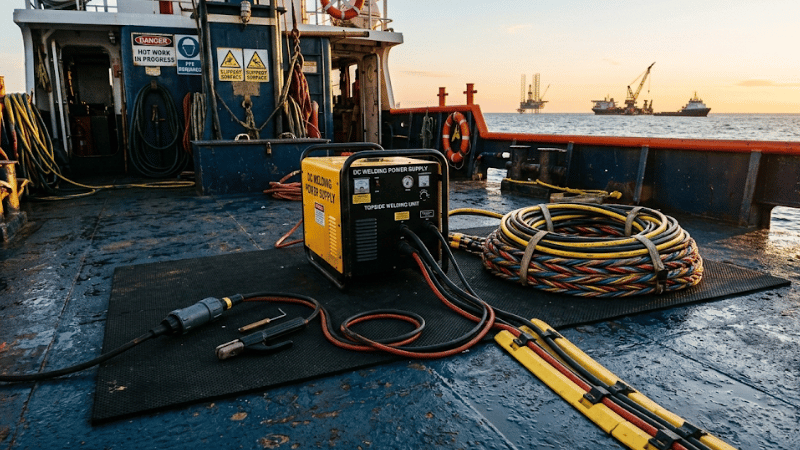
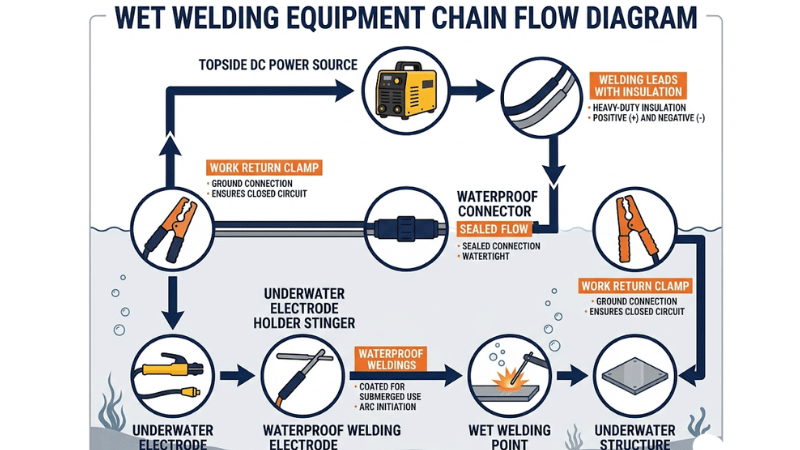
Most people use underwater welding machine as shorthand for a package: a topside DC power source, insulated leads, waterproof connectors, an underwater electrode holder (stinger), and matched waterproof welding electrodes.
If those parts don’t match, you’ll see arc instability, odd heating at connectors, and downtime that magically appears right when the tide is turning.
What an Underwater Welding Machine Really Is (Wet Welding Context)
The practical definition
In wet welding, the “machine” is essentially:
- A DC welding power supply on the surface
- welding leads insulation built for abrasion and immersion
- Waterproof, standardized connectors and strain relief
- An underwater-rated stinger and a solid return path
If you only remember one thing, remember the compatibility chain. Most “mystery problems” trace back to mismatched current range, undersized leads for the run length, connector inconsistency, or a stinger that’s not happy at the amperage being used.
Wet welding vs dry/hyperbaric (quick boundary)
Wet welding happens directly in water. It’s flexible and commonly used for repairs, but conditions are variable. Dry/hyperbaric welding happens in a chamber, offers better control, and adds complexity.
This article focuses only on wet welding equipment.
The Complete Wet Welding Equipment Chain (From Power to Arc)
1) Power source (the “machine”)
A good wet-welding power source is boring in the best way: stable DC output, predictable controls, and a realistic duty cycle at working current.
Avoid picking solely on “max amps.” For field work, the question is: can it hold the output you need, consistently, without turning the deck into a sauna?
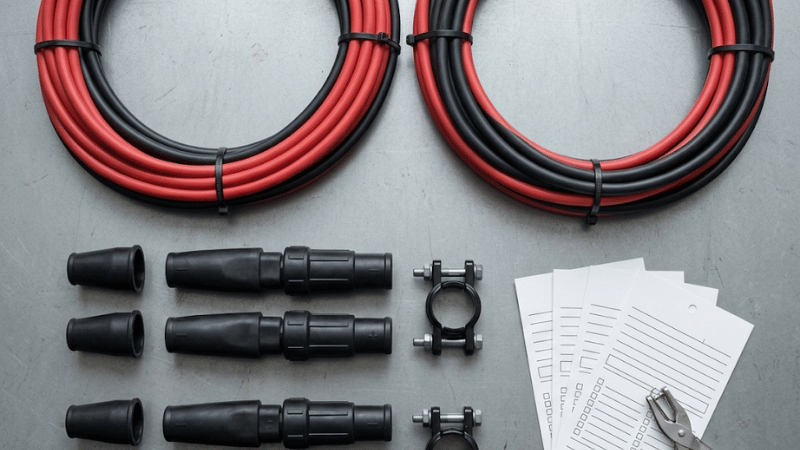
2) Leads and connections
Lead planning is where safe performance is won.
- Plan lead length based on real routing distance
- Size the cable gauge for current and voltage drop
- Protect insulation from sharp edges and pinch points
- Standardize connector types, then stock spares that match
A practical rule: if your lead run grows, your discipline must grow with it, because the ocean is great at finding weak points in insulation and terminations.
3) Underwater electrode holder (stinger)
An underwater electrode holder (stinger) needs immersion-ready construction and a rating that matches your current range. It should also feel secure in gloved hands, because dexterity underwater is never as good as it is in a brochure.
4) Waterproof electrodes
Waterproof welding electrodes are designed for wet conditions, with coatings aimed at stabilizing the arc and reducing moisture-related problems. Handle them like precision consumables, not like generic rods.
5) Return (ground) system
A poor return path can imitate a dozen other issues. Keep contact clean, secure, and repeatable, and inspect return cables with the same seriousness as your hot lead.
A Natural “Reality Check” on Buying Gear (Soft Plug, Mid-Article)
Here’s where many teams get stuck: they can find a welder, they can find cables, they can find a stinger, but they can’t guarantee the full chain is compatible once you factor in depth range, cable runs, connector standards, and spares planning.
That’s exactly why ikratz.com focuses on welding-related equipment and custom configurations. Instead of selling a random pile of parts, the goal is to personalize underwater welding equipment around your constraints, for example your required cable length, connector type, electrode plan, and inspection-friendly spares kit. It’s a quieter kind of advantage, because it shows up as fewer surprises on site.
Decision Framework: Choose a Wet Welding Setup in 10 Minutes
Step 1: Define the job
Write down:
- Depth range and environment
- Material and thickness
- Access constraints and visibility
- Expected current range
- Available topside power (utility or generator)
Step 2: Check the compatibility chain
Confirm these match:
- Machine output range and duty cycle
- Lead length and gauge
- Connector standard across the kit
- Stinger rating and connection type
- Electrode type and diameter plan
Step 3: Build the minimum safe configuration
Minimum safe usually includes:
- DC power source sized with headroom
- Leads with robust welding leads insulation
- Underwater-rated stinger and correct return path
- A simple inspection checklist before energizing
Step 4: Add productivity upgrades
Once minimum safe is locked:
- Standardized connectors across your kits
- A spares pack that matches real failure modes
- Better cable routing protection and strain relief
- A log for inspections and replacements
Safety and “Stop Work” Rules (Non-negotiable)
Wet welding combines electricity with a diving environment, so safety procedures must be supervised by trained professionals.
Stop work immediately if:
- Insulation damage or exposed conductor is found
- Connectors heat abnormally or loosen repeatedly
- Comms fail or become unreliable
- You cannot confirm return path integrity
- Power becomes unstable or inconsistent
For general, non-competitive safety background, these two references are solid starting points:
- OSHA commercial diving overview: https://www.osha.gov/commercial-diving
Conclusion
Wet welding is less about a “welder underwater” and more about a reliable topside DC power source paired with a safe delivery chain. When the underwater welding machine choice, leads, connectors, stinger, electrodes, and return path are compatible, arc stability and uptime improve immediately.
If you want to reduce guesswork, treat the system as one integrated package. That’s also where customization helps: matching cable runs, connector standards, and spares planning to the job, so your setup behaves consistently from shift to shift.
Take the Next Step
Repeatable Wet Welds, Not Guesswork
When safety and uptime matter, don’t rely on “close enough.” A correctly spec’d wet welding setup keeps current delivery, insulation integrity, and consumable compatibility consistent—so results stay stable shift to shift.
➡️ Visit Our Website to Explore Custom Underwater Welding Equipment
Talk to People Who Plan for Real-World Conditions
We’ll match your depth range, materials, thickness, access limits, jobsite power, and connector standards to the right underwater welding machine setup—plus a spares and inspection-friendly plan that cuts rework and surprises.
➡️ Submit an Inquiry & Your Project Details Today
Frequently Asked Questions
Q1: Is there a special “underwater welding machine,” or is it just a normal welder?
A: It’s usually a standard topside DC power source, but wet welding requires a complete safe-delivery chain: insulated leads, sealed connectors, underwater-rated stinger, proper return path, and matched waterproof electrodes.
Q2: What should I prioritize when choosing a wet welding power source?
A: Stable DC output, adequate amperage headroom and duty cycle, compatibility with jobsite power, and a configuration that matches your lead length, connectors, and stinger rating.
Q3: Can underwater welding equipment be customized for my site constraints?
A: Yes. Many teams tailor cable lengths, connector types, spares kits, and electrode plans to their environment and workflow. ikratz.com can configure a compatible package based on your project inputs.