If you’ve ever asked “what is a duty cycle?”, here’s the clean version: it’s ON time ÷ total time. That’s it. No magic, no mystery—just timing.
The confusion comes from where you use it: electronics (signals/PWM), motors (thermal duty types), and equipment ratings (safe run time before overheating). Same phrase, different consequences.
Jump to your scenario: Signals/PWM • Motors • Equipment ratings • Measuring duty cycle
What Is a Duty Cycle? (Plain-English Definition)
The universal idea: “how long something is ON”
The duty cycle definition is the fraction of time something is active during a repeating cycle.
Picture a machine that runs 15 seconds, rests 45 seconds, repeat. It’s “ON” 25% of the time. Simple. Brutally simple.
The two common meanings you must not mix up
Here’s the line in the sand:
- Signal duty cycle: a waveform is HIGH for part of each period (classic PWM square wave timing).
- Device/equipment duty rating: a machine can safely operate only part of the time before it overheats and needs cooldown.
Motors add another layer: standardized motor duty types (S1, S2, S3…) that describe heating behavior under defined patterns.
Quick everyday examples (10%, 50%, 80%)
- 10%: quick burst, long nap.
- 50%: half work, half rest (still not “half power” in every system).
- 80%: mostly on—great for productivity, spicy for heat.
Duty Cycle Formula and How to Calculate It
Core formula (percentage form)
Duty cycle (%) = (ON time ÷ total period) × 100
Calculate from ON/OFF times (Ton, Toff)
If you have Ton and Toff:
- Period = Ton + Toff
- duty cycle percent = Ton ÷ (Ton + Toff) × 100
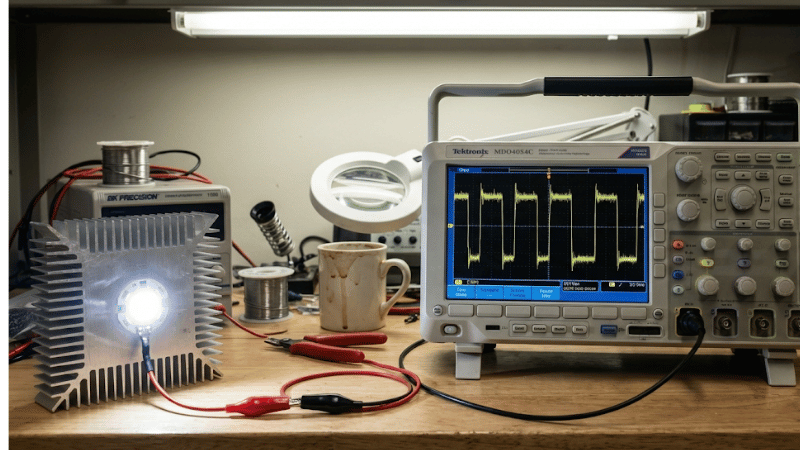
Calculate from pulse width and frequency
If you know pulse width (PW) and frequency (f):
- Period (T) = 1 ÷ f
- Duty cycle (%) = PW ÷ T × 100
Calculate from an equipment duty rating (the “minutes allowed” style)
When a spec says “30% duty,” it often means a fixed time window (commonly 10 minutes in welding-type equipment).
- 30% of 10 minutes = 3 minutes ON, 7 minutes cooling
Common unit traps (the ones that start arguments)
- Mixing milliseconds and seconds (1,000× error)
- Confusing Hz and kHz (another 1,000× error)
- Treating an equipment rating like it’s “continuous unless the vibes are off”
Worked Examples (Fast, No Guesswork)
Example 1 — Ton/Toff (simple)
A relay is ON for 12 s and OFF for 48 s.
- Period = 60 s
- Duty cycle = 12 ÷ 60 × 100 = 20%
Example 2 — Frequency + pulse width (electronics)
PWM frequency = 2 kHz. Pulse width = 150 µs.
- Period = 1 ÷ 2000 = 0.0005 s = 500 µs
- Duty cycle = 150 ÷ 500 × 100 = 30%
Example 3 — “30% duty cycle” on a machine spec sheet
If the rating is 30% over a 10-minute window:
- 3 minutes ON
- 7 minutes OFF
Example 4 — Intermittent pattern (run/rest repeating)
A motor runs 45 s, rests 15 s.
- Period = 60 s
- Duty cycle = 45 ÷ 60 × 100 = 75%
Checklist before calling it “safe”: run time, rest time, ambient temp, load, and how cooling actually happens during OFF.
PWM and Duty Cycle (How It Changes Power)
What PWM is (one sentence)
PWM (pulse-width modulation) controls average power by switching fast and adjusting the PWM duty cycle.
Duty cycle’s effect on average voltage/current/power
For many loads, duty cycle correlates with average voltage over time (conceptually: more ON time = more delivered energy).
But real behavior depends on frequency, load type (resistive vs inductive), ripple, and switching losses. Duty cycle is a big clue, not the whole detective story.
PWM examples people actually care about
- LED dimming: higher duty = brighter
- DC motor speed control: duty affects speed, but torque/current depends on load and controller behavior
- Solenoids/injectors: high duty for pull-in, lower duty for hold (less heat, less drama)
What duty cycle does not tell you by itself
Duty cycle alone won’t tell you frequency, edge quality, switching losses, ripple, or whether your inductive load is about to kick back like a mule.
For a practical welding-side example of real equipment specs, see iKratz’s MWA-400 Orbital Welding Power Source (note the stated duty cycle at rated current).
Motor Duty Cycle vs Motor Duty Rating (Stop Confusing These)
Signal duty cycle driving a motor vs motor duty type rating
- Signal duty cycle: what the controller outputs (PWM timing).
- Motor duty type: how the motor is rated to handle heat under defined operating patterns.

Motor duty types (S1, S2, S3…)
Standards like IEC 60034-1 define duty types such as:
- S1: continuous duty (thermal steady state)
- S2: short-time duty (run then full cool-down)
- S3: intermittent periodic duty (cycling run/rest)
External reference (standards context): IEC 60034-1 overview text
How to pick the right motor duty rating for your load profile
Use this checklist:
- load torque profile (steady/cycling/shock)
- starts/stops per hour
- ambient temperature and airflow
- enclosure and cooling method
- safety margin (because reality is undefeated)
Practical shortcuts
If your cycle is heavy or frequent: oversize, add cooling, reduce peak load, or change gearing. The cheapest fix is often “don’t turn heat into a lifestyle.”
Equipment Duty Cycle Ratings (Welders, Power Tools, Drivers)
What a duty cycle rating means operationally
This is the “how long can I run before the machine overheats?” number. It’s about thermal limits, not feelings.
The 10-minute window concept (convert % to minutes)
In many welding-style ratings, duty is expressed over a 10-minute period:
- 20% duty → 2 minutes ON, 8 minutes OFF
- 60% duty → 6 minutes ON, 4 minutes OFF
Want a buyer-style view that ties cost, output, and duty rating together? iKratz’s blog How Much Is a Welder in 2026? breaks down what actually matters.
Why duty rating drops as output/load increases
More output means more current, more heat in power electronics, magnetics, and cables—so cooldown needs increase.
Safety + productivity implications
Ignore duty limits and you’ll meet: thermal shutdowns, accelerated insulation aging, and downtime that arrives exactly when production is behind. (It’s got impeccable timing.)
Quick comparison matrix
| Term | What it measures | Typical window | What goes wrong if misread |
|---|---|---|---|
| Signal duty cycle | pulse ON vs period | microseconds → seconds | wrong power/control behavior |
| Equipment duty rating | safe runtime vs cooldown | often 10 minutes | overheating, shutdowns, damage |
| Motor duty type (S1–S10) | thermal suitability under patterns | minutes → steady state | undersized motor, overheating |
How to Measure Duty Cycle (Scope vs Multimeter)
Best tool by scenario
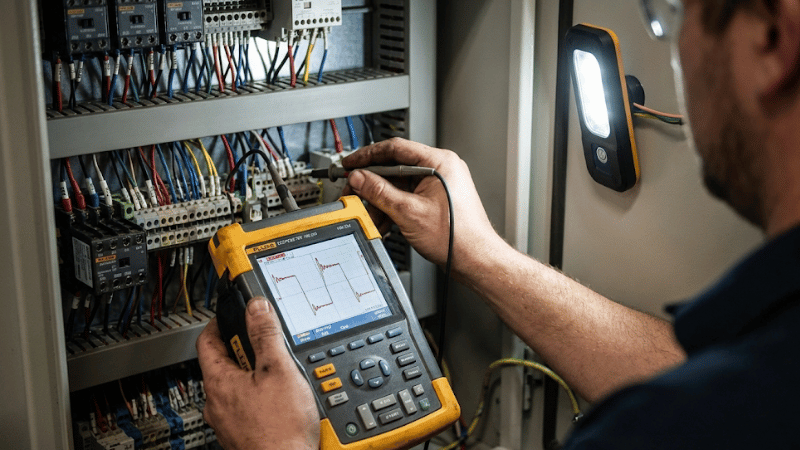
- Oscilloscope: waveform shape, noise, edge quality, thresholds
- DMM duty function: quick duty cycle percent if signal is clean and in range
- Logic analyzer: great for digital timing
External reference (measurement): Fluke guide on measuring duty cycle
Step-by-step measurement checklist (high-level)
- Probe the correct node (controller pin vs load can look very different).
- Use solid grounding and correct coupling.
- Set thresholds correctly (noise can fake your numbers).
- Confirm frequency is within your tool’s supported range.
Top mistakes techs make (and quick fixes)
- Wrong threshold → adjust trigger/measurement levels
- Noisy edges → bandwidth limit/averaging on scope
- DMM out of range → switch to scope
- Circuit loading → use proper probe impedance/attenuation
Common Pitfalls and How to Fix Them (Real-World)
Calculation pitfalls
Mixing Ton/Toff, confusing period vs frequency, and percent vs decimal are the “classic hits.”
Application pitfalls
Assuming 50% duty = half power everywhere is how people end up saying, “Huh… why is it still hot?”
Rating pitfalls
Treating a duty rating like continuous operation—and ignoring ambient temp, airflow, or enclosure—is a shortcut to reduced lifespan.
Experience Notes: What Real PWM Signals Teach You
In the field, PWM signals aren’t always pretty. Noise, edge ringing, and wiring effects can make “simple duty” readings bounce around.
My “3 checks” before trusting a number:
- confirm duty and frequency on a scope
- validate threshold logic
- compare at controller output vs at the load
External reference (PWM learning lab): Analog Devices PWM lab notes
Trust and Safety Notes
Duty cycle is a timing metric, not a safety guarantee. Temperature rise depends on environment, cooling, load, and how the rating was tested.
For high-power systems, safety-critical controls, or industrial machinery retrofits, consult qualified professionals and follow manufacturer manuals and local codes.
Conclusion
Duty cycle means “ON time ÷ total time,” but the time window depends on use. In signals and PWM duty cycle, it’s pulse ON time versus the waveform period—helpful for timing and averages, not a full heat prediction. In motors/equipment, duty is thermal: duty types (S1/S2/S3…) describe heating under cycles, and equipment ratings mean “run, then cool” (often over 10 minutes).
To calculate duty cycle, use the right formula (Ton/Toff, pulse width + frequency, or percent-of-window) and validate with real conditions—thresholds, load, ambient temperature, airflow, enclosure.
Take the Next Step
Built for Real Duty Cycles, Not Brochure Math
When duty cycle limits are real—and overheating means downtime—your equipment needs to handle sustained output, harsh environments, and predictable thermal performance. Explore professional welding solutions designed for demanding industrial work where “cooldown time” is part of the plan, not a surprise.
➡️ Visit iKrtaz Website to See Professional Welding Equipment
Talk to People Who Think in Thermal Limits
If you’re balancing output, runtime, and cooldown windows, we’ll help translate your actual cycle (minutes ON/OFF, load, ambient temperature, airflow) into a safer equipment setup—so you hit productivity targets without cooking your machine.
➡️ Submit an Inquiry & Project Specifications Today
Frequently Asked Questions
1) What is duty cycle in simple terms?
Duty cycle is how long something is ON compared to the total cycle time (ON + OFF), usually expressed as a percentage.
2) How do I calculate duty cycle from frequency and pulse width?
Find the period (1 ÷ frequency), divide pulse width by the period, then multiply by 100%.
3) What does a 30% duty cycle mean on a welder or machine rating?
It usually means you can operate for 30% of the stated time window (often 10 minutes) at that output, then you need the remaining time to cool.