Introduction
A heat exchanger is one of those “boring” pieces of equipment that quietly keeps your facility profitable. It shows up everywhere—HVAC, power, chemicals, oil & gas, food, manufacturing—because controlling temperature controls energy cost, quality, and uptime.
If you’ve ever cooled a hot cup of coffee by stirring (faster heat transfer!) you already understand the concept. Heat exchangers just do it with better math, better materials, and fewer burnt fingers.
What Is a Heat Exchanger?
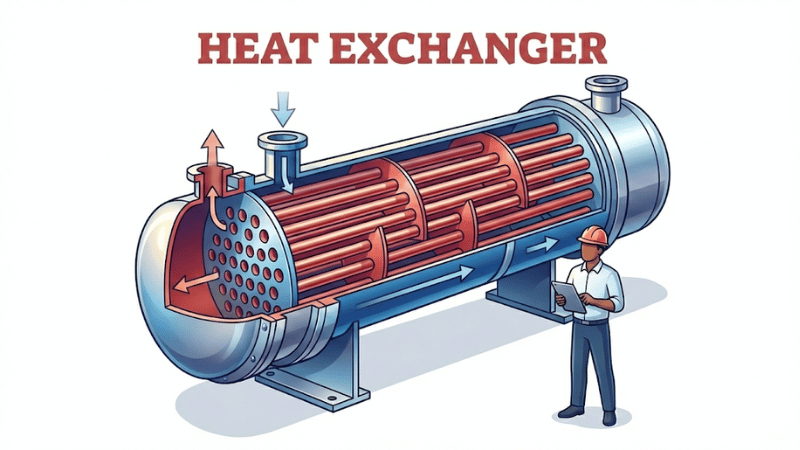
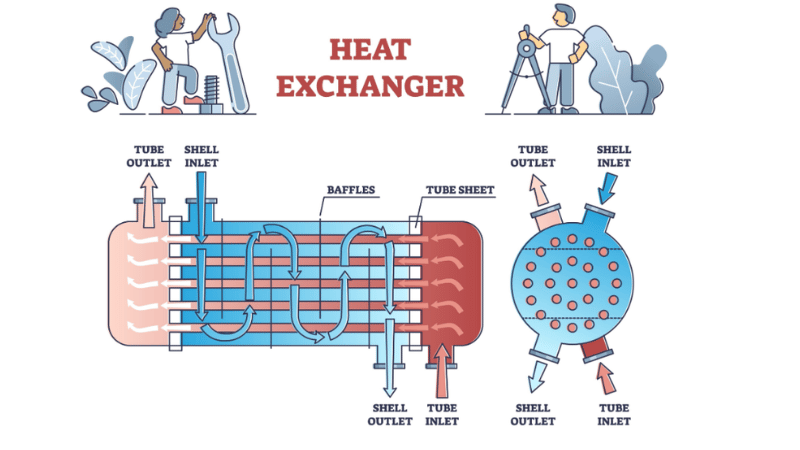
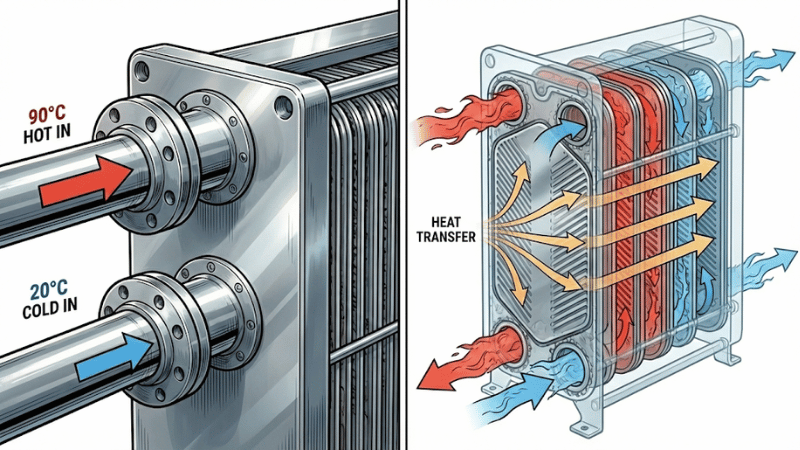
A heat exchanger transfers heat between two fluids—liquid/liquid, gas/liquid, or gas/gas—usually separated by a metal wall so they don’t mix. The goal is to heat, cool, condense, or recover waste heat without wasting utilities.
Don’t confuse it with a heater or chiller. A heat exchanger mainly moves heat from one stream to another; heaters/chillers often add or remove heat using steam, refrigerants, or chilled water.
Common uses include process heating/cooling, condensing and evaporating duties, and heat recovery in HVAC and industrial systems.
How Do Heat Exchangers Work?
Heat flows from hot to cold (thanks, thermodynamics). The exchanger’s job is to control the rate of that heat flow safely and efficiently.
Most performance comes from two mechanisms: conduction through the wall and convection on each fluid side. Radiation exists but usually isn’t the star of the show in typical industrial equipment.
Three practical levers dominate performance:
- Temperature difference (ΔT) and approach temperature
- Surface area (more plates/tubes/fins = more transfer)
- Flow regime (more turbulence often improves transfer but increases pressure drop)
In other words: you can make it transfer more heat, but you’ll pay somewhere—size, pumping power, fan power, or maintenance.
Flow Arrangements That Change Performance
In counterflow vs parallel flow, counterflow usually performs better because the temperature driving force stays stronger along the exchanger length. Parallel flow loses driving force quickly, which can limit how close outlet temperatures can get.
Crossflow is common in air-handling and finned equipment because it’s practical for packaging and airflow, even if it’s not always the absolute best thermally.
Approach temperature is how close the hot outlet can get to the cold inlet (or vice versa). Tight approaches look great on paper, but they usually mean larger surface area, higher cost, and often a higher risk of fouling headaches.
Major Types of Heat Exchangers
Shell-and-Tube
A shell and tube heat exchanger is the industrial workhorse—strong, flexible, and happy in high pressure/high temperature service.
Best for: harsh conditions, dirty fluids, particulates, boiling/condensing
Trade-offs: robust and forgiving, but bigger footprint and cleaning can be more labor-intensive
Common variants you’ll see:
- Fixed tubesheet: simple and common
- U-tube: handles thermal expansion well
- Floating head: easier inspection/cleaning (usually higher cost)
Plate Heat Exchangers (PHE)
A plate heat exchanger (PHE) is compact and very efficient when fluids are relatively clean.
Best for: tight footprint, high efficiency, many HVAC and industrial liquid duties
Trade-offs: excellent performance, but sealing/compatibility and fouling tolerance depend on design
Typical subtypes:
- Gasketed: easiest to open, inspect, and expand
- Brazed: compact, no gaskets, but less flexible for aggressive cleaning
- Welded: better for tougher fluids/temperatures, higher upfront cost
Air-Cooled (Fin Fan)
An air-cooled heat exchanger (fin fan) dumps heat to ambient air—no cooling water loop needed.
Best for: water-scarce sites, remote plants, high water-treatment burden
Trade-offs: depends on ambient temperature, needs space, adds fan power and noise
“Special Tools” When Needed
- Double-pipe: simple choice for small duties and high pressure
- Spiral: better for viscous/fouling services (often more forgiving flow paths)
- Scraped-surface: for fluids that clog everything else (viscous, sticky, particulate-heavy)
How to Choose the Right Heat Exchanger
Define the duty (minimum data)
You need: heat load, inlet/outlet temperatures, flow rates, allowable pressure drop, and turndown range. If those are fuzzy, the design will be fuzzy too—just with nicer spreadsheets.
Classify the fluids (risk map)
Flag anything corrosive, erosive, viscous, scaling, biofouling-prone, or particulate-laden. This is where material selection matters—corrosion-resistant materials like stainless steel or titanium often save you from expensive “surprise maintenance.”
Match operating extremes
High pressure/high temperature and phase change (boiling/condensing) often push you toward shell-and-tube or welded plate designs. Tight approach temperatures can be done with plates, but only if fouling and cleaning are realistically planned.
Maintenance-first reality check
Ask: how will it be cleaned—CIP, manual cleaning, or both? Also check physical access: can you pull a tube bundle, handle plates, or reach fin-fan sections safely?
Score with TCO thinking
Don’t pick purely on efficiency. Score options 1–5 across performance, footprint, maintainability, reliability, and total cost (energy/water/chemicals/labor/downtime). The “best” exchanger is usually the one that stays clean enough to actually meet its duty.
Maintenance, Failure Modes, and Prevention
Most failures come from fouling, corrosion, vibration damage, gasket degradation, or freezing. Fouling factor assumptions are a frequent culprit—too optimistic, and your exchanger slowly turns into a very expensive insulated box.
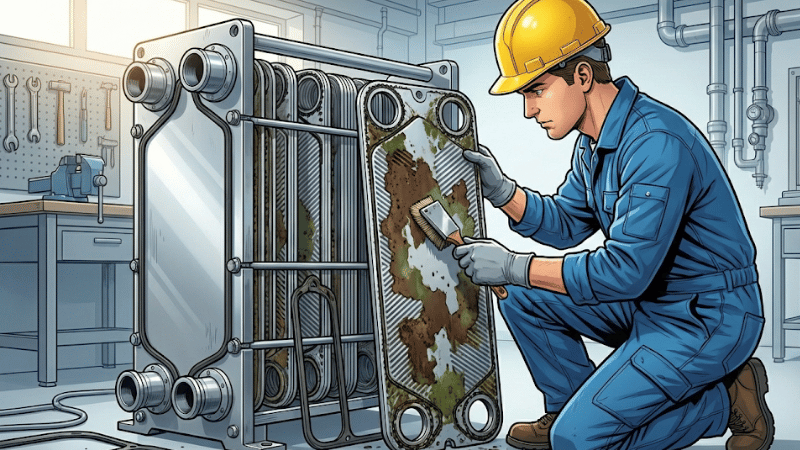
Watch for rising pressure drop and falling outlet performance. Prevention typically involves filtration, sensible velocities, water treatment, and planned cleaning intervals.
Quick maintenance by type:
- Plate: inspect plates and gaskets; CIP carefully (chemistry matters)
- Shell & tube: mechanical or chemical cleaning; inspect tubesheets/tubes
- Air-cooled: clean fins; inspect fans, belts, motors; plan around seasons
Real-World Notes: The 10 Questions That Prevent Bad Specs
- What’s the duty and required outlet temperatures?
- What are allowable pressure drops on both sides?
- What’s the full flow range (turndown)?
- Any solids, viscosity swings, or “sticky” behavior?
- What fouling assumptions are used (and why)?
- Any corrosion history or chloride limits?
- Cleaning method: CIP, mechanical, or both?
- Access constraints: bundle pull / plate pull / fin access?
- What’s the thermal/pressure-drop guarantee basis?
- Spares: lead time and recommended stock (gaskets, tubes, fan parts)?
If you can answer these, you’ll sound competent in vendor calls—and you’ll avoid buying something that can’t be cleaned without a miracle.
Conclusion
A heat exchanger is a controlled way to move heat from hot to cold, using temperature difference, surface area, and flow behavior to hit a required duty without mixing fluids. The basics are simple; the success is in matching real operating conditions to the right design.
In practice, selection isn’t just about peak thermal performance. Shell and tube heat exchanger units win in harsh duty, plate heat exchanger (PHE) units shine in compact clean-service efficiency, and air-cooled heat exchanger (fin fan) designs fit water-limited sites—while maintenance access, fouling risk, and total cost of ownership usually decide the true winner.
Take the Next Step
Built for Real-World Heat Exchanger Duty
Facilities running hot, pressurized, or fouling-prone services don’t “wing it” on thermal equipment. Shell and tube heat exchanger robustness, plate heat exchanger (PHE) efficiency, and air-cooled heat exchanger (fin fan) water-savings only matter if reliability and maintainability match your reality. Use a selection approach built around duty, fluids, access, and TCO—because downtime isn’t a rounding error.
➡️ Visit iKratz to See Professional Heat Exchanger Solutions
Talk to People Who Understand the Trade-Offs
Every exchanger decision is a balancing act—performance, pressure drop, materials, fouling, cleaning method, and site utilities. iKratz specialists help translate your operating data into a vendor-ready shortlist and spec package—onshore or offshore, clean service or “this fluid hates everyone.”
➡️ Submit an Inquiry & Project Specifications Today
Frequently Asked Questions
Q1: What is the difference between parallel flow and counterflow?
A: Parallel flow sends both fluids in the same direction, so the temperature driving force drops quickly. Counterflow vs parallel flow usually favors counterflow because it maintains a stronger driving force across the exchanger—often enabling higher efficiency and tighter approaches.
Q2: Why do heat exchangers fail?
A: Fouling is the most common cause because it insulates heat transfer surfaces and increases pressure drop. Other frequent causes include corrosion from poor material selection, vibration-related tube damage, and gasket degradation in plate units.
Q3: How do you increase the efficiency of a heat exchanger?
A: Common levers include adding surface area (more plates/tubes/fins), improving turbulence with appropriate velocity (within pressure-drop limits), using counterflow where feasible, and preventing/removing fouling through filtration, water treatment, and scheduled cleaning.