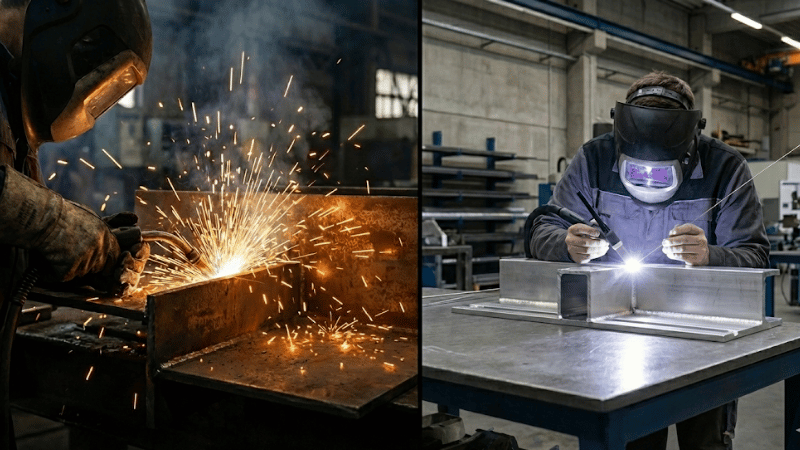
Ever tried to weld aluminum like it’s steel? If so, you probably created modern art instead of a solid bond. These metals are worlds apart.
This guide cuts through the sparks and jargon to show you exactly how to conquer both, making you the master of the torch and arc for any project.
The Fundamental Science: Why They Behave So Differently
At first glance, steel and aluminum are just metals. But to a welder, they’re as different as a heavyweight boxer and a Formula 1 driver. Steel is dense, strong, and straightforward. Aluminum is light, tricky, and demands respect.
The main culprit for their differences is thermal conductivity. Aluminum spreads heat like gossip in a small town—fast and all over the place. Steel, however, keeps the heat localized. This is why you can easily burn a hole straight through aluminum if your settings aren’t perfect.
Then there’s the oxide layer. Aluminum is covered in a tough, invisible “skin” of aluminum oxide that melts at a much higher temperature than the aluminum itself. You have to aggressively clean this layer off before you can even think about striking an arc.
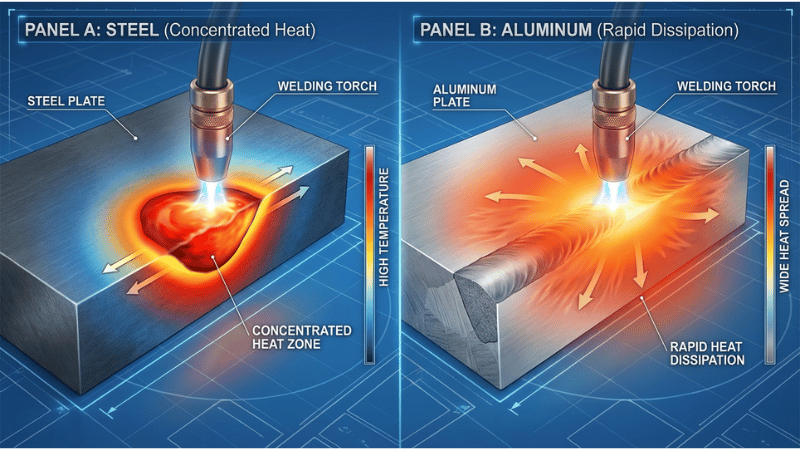
Steel vs. Aluminum: Which Welding Process Should You Choose?
Choosing your process depends entirely on the metal. Trying to weld aluminum with a stick welder is a recipe for frustration and a pile of scrap metal.
For steel, your options are wide open. MIG, TIG, and Stick (SMAW) welding all work beautifully. Steel is forgiving, making it the perfect material for both beginners and industrial applications where strength and cost-effectiveness are key.
Aluminum, on the other hand, is a specialist. You’ll primarily use TIG or MIG welding. For MIG, you absolutely need a spool gun to avoid turning the soft aluminum wire into a tangled mess inside your welder. For TIG, you must use AC (Alternating Current), which is essential for its cleaning action.
The Art of Aluminum: Precision Processes and Settings
Welding aluminum is less of a job and more of an art form. The “cleaning action” of an AC TIG welder visibly blasts away the oxide layer around the weld puddle.
This allows you to create that iconic “stack of dimes” bead that is the hallmark of a master aluminum welder. It requires a spotlessly clean surface, pure argon gas, and a steady hand. One wrong move, and you’re dealing with a brittle, porous weld.

Corrosion Resistance and Protection
When the weld is done, the battle against the elements begins. How do our two contenders hold up against rust and corrosion?
- Aluminum: Forms its own protective oxide layer, making it naturally corrosion-resistant. It’s the reason you see it used in boats and outdoor fixtures without any paint.
- Stainless Steel: The champion of corrosion resistance in the steel family, thanks to its chromium content. It’s a top choice for sterile environments and chemical processing.
- Carbon Steel: This strong, silent type will rust if you look at it wrong. It almost always requires a protective coating like paint, galvanization, or powder coating to survive outdoors.
Application & Industry Showdown
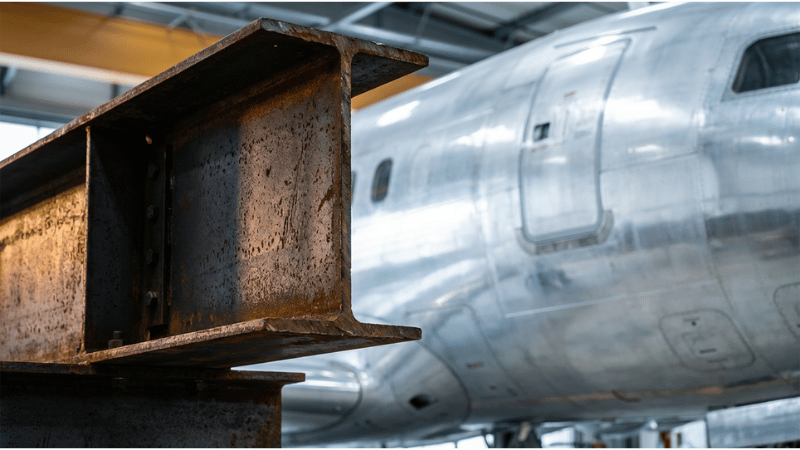
You’ll find these two metals starring in very different roles. Steel is the workhorse, forming the backbone of our world in bridges, buildings, and heavy machinery. It’s chosen for its brute strength and durability.
Aluminum is the racehorse. It’s all about high performance and low weight. You’ll find it in aerospace, high-end automotive manufacturing, and any application where speed and efficiency are paramount.
Conclusion
So, steel or aluminum? There’s no “better” metal, only the right metal for the job. Steel offers strength and simplicity, while aluminum provides lightweight performance at the cost of complexity.
Understanding their fundamental differences in thermal conductivity, oxide layers, and process requirements is what separates the amateurs from the pros. Master these, and you’ll be ready to tackle any welding challenge that comes your way.
Ready to Upgrade Your Welding Game with iKratz?
iKratz’s industrial-grade welders are engineered to give you the precision and power needed to conquer any material. We build equipment that solves real-world problems like wire feeding and heat management, so you can focus on laying the perfect bead.
Contact an iKratz expert today to find the perfect multi-process machine for your shop and get a free demo of our advanced Pulse MIG technology.
Frequently Asked Questions
Q1: Can I use a standard DC TIG welder for aluminum?
No. You need an AC TIG welder to break up the stubborn aluminum oxide layer. DC TIG is suitable only for steel and other ferrous metals.
Q2: Why does my aluminum MIG wire keep tangling?
This is “birdnesting.” Aluminum wire is too soft for a standard MIG gun. You must use a Spool Gun or Push-Pull system, common features on iKratz MIG welders, for reliable wire feeding.
Q3: Is 100% Argon gas really necessary for aluminum?
Yes, it is absolutely critical. Even a small amount of CO2 will contaminate an aluminum weld, causing extreme porosity and a weak joint.
Q4: Is welding aluminum fundamentally harder than welding steel?
Most welders agree it presents more challenges. However, with proper training, diligent preparation, and the right advanced equipment from iKratz, welding aluminum becomes a manageable and highly rewarding skill.