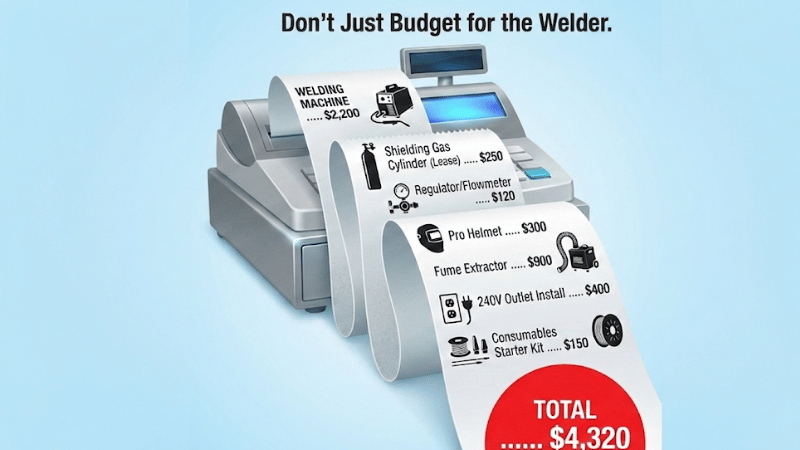
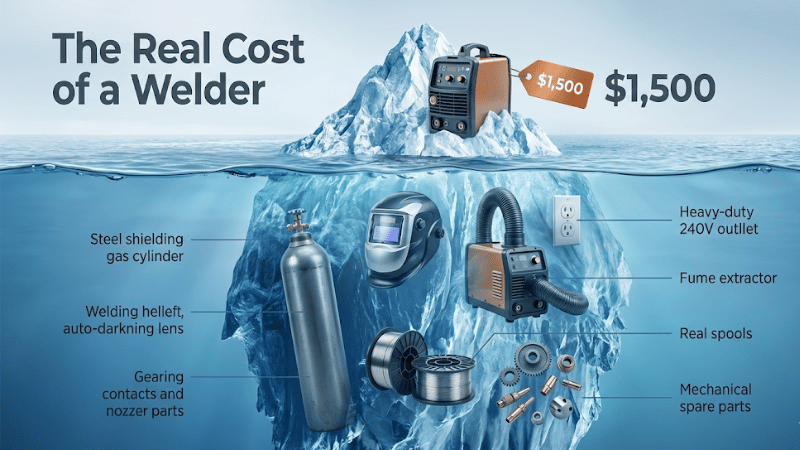
Buying a welder is like buying a “cheap” printer: the sticker price is only the opening act. The real cost shows up later—gas, consumables, power, and that “tiny accessories” run that somehow totals real money.
This guide is for shop owners and industrial buyers who need a realistic 2026 budget. You’ll leave with a true all-in setup number, plus a smarter path—up to and including orbital TIG when manual variability becomes expensive.
Why “welder price” ≠ your real budget
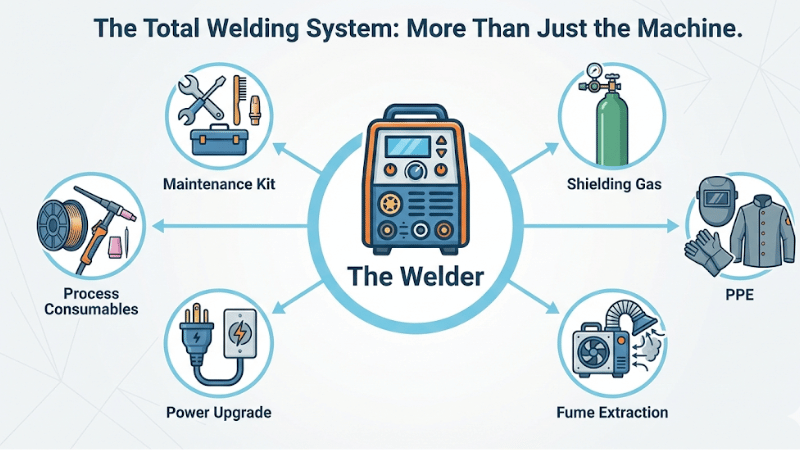
A welding machine is a system. Process, accessories, gas, safety, and power decide the real budget—and whether your welds look like craft or chaos.
Who this guide is for + what you’ll decide by the end
You’ll decide (1) MIG vs TIG vs multiprocess, (2) what you’ll spend all-in, and (3) when it’s time to step into repeatability-tier automation like orbital TIG.
2026 Welder Price Ranges (Fast Answers)
If you’re here for the direct answer to how much is a welding machine, here’s the honest range: most buyers land in the $700–$3,500 zone for a capable MIG or TIG setup—before gas, PPE, ventilation, and electrical work.
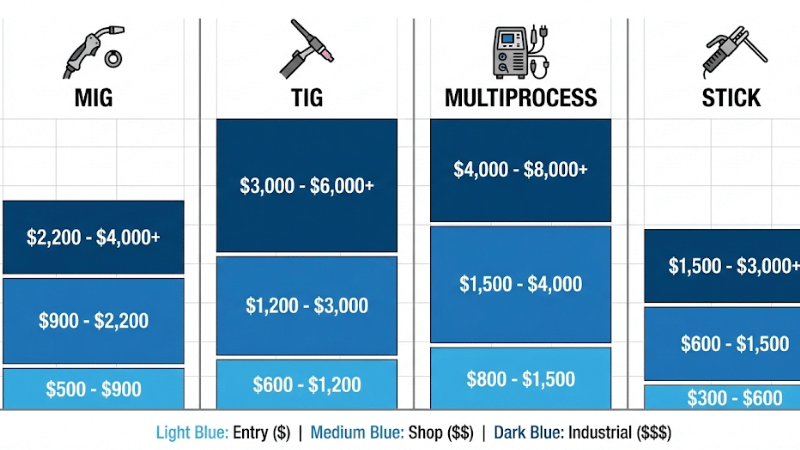
Typical price tiers by type (entry → shop → industrial)
MIG (wire)
- Entry: ~$500–$900
- Shop: ~$900–$2,200
- Industrial: ~$2,200–$6,000+
Usually included: machine + MIG gun + basic leads.
Often extra: cylinder, regulator/flowmeter, and serious consumable spares.
TIG (DC vs AC/DC)
- DC TIG (steel/stainless): ~$600–$1,800
- AC/DC TIG (aluminum capable): ~$1,000–$3,500
- Industrial AC/DC TIG: ~$4,000–$12,000+
Usually included: power source + basic torch (varies).
Often extra: pedal, upgraded torch, water cooler, cups/tungsten kits.
Multiprocess (MIG + Stick + TIG)
- Entry: ~$700–$1,500
- Shop: ~$1,500–$3,000
- Industrial: ~$3,000–$8,000+
Multiprocess is flexibility, not wizardry. Great for mixed maintenance jobs, less ideal for dedicated production.
Stick (SMAW)
- Entry: ~$200–$700
- Shop: ~$700–$2,000
- Industrial: ~$2,000–$5,000+
Stick remains the “works anywhere” option, especially outdoors and on less-than-perfect steel.
Cost drivers that actually matter
If you weld more than “a few minutes here and there,” duty cycle matters more than fancy menus. Duty cycle is basically your welder’s stamina—how long it can run before it needs a break. If you ignore it, your schedule will become the break.
Other cost drivers that move the needle:
- Amperage headroom (buying “just enough” is how you buy twice)
- AC TIG (aluminum capability)
- Pulse TIG (heat control on thin material)
- Torch cooling (air vs water-cooled)
- Serviceability (parts + local repair + downtime risk)
The “repeatability tier” most buyers ignore: Orbital TIG (inserted early)
If your work involves high-purity small tubing and you’re doing it repeatedly, the conversation shifts from “welder price” to “quality consistency + documentation.” That’s where orbital TIG earns its keep.
A compact closed-head example is iKratz MWF-12, designed for Φ3.17–12.7 mm tubing with wall ≤1.0 mm, often paired with an integrated control power source like MWA-200.
If your jobs trend toward larger OD work where closed heads aren’t practical, open-head options become relevant, such as iKratz MWG-170.
Full Setup Cost Breakdown (All-In Budget)
Here’s the part most budgets “forget” until the PO is already approved. The machine is the headline. The accessories, gas, and safety are the subscription you didn’t know you signed up for.
Essentials checklist by process (MIG vs TIG)
MIG essentials
- Welder + gun
- Shielding gas (or flux-core wire for gasless)
- Regulator/flowmeter
- Wire spools + contact tips + nozzles + liners
- Spares kit (because downtime is never convenient)
TIG essentials
- Welder + torch (often upgraded)
- Foot pedal (for most manual TIG work)
- Tungsten + cups + collets/collet bodies
- Filler rod + regulator/flowmeter
- Optional: water cooler for sustained higher amps
Hidden costs most buyers miss
- Gas cylinder plan: purchase vs lease vs exchange
- Power/outlet upgrades: 240V circuit runs, correct breaker sizing, proper cable
- PPE: helmet, gloves, jacket, lens consumables
- Ventilation/fume extraction: especially indoors
- Maintenance/spares: clamps, leads, liners, torch parts, consumable kits
For safety and compliance guidance on ventilation and welding operations, use OSHA as a baseline reference: OSHA welding/cutting/brazing.
Which Machine Should You Buy? (Decision Framework)
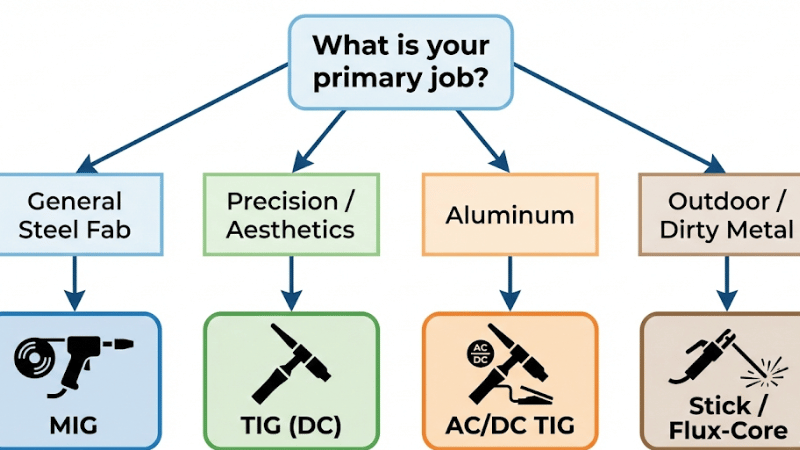
Buy based on material + thickness + quality requirement + volume. Not vibes. Not “my buddy said TIG is cleaner.” Not “I might weld aluminum someday.”
“If you weld X, buy Y” rules
- Mild steel fabrication and general shop work → MIG for speed and throughput
- Stainless appearance-critical work → TIG (DC) for control and cleanup reduction
- Aluminum:
- productivity on thicker sections → MIG with the right feeding setup
- precision on thinner sections → AC/DC TIG
- Outdoor, windy, rusty steel → stick or flux-core
- Mixed maintenance tasks → multiprocess (with honest expectations)
Common wrong-machine mistakes + fixes
- Underpowered duty cycle → buy headroom, not regret
- Wrong gas/wire/tungsten → match consumables to the job
- Expecting TIG finish from MIG without prep → clean, fit, tune parameters
- Buying AC/DC TIG “just in case” → start with what you weld now, upgrade when needed
Ownership Cost (TCO) + Checklists You Can Use
Sticker price is a one-time hit. Total cost of ownership (TCO) is where ROI actually lives: consumables, downtime, rework, training time, and parts availability.
3-year TCO rubric (what moves ROI)
- Consumables burn rate (tips/wire vs tungsten/cups)
- Downtime and repair access (local service matters)
- Rework/scrap rate (quality = money)
- Training ramp (MIG ramps faster; TIG ramps deeper)
- Parts availability and lead times
“Before you blame the machine” 10-point setup checklist (Experience insert)
- Polarity check
- Gas flow + leak check
- Correct wire/tungsten/filler selection
- Ground clamp contact quality
- Drive rolls + liner condition (MIG)
- Contact tip size matches wire (MIG)
- Cup/gas lens condition (TIG)
- Amperage range matches thickness
- Clean base metal
- Test bead, change one variable at a time
Safety notes (keep it boring, keep it safe)
- Fumes and ventilation guidance: OSHA welding safety resources
- Cylinder handling best practices: CGA cylinder & equipment safety
Not for code-compliance work: regulated applications may require qualified procedures, certified welders, and documented inspection.
“Near Me” Buying + When It’s Time to Consider Orbital TIG
Supplier/dealer checklist (local intent done right)
- Service turnaround and repair access
- Consumables on shelf (not “two weeks out”)
- Warranty clarity and logistics
- Training, demo options, parameter support
- Returns policy for heavy equipment
Manual TIG → Orbital TIG: when it’s justified (not just “cool”)
If you’re producing high-purity tubing welds repeatedly and need consistency, traceability, and predictable results, orbital TIG can become the “repeatability tier” that reduces rework and QA churn.
Closed-head example for small tubing: iKratz MWF-12.
Open-head example for larger OD pipeline work: iKratz MWG-170.
Spec-based quote prompt (what speeds up quoting):
- material, OD, wall, joint type
- purge needs + cleanliness level
- weld volume per week/month
- acceptance criteria + documentation needs
- site constraints (power, access, fixturing)
Conclusion
The real answer to how much is a welding machine in 2026 isn’t just the unit—it’s accessories, gas, consumables, power, and safety gear. MIG usually wins on speed, TIG on precision, and multiprocess on flexibility (with trade-offs).
To buy smarter, compare TCO—rework, downtime, and consumable burn often beat sticker price. If you’re doing high-purity tubing at volume, orbital TIG welding systems can pay off when repeatability and documentation become non-negotiable.
Take the Next Step
Built for Real-World Welding Budgets and Repeatability
Buying a welder isn’t a “wing it” job. MIG speed and TIG precision only pay off if duty cycle, power, consumables, and shielding gas match your materials and workload. Choose equipment around process, thickness, and environment—because rework and downtime aren’t cheap.
➡️ Visit iKratz to See Professional Welding Solutions
Talk to People Who Understand the Trade-Offs
Every setup is a trade-off: MIG vs TIG, AC/DC needs, gas coverage, access, portability, and quality requirements. iKratz specialists turn your material, OD/wall, volume, and acceptance criteria into a vendor-ready shortlist—manual TIG now or orbital TIG when repeatability and documentation matter.
➡️ Submit an Inquiry & Project Specifications Today
Frequently Asked Questions
Q1: How much does a full welding setup cost including accessories and gas?
A: It varies by process and job, but your real budget must include the machine, torch/gun, gas, consumables, PPE, ventilation, and often power upgrades.
Q2: Is MIG (wire) or TIG cheaper to start with for beginners?
A: MIG is usually cheaper and faster to become productive with; TIG often costs more due to accessories and precision features (especially for aluminum).
Q3: When is an orbital TIG welding system worth the cost?
A: When you need consistent weld quality, higher throughput, and documentation/traceability—and manual TIG variability becomes expensive at your required quality level.